
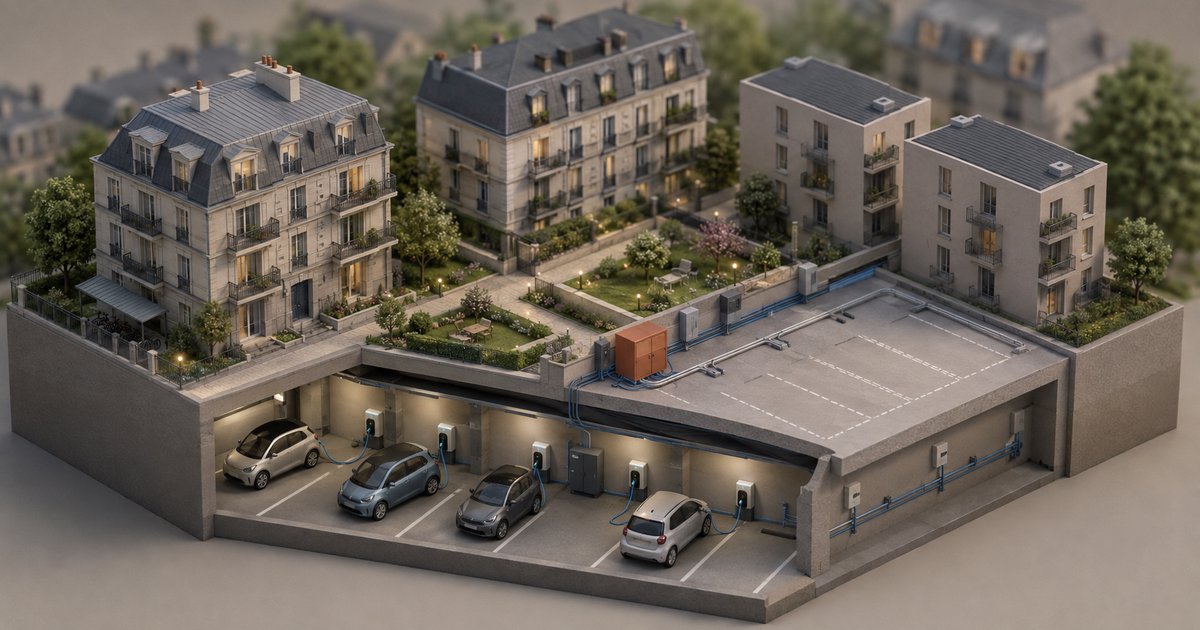
Home charging is most of the economics of owning an electric car in Europe, and for anyone living in a flat it is also the hardest part to arrange. France publishes a quarterly count of how far that has got, and the second-quarter 2026 figures are simultaneously the best on record and a reminder of how early it still is.
The count
Avere-France, which runs the state-backed Advenir subsidy programme, put 18,289 collective residential buildings as equipped with charging at the end of Q2 2026, a 45% rise in a year. A further 43,648 buildings have projects approved but not yet installed.
| Buildings equipped | |
|---|---|
| End of 2024 | 10,595 |
| Q2 2025 | 12,628 |
| Q2 2026 | 18,289 |
Charge points inside those buildings reached 44,331, against 32,069 a year earlier — up 38%.
The number that actually matters
France has roughly 252,000 collective buildings with parking. An equipped total of 18,289 is an equipment rate of 7.2%.
So the growth is real and the base is small. On these figures more than nine flats in ten still have no charging where the car is parked, which for a prospective buyer means relying on the public network at public prices — the gap TeslAnt measured in Italy, where home charging cost €0.25/kWh against €0.63–0.74 in public. It is also the constraint behind France's slowing public build-out, which passed 200,000 points in July.
One caveat cuts the other way: the count covers only installations funded through Advenir, so the true national total is higher by an unknown margin.
What it costs
Advenir's rates were revalued on 1 April 2026, and the increases are large. Each grant covers half the cost up to the cap shown.
| Advenir grant in a copropriété | Cap, excluding VAT |
|---|---|
| Individual charge point | €1,000 (previously €600) |
| Point on a shared solution | €1,660 |
| Collective infrastructure, per building | from €12,500 (previously €8,000) |
| Outdoor groundworks supplement | up to €3,000 |
Two conditions decide whether a household actually gets the money. The new amounts apply to projects voted at a general meeting after 1 April 2026, and the application must be filed and accepted before work begins — there is no retrospective approval.
How these chargers get used
The usage data will look familiar to any Tesla owner. In collective residential buildings, 60% of charging sessions start between 21:00 and 03:00, at an average of 4.7 kW.
That is overnight AC charging at low power, and it is the point. Shared building infrastructure does not need to be fast, it needs to exist — which is why a distributed 3.7–7 kW installation across a car park is the right answer here and a 400 kW site is not. It is also why load management matters more than peak power in these buildings, the problem rival home chargers are now solving in the box.
What to watch
Advenir is funded to support 250,000 further charge points by the end of 2027 on a €520 million budget. Whether the equipment rate moves from 7% to something structural depends less on the grant than on how fast co-ownership meetings vote: the 43,648 approved-but-unbuilt buildings are more than double the number already finished, and they are the pipeline that decides the next two years.