
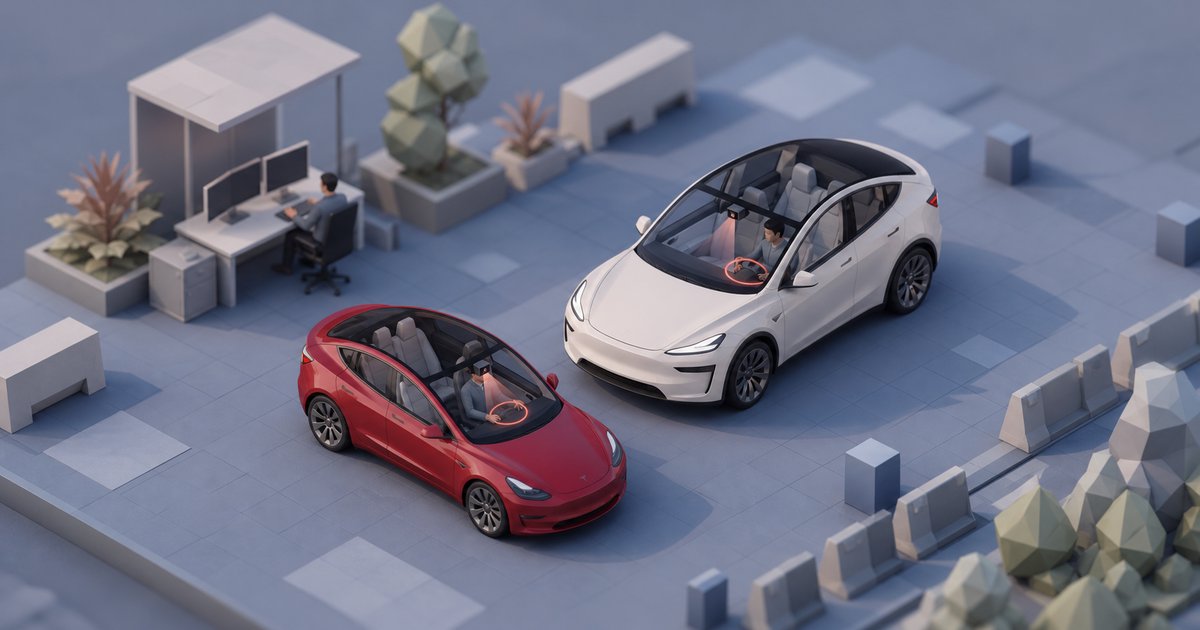
Checking that a hand is on the steering wheel does not tell you whether the driver is looking at the road. China's market regulator has now made that a defect finding, and Tesla is recalling 2,740,642 cars because of it.
The State Administration for Market Regulation (SAMR) filed the action on 21 August 2026. It covers Model 3 and Model Y built in Shanghai between 4 March 2019 and 7 December 2025, and the regulator's language is specific: the existing attention monitoring is insufficient to alert the driver when their gaze leaves the road. The remedy is an over-the-air update that adds cabin-camera gaze monitoring on top of the steering-wheel torque check. It takes effect immediately.
Two recalls, one day, one company
This is not the door-handle action. On the same day SAMR also published Tesla's recall of 2,975,910 cars over interior emergency door releases, part of an eleven-carmaker campaign covering more than 7 million vehicles. The two are separate filings with separate causes, separate remedies and separate effective dates.
Together they come to 5,716,552 cars — Tesla's largest recall in any market, ever.
| Cars | Cause | Effective | |
|---|---|---|---|
| Driver monitoring | 2,740,642 | Torque check does not detect gaze | Immediately |
| Emergency door release | 2,975,910 | Release hard to identify and operate | 25 September 2026 |
| Total | 5,716,552 |
What actually changes in the car
Torque sensing infers attention from a small steering input. It is cheap, works without a camera, and is defeated by anything that holds the wheel. Gaze monitoring watches where the eyes point and warns when they leave the road too long. Tesla's Chinese cars had the cabin camera all along; what the recall does is put it in the loop for standard assisted driving instead of leaving torque as the sole check.
Why a European owner should read this as a shrug, not a warning
The interesting part for readers here is that Europe is already on the far side of this.
Tesla has used the cabin camera for attentiveness on Autosteer since 2021, and European Model 3 and Model Y have shipped with Tesla Vision since April 2022 — the camera-based stack that includes cabin monitoring. The processing stays in the car and the footage does not leave it unless the owner enables data sharing.
Beyond what Tesla chose to do, EU law requires it. Regulation (EU) 2019/2144 mandates Advanced Driver Distraction Warning on new type approvals from 7 July 2024 and on every new vehicle sold from 7 July 2026. ADDW is camera-based by construction: it tracks gaze direction and head position and must warn when the driver's eyes leave the road beyond a set threshold.
So the correct reading is not that Tesla's driver monitoring was found wanting and Europe should worry. It is that China has just imposed, by recall, roughly what the EU already imposes by type approval — and that the European specification was the stricter one.
Where it does matter for FSD in Europe
Driver monitoring is the mechanism regulators trust when they are asked to approve a supervised system. It is the thing that makes "supervised" mean something enforceable rather than aspirational.
A major regulator ruling that torque sensing alone is not adequate raises the floor everywhere that ruling is read — and it will be read by the authorities Tesla still needs. France refused to support EU-wide approval of FSD in July, and the Dutch RDW process has not concluded. None of them will now accept a hands-on-wheel check as sufficient evidence of an attentive driver.
The counterweight is that cameras are not infallible either. Tesla's gaze monitoring has been demonstrably fooled by a doll's head on the headrest, and driver-monitoring quality varies with lighting, glasses and seating position. A regulator that mandates camera monitoring has raised the floor, not solved the problem.
What to do
Nothing. There is no European action, no service visit and no change to a European car arising from this. The number worth carrying away is 5,716,552 — and the fact that neither half of it requires a workshop.