
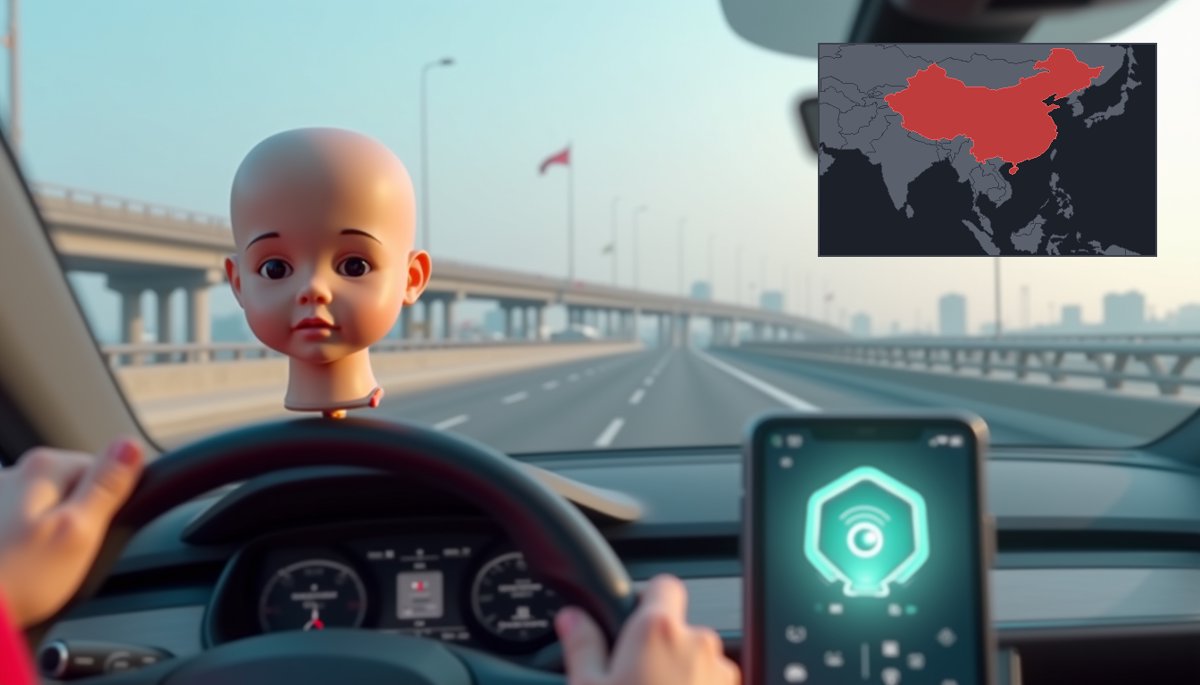
A cottage industry on Chinese e-commerce platforms is selling tiny plastic doll heads designed to do one thing: trick Tesla's cabin camera into believing a driver is watching the road. The devices cost as little as $20 to $50, are marketed as travel companions or dashboard decorations, and represent the latest escalation in a long arms race between Tesla's driver-monitoring safeguards and owners determined to defeat them.
How a Cheap Toy Defeats the Camera
Modern Teslas watch the driver with an interior camera that tracks head position and eye movement, replacing the older method of sensing hands through steering-wheel torque. The fake heads, some shaped like celebrity figurines, others small screens showing blinking eyes, are mounted near the rear-view mirror, where they apparently satisfy the camera's check for an attentive face. Electrek reports one Model 3 owner in China who fixed a head resembling a famous actor to the cabin and then drove for 30 minutes without a single alert, one hand eating sunflower seeds and the other filming the stunt.
That is the danger in a sentence. Tesla's Full Self-Driving (Supervised) and Autopilot are Level 2 systems: capable, but legally and technically dependent on a human ready to take over at any moment. Defeating the monitor removes the one safeguard that makes hands-off misuse detectable.
An Escalating Arms Race
The doll heads are only the newest move. When Tesla relied on steering-wheel torque, owners hung weights from the wheel to simulate a hand. The switch to camera-based monitoring closed that loophole; the plastic heads are the response. Customer reviews, Electrek notes, are explicit about why people buy them, the freedom to use a phone or even nap while the car drives.
Regulators are already watching. In the United States, the NHTSA has logged 80 FSD-related traffic violations and upgraded its probe to an engineering analysis covering 3.2 million vehicles, after incidents including a Tesla on FSD that drove through a railroad crossing gate seconds before a train passed. Tesla has not publicly commented on the head-shaped defeat devices.
Why It Matters as FSD Reaches Europe
For European readers this is more than a curiosity from another market. Tesla's FSD (Supervised) has now been approved in five European countries, most recently when Belgium became the fifth nation to clear it. Those approvals rest entirely on the premise that a human stays in charge, and Belgium's regulator even retains the power to suspend the system. Tools that fool driver monitoring strike directly at that premise. As supervised driving spreads across the continent, the integrity of the cabin camera is not a niche concern but the foundation European authorities are counting on, and any sign that it can be cheaply defeated could shape how quickly the next approvals come.
Update: 2026-08-21
On 21 August 2026 China's State Administration for Market Regulation had Tesla recall 2,740,642 domestically built Model 3 and Model Y cars, produced between 4 March 2019 and 7 December 2025, because their attention monitoring is "insufficient to provide the driver with alerts when their gaze leaves the road". The remedy, effective immediately, is an over-the-air update adding cabin-camera monitoring on top of the existing steering-wheel torque check, according to Electrek. That qualifies the account above: for standard assisted driving in China, Tesla had not replaced torque sensing with the camera at all, so the gaze monitoring these doll heads defeat was not yet the safeguard in every car. A regulator has now made it one. The recall is separate from the door-release action filed the same day; together the two cover 5,716,552 cars.