
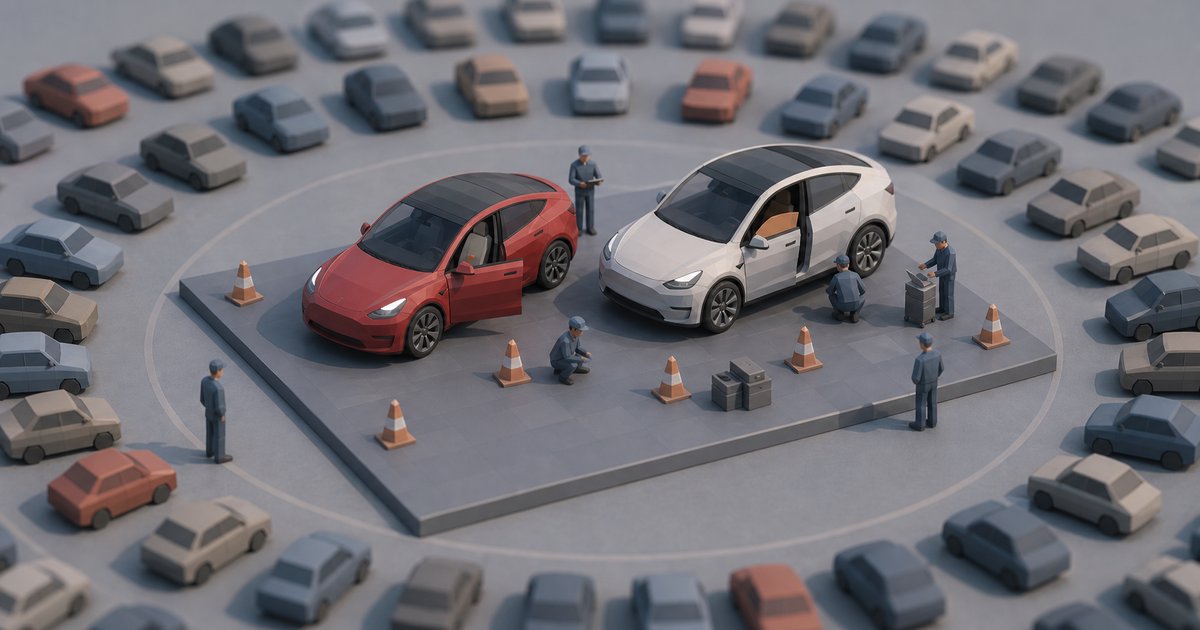
China's market regulator published recall plans from eleven carmakers on 21 August 2026, covering more than 7 million vehicles. It is the largest recall campaign the country has ever run, and the single largest participant is Tesla, with 2,975,910 cars.
The defect is not a component that fails. It is a component nobody can find. The State Administration for Market Regulation (SAMR) concluded that interior emergency mechanical door releases sit too close in colour to the surrounding trim to be identified and operated under pressure. In a severe crash that disables the 12-volt system, the electronic door buttons stop working; if an occupant cannot locate the mechanical backup, they cannot get out, and rescuers outside cannot get in.
Tesla's share of it
| Vehicles | |
|---|---|
| Model 3 (Shanghai-built) | 973,156 |
| Model Y (Shanghai-built) | 1,956,713 |
| Imported Model S / Model X | balance to 2,975,910 |
| Door-release recall total | 2,975,910 |
| Driver-monitoring recall, filed same day | 2,740,642 |
| Combined | 5,716,552 |
The door-release action takes effect on 25 September 2026. The driver-monitoring recall filed the same day is a separate matter with a separate cause, and takes effect immediately.
The remedy is a sticker and a window
Tesla's fix has two parts, both free and neither involving a new handle. Owners get warning labels that mark where the emergency release actually is. And an over-the-air update changes crash behaviour so the windows lower automatically after a collision — which does not open a door, but does open an exit.
That is worth stating plainly: the release mechanism itself is unchanged. What changes is how findable it is, and what happens if it is never found.
The other ten
| Automaker | Vehicles | Remedy |
|---|---|---|
| Tesla | 2,975,910 | Labels + OTA window lowering |
| Xiaomi | 390,435 | Labels + OTA console unlock and window strategy |
| Leapmotor | 371,200 | Not detailed |
| XPeng | 264,842 | Warning labels |
| Zeekr | 92,658 | Not detailed |
| Chery | 68,488 | Replacement covers, improved design |
| Dongfeng | 53,452 | Not detailed |
| Arcfox | 46,850 | Covers replaced with text labels |
| FAW | 11,908 | Not detailed |
Chery and Arcfox are the only two changing the physical part. Everyone else is labelling.
China has already written the forward rule
The recall handles cars already sold. Mandatory national standard GB 48001—2026 handles the rest: from 1 January 2027, new models certified in China must have a mechanical release on every door. That converts a design preference into a type-approval condition, and it is the reason this recall is not a one-off enforcement action but the transition to a standard.
Two regulators, one month, opposite conclusions
A month earlier, the United States looked at substantially the same allegation and did not act on it. On 24 July NHTSA denied the petition to open an investigation into Tesla's door releases and opened rulemaking instead, citing insufficient evidence of a defect trend. China reached the opposite verdict and made it binding on 2.98 million cars.
Neither is obviously wrong — NHTSA judges defect trends, SAMR is enforcing toward a standard it has already written.
What this means in Europe
Nothing has been recalled here, and no European regulator has ordered anything — but the interior release on a European Model 3 or Model Y is the same part SAMR objected to. UNECE is working on rules for electronic door handles, and Tesla has said it is redesigning the mechanism to merge the electronic and mechanical releases into one control, the design already visible on Cybercab. Tesla builds one car for the world where it can, so a release good enough for GB 48001 is the likely global default rather than a China-only variant.
Until then the practical step is unglamorous and takes a minute: find the manual release in your own car, in the owner's manual, before you need it. Its location differs by model and build year, and Tesla is about to spend money on 2.98 million stickers precisely because owners do not know where it is.