
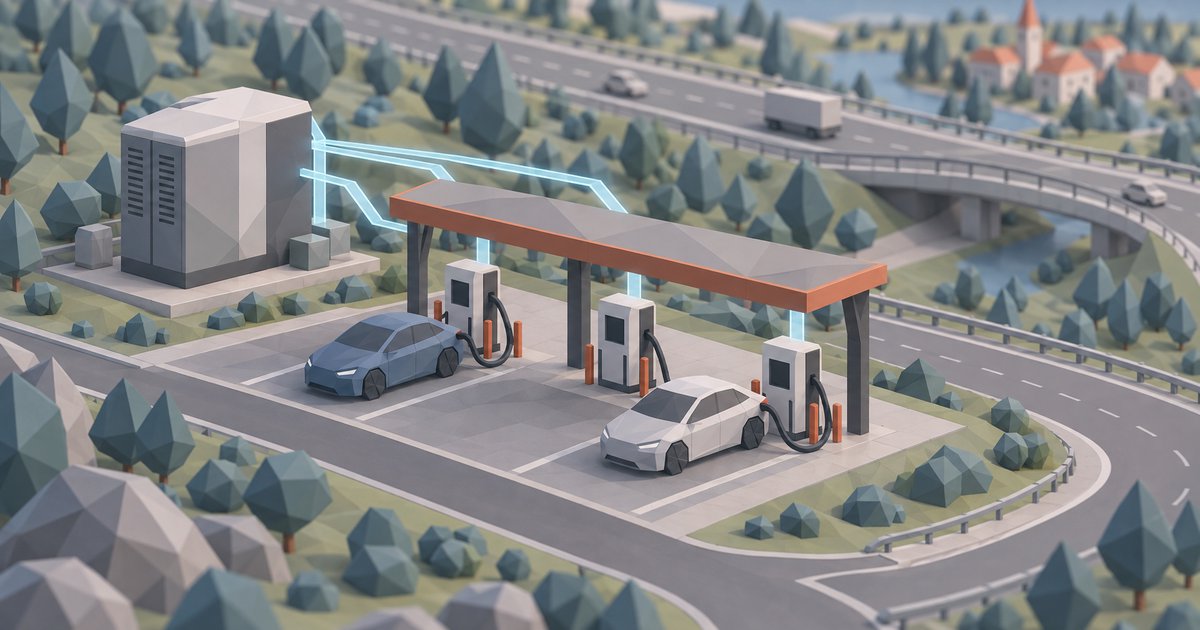
Shell has switched on its first three state-co-funded fast-charging sites in Poland, at Marki, Poznań and Białystok. Each is rated at 400 kW, and each is the start of a build-out that Shell says runs to the end of 2028.
The programme is financed jointly with Poland's National Fund for Environmental Protection and Water Management, the state body that channels EU and domestic environmental money into charging infrastructure.
What was actually announced
| Milestone | Stations | Charging points |
|---|---|---|
| Live now | 3 | 6 |
| By end of 2026 | 25 | 50 |
| By end of 2028 | 60 | 120 |
One caveat on the last row. The Polish wire copy describes the 2028 figure as additional stations, which leaves it genuinely unclear whether the 60 includes the 25 due this year or sits on top of them — the difference between a 60-station network and an 85-station one. Shell has not published a single cumulative total, so treat 60 as the floor.
For scale: Shell currently runs about 40 charging points across 17 locations in Poland, against 441 fuel stations at the end of 2025. Even the conservative reading roughly quadruples its charging footprint. Shell says the new sites go on major routes and at the exits of large cities.
What a Tesla will actually draw
Not 400 kW. No Tesla sold in Europe can take it — a Model 3 or Model Y peaks in the region of 250 kW on a good day, with a warm battery and a low state of charge, and holds that for a short part of the curve. The same arithmetic applied when Ionity opened a 600 kW site in Karlsruhe.
The number still matters, just not the way the headline suggests. A 400 kW cabinet typically splits across two points, so the practical gain is that a second car arriving does not halve your session. Headroom is what you are buying, not peak speed.
What this costs a Polish owner
Shell was unusually direct about this. Company representatives acknowledged that Shell Recharge sites are currently among the most expensive on the Polish market, and said pricing will be adjusted to market conditions with rates that differ by location.
That is worth holding next to what Polish drivers already pay. Orlen's summer promotion ended at the start of September and its rates went back to 2.69 złoty per kWh. Tesla, meanwhile, keeps opening Superchargers in Poland to other brands, which puts a competitive floor under exactly the corridors Shell is building on.
So the honest read for a Polish Tesla owner: more 400 kW capacity on the main routes is good, the power figure is not for you, and whether you use these sites will come down to a tariff Shell has not published yet.
What is not settled
Shell has committed to at least one further station in 2027 without deciding whether it will be 200 kW or 400 kW. No per-kWh price, no roaming terms and no site list beyond the first three have been released. There is also no reliability commitment attached — the same gap TeslAnt noted when Shell rebuilt 150 fast-charging points in Germany and published no uptime data to go with them.
A funded plan with a state partner is a stronger signal than a press-release target. It is still a plan.