
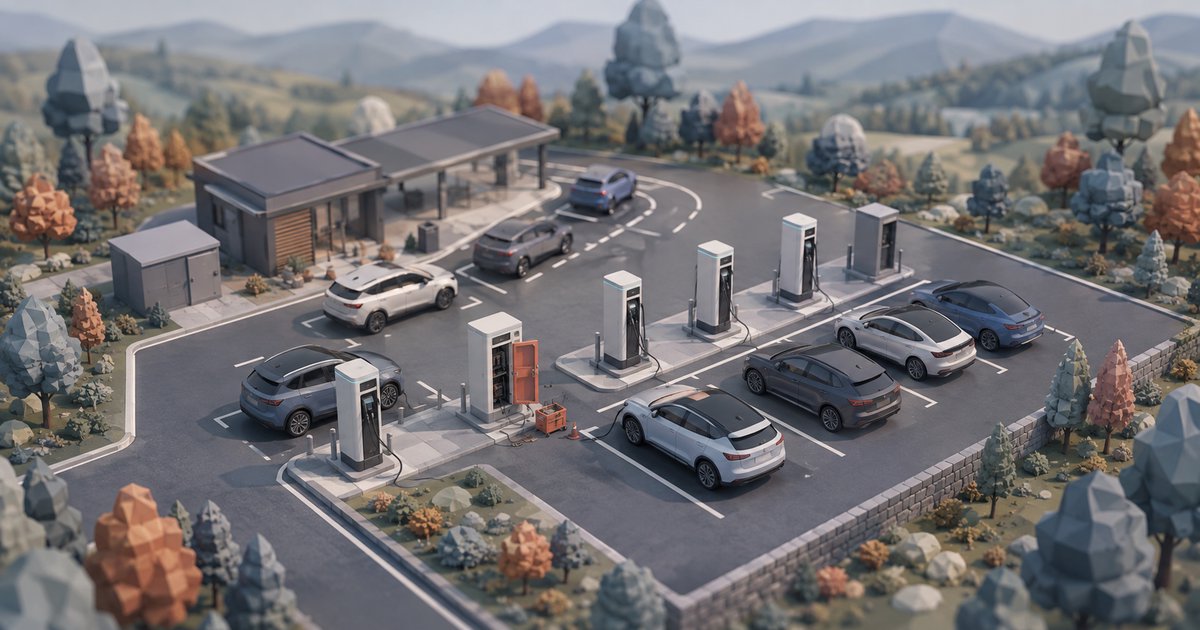
Shell Recharge has replaced the hardware at 150 fast-charging points across more than 40 German sites, work it says was finished by the end of August 2026. At least 50 more points are due to get new hardware by the end of the year, taking the 2026 programme to a minimum of 200.
The framing is the interesting part. "The next phase of electromobility will not be decided by the number of charging points alone, but by their reliability in everyday use," said Florian Glattes of Shell Mobility Germany, Austria and Switzerland.
That is the correct diagnosis. It is also unaccompanied by evidence.
What Shell did not say
| Disclosed | Not disclosed |
|---|---|
| 150 points modernised | power output of the new hardware, in kW |
| 40+ sites | which systems were replaced |
| ≥50 more by year-end | connector types, Plug and Charge support |
| ~2,400 points in Germany | payment terminal changes |
| "higher technical stability" | uptime before or after, in any form |
For a programme justified explicitly on reliability, the absence of a single availability metric is the story. There is no baseline failure rate, no post-upgrade figure, and no definition of the "higher technical stability" the new equipment is said to provide. A driver cannot tell from this announcement whether a Shell site that failed them in June is now fixed.
Scale matters too: 150 points is about 6% of Shell's roughly 2,400 German charging points. Even at 200 by December, the large majority of the network is running the hardware it was running last year.
Why a Tesla driver in Germany should care anyway
Superchargers are not the whole picture for a European Tesla, and increasingly they are not meant to be. Tesla cars charge on CCS across the continent, third-party networks cover routes and destinations the Supercharger map does not, and pricing between them is now genuinely competitive.
Reliability is where third-party charging still loses to Tesla, and it is a hardware-and-software problem rather than a coverage one — failed handshakes, dead payment terminals, sessions that stop at 4 kW. Shell replacing physical units at 40 sites is the sort of unglamorous work that actually addresses it, which is why it deserves reporting even without numbers attached.
It also lands against a network that has begun losing on the metric it used to own. Tesla's Supercharger network fell to fourth in J.D. Power's 2026 study, beaten on cost, and Europe's charging market keeps consolidating — as Scandinavia's motorway venture splitting three ways showed on 1 September. Operators competing on whether a charger works, rather than on how many they have installed, is the healthier version of that competition.
The test is simple and Shell has not made it possible: publish the uptime figures next year and let drivers check the claim.