
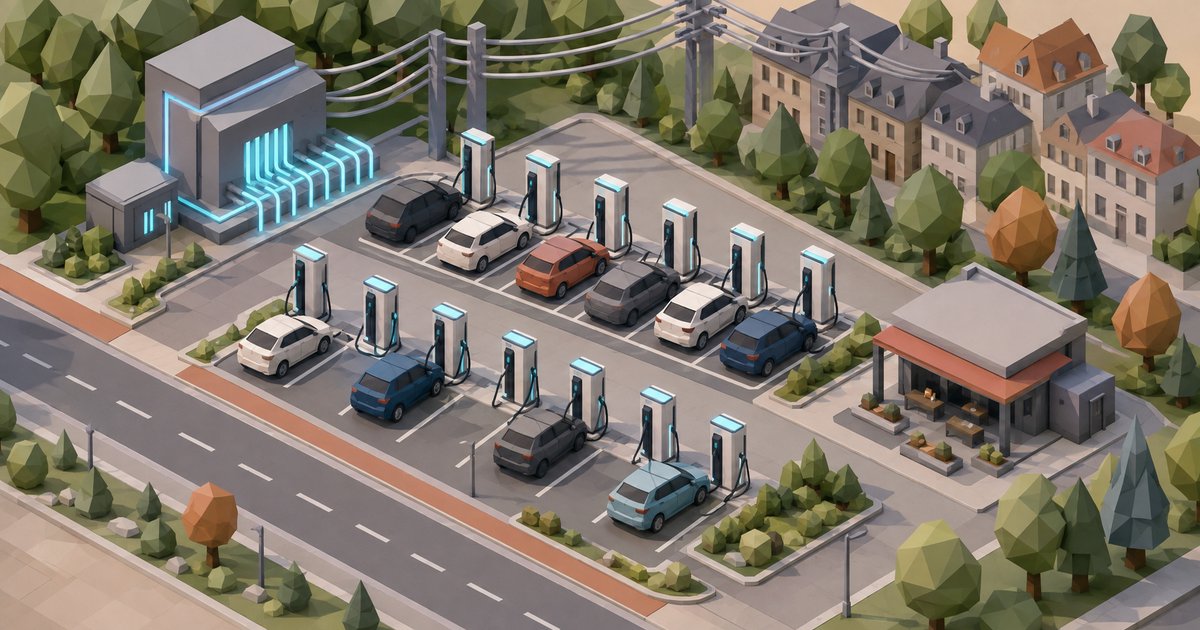
Ionity opened its 200th German site on 7 September, in Karlsruhe, and the hardware is the interesting part. The site has twelve high-power charging points: eight Alpitronic HYC1000 units rated up to 600 kW per vehicle, and four HYC400 units up to 400 kW. Ionity now runs more than 1,500 high-power charging points in Germany.
The location is at Zimmerstrasse 24 in Karlsruhe, next to the A5 and close to the Karlsruhe interchange with access to the A8 towards Stuttgart. Since the start of 2023, Ionity has opened roughly two new German sites a month.
No Tesla can use 600 kW
Worth saying plainly, because the headline number will be quoted at people: no current Tesla passenger car will draw 600 kW. Tesla's cars peak at up to 250 kW on DC, and nothing in the range — Model 3, Model Y, or the long-wheelbase Model Y L — goes beyond that.
So why does a 600 kW cabinet matter to a Tesla owner? Because of what happens when the site is busy.
| Practical effect | |
|---|---|
| Headline 600 kW | Unreachable for any Tesla; relevant to 800 V cars and coming trucks |
| Deep power reserve | A Tesla can hold its own 250 kW peak while neighbouring bays are occupied |
| Twelve bays | Lower chance of queueing on an A5 corridor stop |
The failure mode European drivers actually meet is not a low headline figure — it is arriving at a four-bay site where the cabinet splits its output and a car that should take 250 kW takes 110 kW. Hardware specified far above what any one car can absorb is how that gets designed out.
Where Ionity sits for a Tesla driver
Ionity is a CCS network, so it is the alternative rather than the default. It also has a reputation for ad-hoc pricing well above Tesla's Supercharger rates, which is why the tariff matters as much as the plug.
The context has not changed much this year: TeslAnt reported in August that Germany's fast-charging network grew 40% in a year while the ad-hoc price stayed at 57 cents. More capacity has not yet translated into cheaper energy. Ionity's expansion is part of that same pattern — build-out first, pricing pressure later, if at all.
The network has also been pushing beyond Germany: it opened its first London charging hub at Greenwich in August with twelve bays, the same site size as Karlsruhe.
The number that would change the picture
Two hundred sites and 1,500 points in one country is real infrastructure, built at a steady two sites a month for close to four years.
What Ionity has not published is a reliability figure. Neither did Shell, when it rebuilt 150 German fast chargers earlier this month. For a driver deciding whether to rely on a CCS network for a motorway trip instead of routing via Superchargers, uptime is the deciding number, and it remains the one nobody in the sector volunteers.