
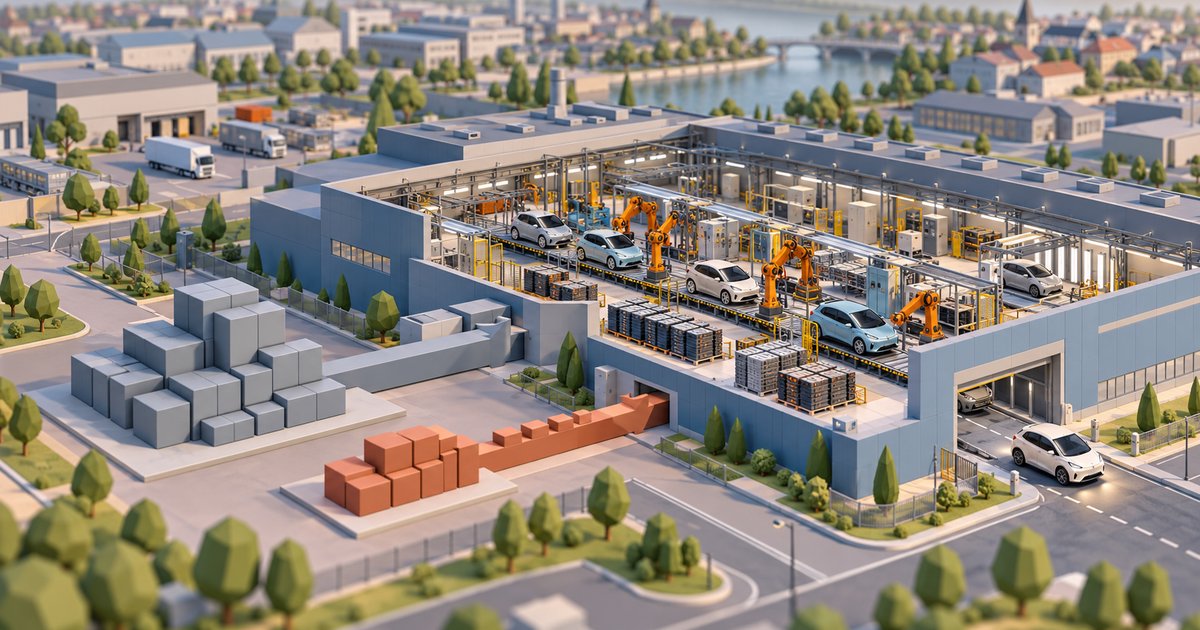
Renault will reinvest more than EUR 10 billion in France over the next five years, in electric vehicles and in making cars more affordable. Chief executive François Provost said so on France Inter radio on Saturday 3 October 2026.
That reads as a commitment, and it is one. It is also smaller than the one it follows.
The number is a step down
| Period | Amount | Status |
|---|---|---|
| Previous five years | EUR 13 billion | Spent |
| Next five years | More than EUR 10 billion | Pledged, conditional |
Provost's own framing supplies both figures: "Over the last five years, we invested EUR 13 billion in France... over the five coming years, if the social and political context allows it, we will re-invest more than EUR 10 billion to continue pushing on electric and on making cars more affordable."
One caution: EUR 10 billion is a floor — "more than" — while EUR 13 billion is a completed total, so the gap could narrow. Neither figure is inflation-adjusted.
What the comparison rules out is the obvious reading of the headline. This is not Renault increasing its bet on France. It is Renault continuing it at a lower rate, after the expensive part — converting the footprint to electric — is largely done.
The condition is new
"If the social and political context allows it" is not boilerplate. It is a public escape clause attached to a public number, from the chief executive of France's largest carmaker, and the detail Bloomberg led on.
France has spent 2026 arguing about how it pays for electrification — witness the fight over the state utility discounting BYDs while the industry minister objected. Pricing political risk into a capital plan is reasonable. It is also a lever: the pledge can be revisited without anyone breaking a promise.
Production is going the other way
Renault built 500,000 cars in France in 2025 and expects at least 25% more in 2026 — roughly 625,000 — which Provost attributed to rising electric volume. Falling investment alongside rising output is what a company looks like when plants it has already paid for start filling up.
That is the opposite of what France's other volume maker is doing. Stellantis spent late September idling two French EV lines because its own battery venture could not keep up.
What a European Tesla buyer should take from this
"More affordable cars" names a contested segment.
French electric demand is at a record: BEVs took 41.6% of September registrations, with the Model Y outselling every car in the country. Reuters rounded that to 42%. Tesla wins on the volume model today, in a market where Renault is now explicitly spending to compete below it — and Renault has shown it can take cost out without losing capability, moving the Mégane to LFP and gaining range.
Renault is not alone. BMW confirmed a cheaper Neue Klasse EV for 2028 aimed at Europe days earlier, and Chinese brands took a record 11.7% of Europe in August. The cheap end of the European market is where the next three years are fought, and Tesla's European entry pricing sits inside it.
What the announcement does not say
No plants were named, and no models. There is no annual split and no commitment that survives a change in the "social and political context". It was a radio interview, not a capital markets day.
The figure worth holding on to is not EUR 10 billion. It is the EUR 3 billion that is no longer there.