
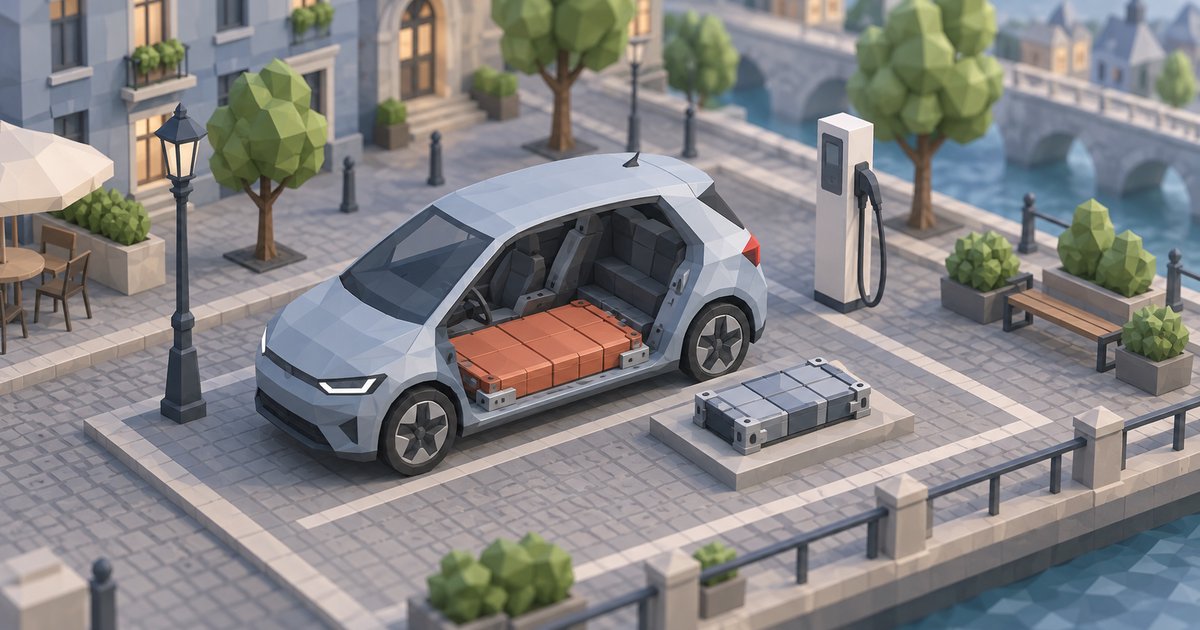
Lithium iron phosphate is normally the compromise chemistry. It is cheaper, it tolerates being charged to 100% every night, and it lasts — but it stores less energy per kilogram, so a carmaker switching to it usually gives back range. Renault has just switched the Mégane E-Tech to LFP and gained range instead.
The new model year, announced on 25 September 2026, replaces the outgoing nickel-based 60 kWh pack with a 67 kWh LFP battery. On the WLTP cycle the car is quoted at up to 501 km, against 468 km before — about 33 km more from a chemistry that was supposed to cost it.
What changed
| Outgoing | New model year | |
|---|---|---|
| Battery | 60 kWh, nickel-based | 67 kWh, LFP |
| WLTP range | 468 km | up to 501 km |
| DC charging peak | — | 165 kW |
| 15–80% charge | — | about 24 minutes |
| Motor | 220 hp | 218 hp (160 kW), 300 Nm |
| 0–100 km/h | — | 7.6 s |
The charging claim is the part worth watching. Renault says 15 to 80% now takes about 24 minutes, a quarter less than the outgoing car. LFP packs have historically charged slowly in the cold, and a European buyer will want to see that 24 minutes reproduced in February before treating it as settled.
Renault has also collapsed the range: one battery, one motor, two trim levels — Techno and Esprit Alpine. In Germany the car starts at €34,990, unchanged despite the larger pack. Spanish prices have not been published; the current car lists there at €39,200, so the German figure should not be read as a Europe-wide one.
The Tesla comparison is closer than the badges suggest
Tesla's entry rear-wheel-drive Model 3 in Europe runs LFP cells too, which makes this a like-for-like matchup on chemistry rather than a hatchback-versus-saloon argument. On range the Tesla is still comfortably ahead — its base rear-driven car moved up to 572 km WLTP in August on low-rolling-resistance tyres — and it starts around €37,000 in Germany against the Mégane's €34,990.
So Renault has not caught the Model 3. What it has done is narrow the gap in the segment below it using the same chemistry, at a lower price, without raising it. That is the move a Tesla buyer comparing a €35,000 and a €37,000 car actually has to weigh.
There is a second-order reason to care. LFP is the chemistry whose durability keeps showing up well in European fleet data — a Swedish study found Tesla's LFP Model 3 pack held up best after 100,000 km. A volume European brand adopting it for its core C-segment car, and getting more range while doing so, is evidence that the density penalty which kept LFP out of mainstream European cars is shrinking.
Where it leaves the Mégane in Europe
The Mégane E-Tech has been a solid car with a fading position: launched in 2022, it now sits in a segment crowded by newer platforms and by Renault's own R5. A bigger, cheaper-to-build battery with more range and faster charging at an unchanged entry price is the most useful thing Renault could have done for it short of replacing it.
Whether it is enough is a question for the registration data. In Renault's home market in August, the Model Y led a record 38% BEV share on 4,622 registrations, double the second-placed Renault 5 — and the Mégane did not make the top five, in a month when three other Renaults did. A 33 km range gain does not fix that on its own.