
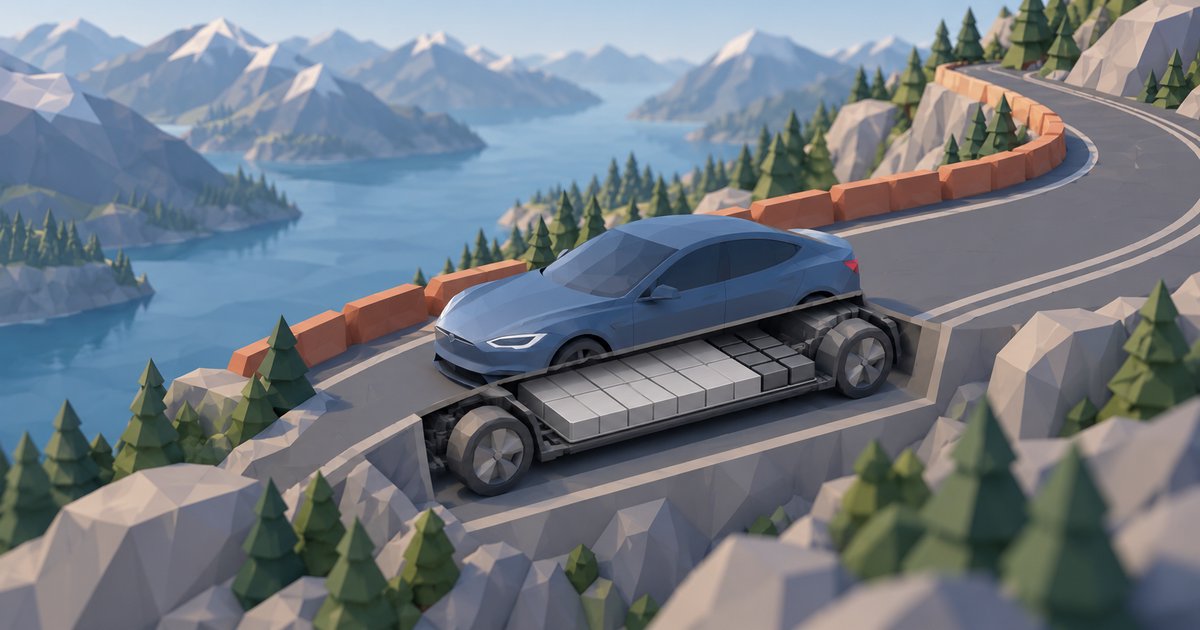
Bjørn Nyland has re-run the range test on his 2013 Model S P85 — the car he calls the Millennium Falcon — now that it has passed 416,000 km. Because he measured the same pack five years ago, the result is a rare before-and-after on one battery, and it says something slightly uncomfortable.
What the car returned
| Measure | Figure |
|---|---|
| Odometer | over 416,000 km |
| Usable capacity now | about 58 kWh |
| Usable capacity when new | 74 kWh |
| Capacity remaining | about 78% |
| Real-world range | close to 350 km |
| Consumption at 90 km/h | 16.6 kWh/100 km |
| Consumption at 120 km/h | 22.3 kWh/100 km |
The test was published on 3 October 2026. Two numbers in that table need a caveat first.
The 85 kWh in the name is not the baseline
A P85's pack is 85 kWh gross and was never 85 kWh usable. The baseline is 74 kWh, what Nyland's car delivered when new. Write-ups of this test that divide 58 by 85, get 68% and report a collapse are measuring against the badge. Against 74 kWh, 58 kWh is about 78% — a loss of roughly 21%.
And it is not the original battery
The pack in the car today is not the one it left the factory with — the original was replaced under warranty after about 86,000 km. The 416,000 km belongs to the car; the pack underneath has done roughly 330,000 km over about twelve years. That distinction is what makes the comparison possible, because Nyland measured this same pack five years ago.
The part that is new
| Pack distance | Usable capacity | Loss from new |
|---|---|---|
| about 265,000 km (2021) | 65.9 kWh | 11% |
| about 330,000 km (2026) | about 58 kWh | about 21% |
The first 11% took 265,000 km. The second 10% took about 65,000 — half this pack's total loss arriving in the last fifth of its distance. If degradation tracked mileage the curve would be flattening, because cell chemistry usually slows after the early losses. This one did the opposite.
The likeliest reading is calendar ageing rather than cycling. A twelve-year-old NMC pack loses capacity whether it is driven or not, because the mechanisms that do it — electrolyte decomposition, lithium inventory loss at the anode — run on time. At seven years the mileage was doing most of the damage; at twelve, time has overtaken it. The practical rules for slowing that down are unchanged: charge state, not charge count, is what an NMC pack minds.
What it means for a European used buyer
It is one car, read off an OBD dongle by its owner, not fleet data — and a 2013 pack, with first-generation cells and a decade of charging habits nobody logged.
Set it beside the other long-distance data points covered here recently and they disagree usefully. A 2021 UK Model 3 Long Range reached 250,000 miles on its original pack with 84% left — more distance than Nyland's pack, less degradation, newer cells. Hansjörg Gemmingen's 2013 Model S P85+ passed 3 million kilometres, but needed four packs to do it. And across the European fleet, Aviloo's half-million tests put the Model Y at a median 90.3% after 150,000 km.
That spread is the finding. A European buyer looking at a high-mileage Tesla is not really pricing distance — a 2021 car at 400,000 km is a better bet than a 2013 car at half that, because the clock runs whether the car does or not.
What it does establish is a floor. After twelve years and 330,000 km the pack still returns about 350 km of real range at 16.6 kWh/100 km — a usable car, not a project. For scale, the cheapest new Model Y RWD manages 360 km at 120 km/h in Nyland's own test set: a current entry-level Tesla does at motorway speed roughly what this one does in total.
The summary for anyone shopping used is that the capacity will probably still be there — and that the number to ask the seller for is the usable kWh, not the badge on the boot.