
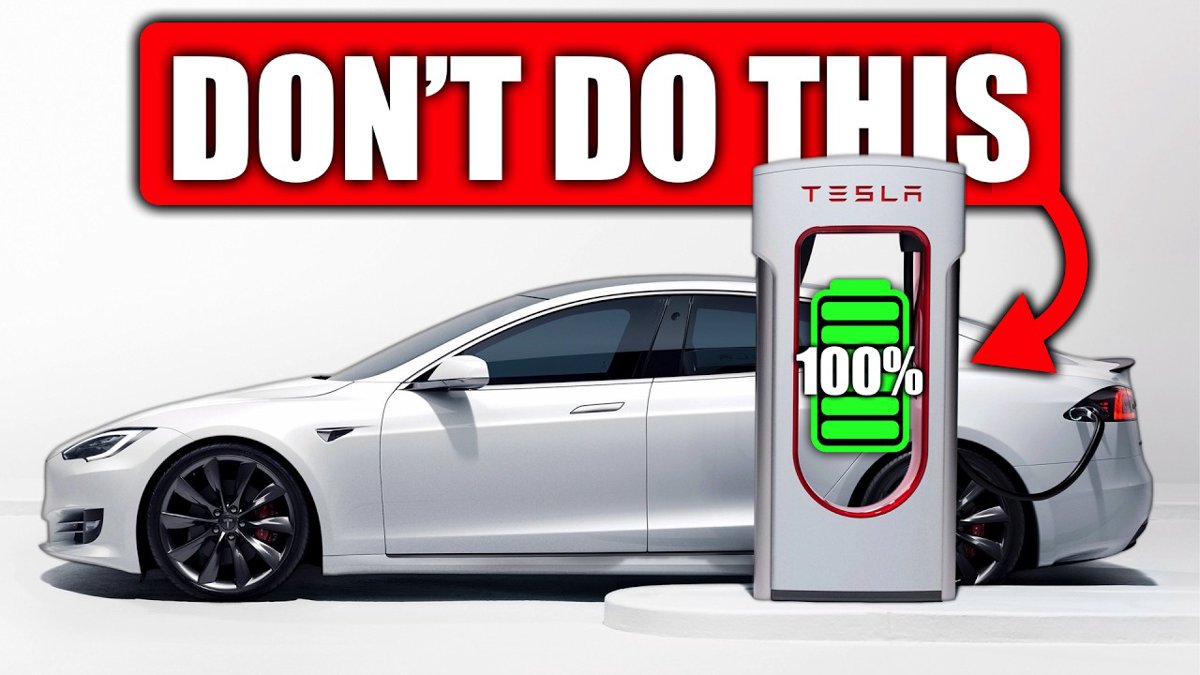
Why NMC Battery Care Matters
NMC — the nickel-manganese-cobalt cathode chemistry used in Long Range Model S, Model X, and some Model 3 and Model Y packs — delivers the range European Tesla drivers rely on. But every charge cycle leaves microscopic marks on the cathode crystals, and the rate of that degradation depends heavily on how you use the battery.
Engineering Explained's recent video distils guidance from Dr. Jeff Dahn, the Dalhousie University researcher who has held the NSERC/Tesla Canada Industrial Research Chair since 2016. His team's work on single-crystal NMC cathodes feeds directly into Tesla's battery roadmap. If anyone knows how to make an NMC cell last, it's his group.
Three rules come out of the research. None of them require you to baby the car — Tesla's warranty covers battery degradation either way — but if you want the pack to last 400,000 km plus, they matter.
Rule 1: Don't Store at 100% in the Heat
Degradation accelerates with both temperature and state of charge. A Dahn-group study stored identical NMC cells at 50 °C for 400 days. Cells held at 100% lost more than 40% of their capacity in under 200 days. Cells held at 30% were still at 85% capacity after 400.
For European owners leaving a Tesla parked for weeks — at an airport in summer, say — set the charge limit to around 30% before you go. In cold weather, temperature suppresses the side reactions, so 70% is fine. This is the main storage lever.
Rule 2: Plug In After Every Trip
Shallow charge cycles punish the cathode far less than deep ones. The cathode is a mosaic of tiny crystallites that expand and contract as lithium moves in and out; a full 0–100% swing cracks the crystal surfaces, which then react with the electrolyte and consume useful material.
A cell cycled 40–60% repeatedly retained about 85% capacity after 3,200 equivalent full cycles — roughly 800,000 km for a 250-mile-range EV. The same cell cycled 0–100% dropped to 50% capacity in under 100 days. The practical takeaway: don't wait for the battery to get low. Plug in when you get home, even for a 30 km commute.
Rule 3: Charge to 75% Daily
The voltage curve of a high-nickel NMC cell shows a flat region between about 75% and 100% state of charge. That plateau is where the most volumetric change — and trace oxygen release — occurs during charging. Avoiding it reduces micro-cracking and gas formation inside the cell.
| Use case | Recommended charge limit |
|---|---|
| Daily driving | 75% |
| Long road trip next morning | 100% overnight |
| Long-term storage in heat | 30% |
| Long-term storage in cold | 70% |
| LFP pack (Standard Range Model 3/Y) | 100% regularly is fine |
LFP chemistry — used in many European Standard Range Model 3 and Model Y vehicles — behaves differently and Tesla actively recommends charging LFP packs to 100% at least weekly for accurate state-of-charge calibration. The three rules above apply specifically to NMC packs.
What About Supercharging?
Dahn says DC fast charging is not a meaningful source of degradation for modern EVs. The vehicle's battery management system throttles current based on cell temperature and state of charge, so you can't charge faster than the pack is designed to handle. Use Superchargers as needed — they're not the enemy.
What This Means for European Owners
Tesla's 8-year / 160,000 km battery warranty in Europe guarantees at least 70% capacity retention. These rules aren't about avoiding warranty limits — they're about comfortably outlasting them. For the Dutch, German, French, and Nordic owners who make up most of the European Tesla fleet, two habits matter most: set the charge slider to 75% for daily driving, and drop it to 30% before long trips away from home during summer. Everything else is a rounding error.