
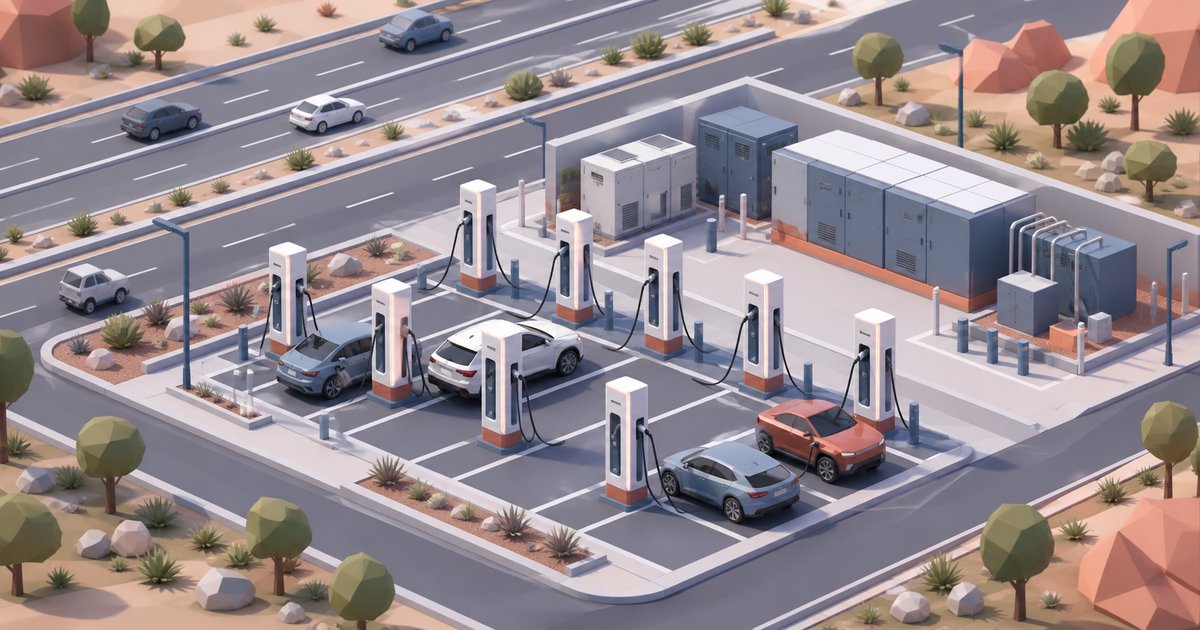
One of Tesla's biggest charging rivals in the United States has decided that the fastest way to compete with the Supercharger network is to buy it. EVgo has signed an agreement to deploy Tesla V4 Superchargers under its own brand — Tesla-built, Tesla-maintained, EVgo-owned.
What the deal actually is
The agreement runs through Tesla's Supercharger for Business programme, which lets a third party own charging hardware that Tesla builds and continues to operate. The split of responsibilities is unusual enough to be worth stating plainly:
- EVgo owns the chargers, and handles site host relationships, utility connections and pricing.
- Tesla builds, operates and maintains the hardware itself.
- The sites will carry EVgo branding, and will appear in Tesla's in-car navigation.
EVgo describes it as one of the largest Supercharger deployments by any non-Tesla company in the US. Installations begin this autumn, with the first sites expected to be live in the second half of 2026.
The hardware is the full V4 specification
These are not derated units. The V4 Superchargers EVgo is installing are rated at up to 500 kW on an architecture supporting up to 1,000 volts, with the long V4 dispenser cables that make the stalls usable by vehicles whose charge port is not in the Tesla position.
| V4 Supercharger | Specification |
|---|---|
| Peak power | Up to 500 kW |
| Architecture | Up to 1,000 V |
| Connector | Native NACS (SAE J3400) |
| Non-Tesla support | Integrated NACS-to-CCS1 adapter (Magic Dock) |
The built-in Magic Dock matters for a network like EVgo's, whose customers drive a mix of NACS and CCS1 cars. It removes the adapter problem at the stall rather than leaving it to the driver. If the connector alphabet is unfamiliar, our guide to EV charging plugs by region covers what each standard is and where it applies, and the Supercharger generations explainer traces how V4 differs from what came before.
What it means — and does not mean — for Europe
Be clear about the scope: this is a US deployment, and nothing announced here changes a single charging stall in Europe. European drivers should not expect EVgo-branded Superchargers on the continent.
What travels is the business model. Tesla has spent two years turning the Supercharger network from a Tesla-owner benefit into infrastructure it sells to other people — first by opening stalls to other brands, now by selling the hardware and the operations to a competing network. A rival that could have bought merchant DC chargers from any of a dozen suppliers instead concluded Tesla's cabinets and uptime record were worth ceding the operating relationship for. That is a competitive judgement European charge point operators will be reading closely.
It also lands alongside Tesla's own commercial push on this side of the Atlantic, where the company has been building out a Semi and Megacharging presence in France and Germany. Europe's constraint has never really been Tesla's willingness to build — the AFIR targets are already being met almost everywhere. It is whether third parties want Tesla operating hardware on their sites. In the US, one of the largest of them just said yes.