
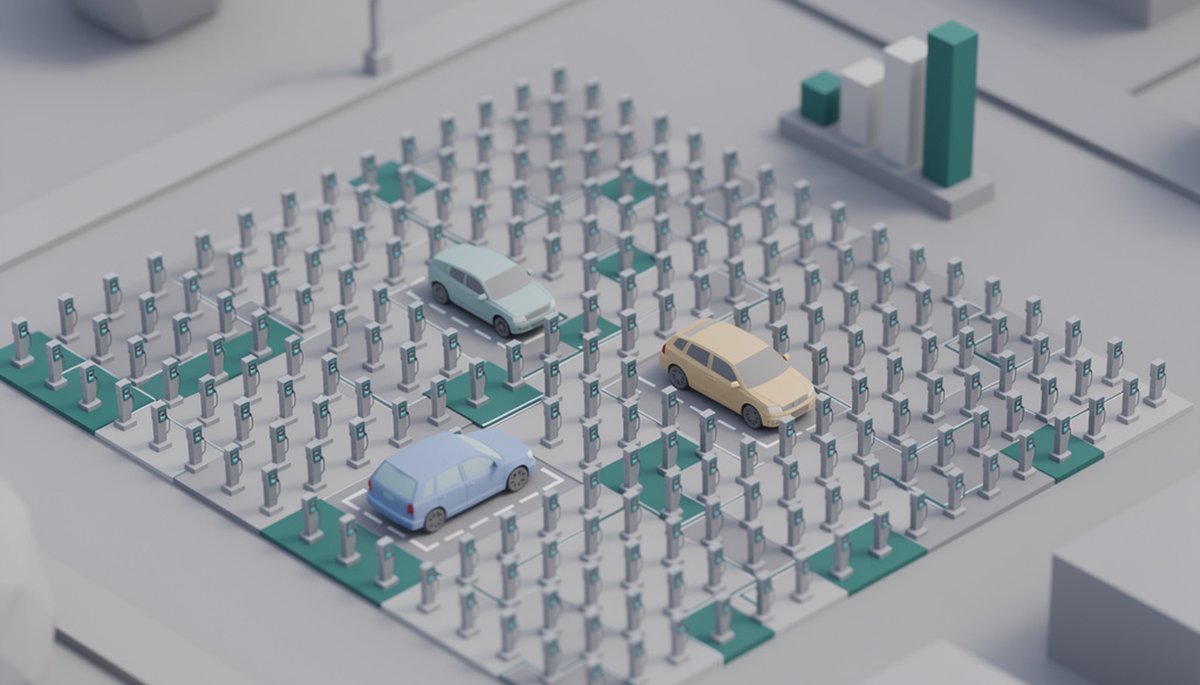
Europe Has Built the Chargers Faster Than the Cars
The familiar complaint that Europe cannot electrify because it lacks chargers is looking increasingly out of date. A new analysis by the campaign group Transport & Environment (T&E) finds that public charging infrastructure across the EU has grown faster than the battery-electric vehicle (BEV) fleet it is meant to serve. By the end of March 2026, every member state except Malta already met the fleet-based targets set out in the EU's Alternative Fuels Infrastructure Regulation (AFIR) — the binding law that ties charging capacity to the number of electric cars on the road.
What AFIR Actually Requires
AFIR sets two kinds of target. The first is fleet-based: each country must provide at least 1.3 kW of publicly accessible charging capacity for every BEV registered in its national fleet. The second is geographic: fast-charging stations of at least 150 kW must sit along Europe's main motorway corridors at regular intervals, so that long journeys are possible without route anxiety.
On the fleet-based measure the EU is comfortably ahead. Across the bloc, total public charging capacity now exceeds the minimum requirement by 180%, and there were roughly 1.1 million public chargers installed by the end of last year — five times as many as in 2020. Malta is the sole holdout, a reflection of how quickly its EV fleet has grown relative to a small island grid rather than any collapse in the wider trend.
The Motorway Picture Is Catching Up
The geographic targets are progressing more unevenly, but still faster than the deadlines demand. Under AFIR, ultra-fast stations of at least 150 kW should appear every 60 kilometres along the TEN-T Core network — the busiest cross-border routes — by 2025. As of June 2026, 79% of that Core network met the requirement. On the wider TEN-T Comprehensive network, which covers regional motorways and primary roads, 20 of the EU's 27 member states have already hit their 2027 targets, roughly 18 months ahead of schedule.
| AFIR metric | Status (2026) |
|---|---|
| Fleet-based target met | 26 of 27 states (all but Malta) |
| Public capacity vs. minimum | +180% |
| Public chargers installed | ~1.1 million (5x 2020) |
| TEN-T Core 150 kW every 60 km | 79% complete |
| TEN-T Comprehensive 2027 target met early | 20 of 27 states |
Why It Matters for Tesla Owners
For Tesla drivers the report reframes a long-standing argument. Tesla has spent years positioning its Supercharger network as the answer to Europe's charging gaps, and it continues to expand — from Europe's first 500 kW V4 Supercharger in Norway to opening its stalls to other brands. But T&E's data suggests the bottleneck for European EV adoption is no longer the plug: it is car pricing, purchase incentives and grid connections. With lawmakers now moving to scrap permits for highway fast-charging stations, the infrastructure side of the equation is, on these numbers, largely solved. That should make it easier for buyers weighing a Model 3 or Model Y to treat public charging as a settled question rather than a reason to wait.