
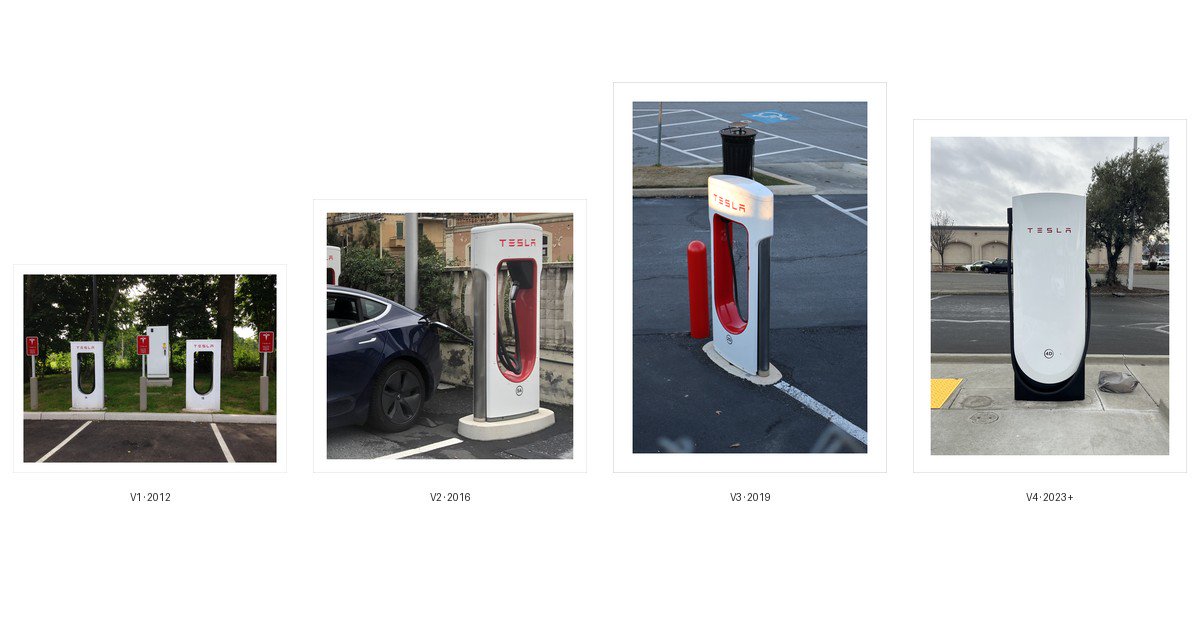
Plug in at a Tesla Supercharger and the post in front of you could be anything from a 2012-vintage unit to brand-new 2026 hardware. The network looks uniform, but under the skin it spans four generations that differ enormously in power, cooling and even how they share electricity between cars. Here's what each generation actually delivers, how Superchargers differ from Destination Chargers, and how Tesla decides where to build them.
The generations at a glance
| Generation | Year | Peak power (per stall) | Key change |
|---|---|---|---|
| V1 | 2012 | 90–120 kW | Paired stalls share one cabinet |
| V2 | ~2016 | 120–150 kW | Same paired design; Europe gets dual-cable Type 2 + CCS2 |
| V3 | 2019 | 250 kW | Liquid-cooled cable; each post charges independently |
| V3+ / "V3.5" | ~2024 | 325 kW | Better cooling, 1,000 A on the V3 backend |
| V4 cabinet | 2024–25 | up to 500 kW | 400–1,000 V; 8 posts per cabinet; up to 1.2 MW for the Semi |
Peak power climbs every generation, but the important nuance is how that power reaches your car (Wikipedia).
Every generation, up close
V1 (2012) — the original
The first Superchargers delivered 90 or 120 kW, but with a catch: stalls were wired in pairs that shared a single cabinet. Park next to someone already charging and you split the power between you (Wikipedia). It was enough for the early, smaller-battery Model S and it bootstrapped the network — but the neighbour penalty was real.
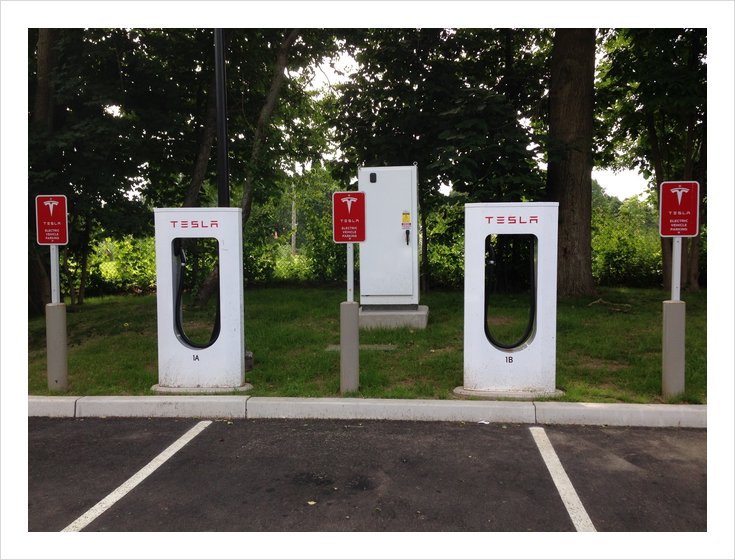
V1 Supercharger station, Greenwich, Connecticut — the paired stalls (A/B) share one cabinet's power. Photo by Z22, CC BY-SA 3.0, via Wikimedia Commons.
V2 (~2016) — more power, same sharing
V2 lifted the ceiling to 120–150 kW but kept the paired-cabinet design, so the power-sharing trade-off carried over (Wikipedia). In Europe this is the era of the distinctive dual-cable post, carrying both a Type 2 and a CCS2 connector during the continent's switch to the CCS2 standard.
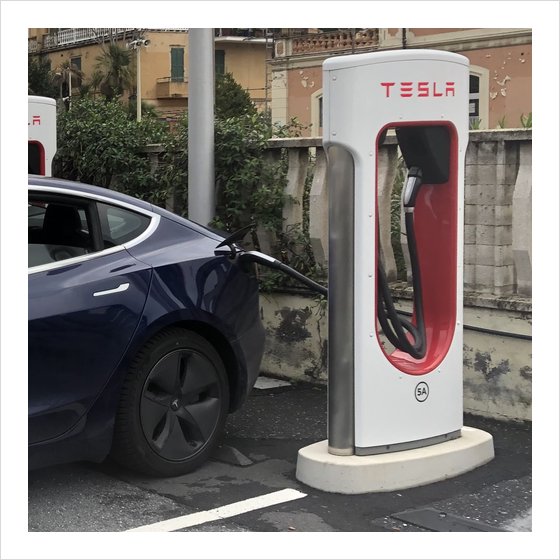
European V2 charger with dual cables — a Type 2 connector and a CCS2 connector (Imperia, Italy). Photo by Lklundin, CC BY-SA 4.0, via Wikimedia Commons.
V3 (2019) — the big jump
V3 was the step change: 250 kW per stall, a liquid-cooled cable thin enough to handle one-handed, and — crucially — an architecture where each post can hit full power independently of its neighbours (Wikipedia). A later refinement sometimes called V3+ or "V3.5" pushed this to 325 kW. For nearly every Tesla on the road today, a V3 stall is already as fast as the car can accept.
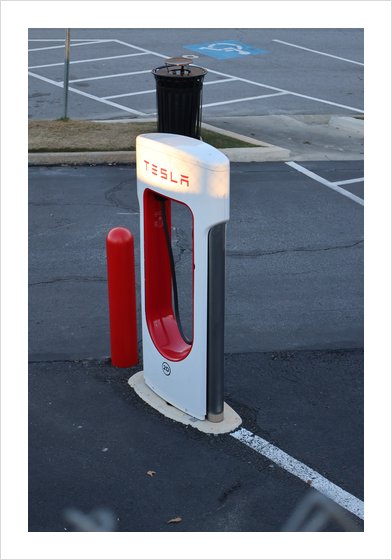
Tesla V3 Supercharger — slimmer post and a single liquid-cooled cable. Photo by Nashucks, CC0 1.0, via Wikimedia Commons.
V4 (2023+) — two very different things
This is where it gets confusing. "V4" can mean two distinct pieces of hardware:
- The common V4 post — a taller dispenser with a longer cable, a card reader and (in North America) a Magic Dock — but bolted onto an older V3 cabinet, so it still caps around 325 kW.
- The new V4 cabinet (announced November 2024, first full station in 2025) — which operates at 400–1,000 V and delivers up to 500 kW per stall to an 800-volt vehicle, with 1–1.2 MW shared across eight stalls and up to 1.2 MW for the Tesla Semi (Wikipedia, Not a Tesla App).
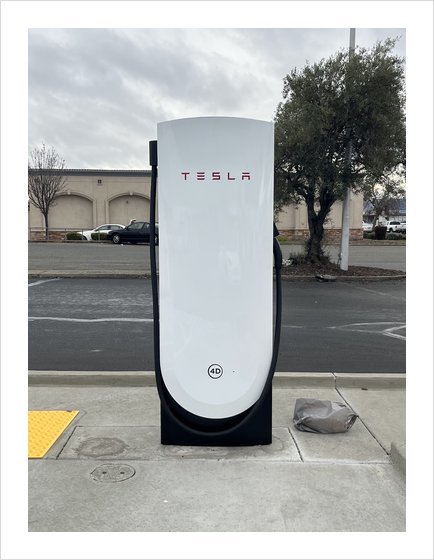
Tesla V4 Supercharger — taller post, longer cable and an integrated card reader. Photo by Gamesyns, CC BY-SA 4.0, via Wikimedia Commons.
The 500 kW figure deserves an asterisk. It needs an 800-volt car — today, only the Cybertruck — and even then the peak lasts only seconds at very low charge. In real-world tests a full 10–80% session is just three to four minutes faster than a 250 kW V3 stall, because average power over a session is far below the peak (Not a Tesla App). Don't read "500 kW" as the everyday V4 experience.
Supercharger vs Destination Charger
Tesla runs two completely different kinds of charger, and it's easy to mix them up.
| Supercharger | Destination Charger | |
|---|---|---|
| Type | DC fast charging | Level 2 AC (Tesla Wall Connector) |
| Power | 250–500 kW | up to ~11.5 kW (240 V, 48 A) |
| Speed | up to ~200 mi in ~15 min | up to ~44 mi per hour |
| Where | Highways, travel corridors | Hotels, restaurants, shops |
| Who owns it | Tesla | The host business |
A Supercharger pushes DC straight into your battery for road-trip-speed charging. A Destination Charger is a Tesla Wall Connector that a hotel or restaurant installs, owns and operates — adding up to ~44 miles of range per hour while you eat, sleep or shop, and usually free to use (EnergySage). One is for getting back on the motorway fast; the other is for topping up while you're parked anyway. (If the connectors themselves confuse you, see our guide to EV charging plugs by region.)
How Tesla chooses sites — and builds them
Supercharger placement is corridor-first. A geospatial study of the US network found roughly 92% of stations sit within a highway buffer, strung along interstates so the gaps stay inside a typical car's range; the rest cluster at amenity-rich "destination" spots (GeoMarvel). Beyond the road map, Tesla weighs amenities (host sites need six-plus parking spaces, restrooms and food nearby), grid capacity — an eight-stall V4 cabinet is a serious electrical load, increasingly buffered with on-site Megapack storage — and real-estate leases with retail and hospitality partners (EnergySage).
Construction is trending hard toward prefabrication. Tesla has opened sites on pre-poured concrete slabs in days rather than weeks, and its newest foldable V4 design is the next step in the same logistics playbook (see below). The one thing prefab can't shortcut is the utility interconnection — getting the grid hookup approved and energised remains the gating step for any new site (Tesery).
The foldable V4 (2026)
Announced in March 2026, the foldable Supercharger is a logistics innovation, not a power upgrade — it still uses the same V4 cabinet. Each "Folding Unit" pairs one cabinet with eight posts on a hinged base: it ships collapsed (stalls back-to-back) and unfolds on site into a single longer row. Tesla says the design fits 33% more posts per truck, deploys about twice as fast, and cuts installation cost by 20%+ (The Driven, CleanTechnica). The first European deployments were reported in June 2026 (Teslarati). These are Tesla's own launch figures rather than independently audited numbers — but the goal is clear: build out the network faster and for less money.
Why it matters to European drivers
For most owners, the practical takeaway is reassuring: a V3 stall already charges your car about as fast as it can go, so you rarely need to hunt for V4. The 500 kW headline mainly matters to Cybertruck drivers today and to whatever 800-volt Teslas arrive next. The foldable rollout matters in a different way — it should mean more stalls, sooner, especially across Europe as the network keeps expanding. And whether you pull up to a 2014 V1 post or a 2026 foldable unit, the plug experience for a European Tesla stays the same: CCS2, no adapter, just charge.
Image credits
Supercharger photographs are reproduced under their respective Creative Commons licenses:
- V1 (2012) — Tesla Greenwich North Supercharger Station: photo by Z22, CC BY-SA 3.0 — source
- V2 (2016) — European dual-cable V2 charger: photo by Lklundin, CC BY-SA 4.0 — source
- V3 (2019) — Tesla V3 Supercharger: photo by Nashucks, CC0 1.0 — source
- V4 (2023+) — Tesla V4 Supercharger: photo by Gamesyns, CC BY-SA 4.0 — source
Further reading
- Tesla Supercharger — Wikipedia
- Tesla Destination Charger guide — EnergySage
- Analyzing Tesla Supercharger locations — GeoMarvel
- First 500 kW V4 cabinet, real-world speed — Not a Tesla App
- Tesla's foldable Supercharger — The Driven
Wikipedia content used under CC BY-SA 4.0.