
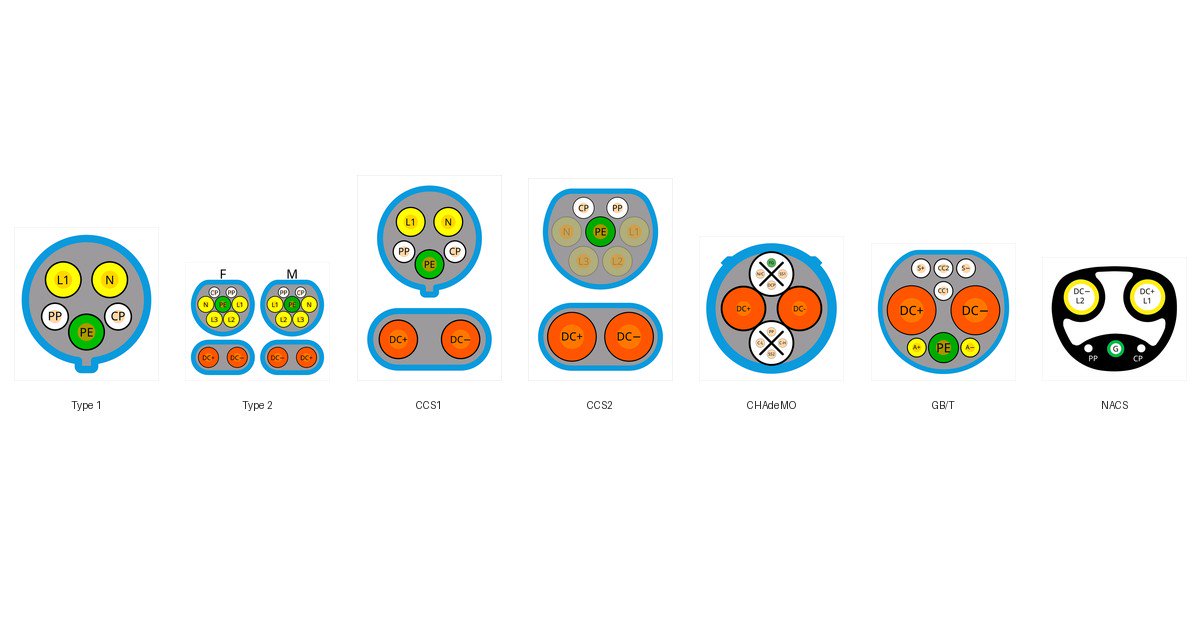
Plug a Tesla — or any electric car — into a public charger and the socket you meet depends almost entirely on where you are standing. The world has settled into a handful of regional camps, each with its own connector for slow AC charging and fast DC charging. For drivers in Europe the picture is refreshingly simple; for anyone comparing markets, or importing a car, it is anything but. This guide walks through every major plug, what it does, and where Tesla fits.
What a European driver actually sees
At any public charger in the EU or UK you will meet just two connectors: Type 2 (Mennekes) for AC charging and CCS Combo 2 (CCS2) for DC fast charging. This is not luck — EU Directive 2014/94/EU has required Type 2 and CCS2 across the charging network since 2014 (European Commission, Wikipedia). It applies to Tesla too: European Teslas built since May 2019, and newer Superchargers, use CCS2, so a Tesla driver in Europe charges on exactly the same hardware as everyone else (Wikipedia).
The connectors at a glance
| Connector | AC | DC | Region | Typical power |
|---|---|---|---|---|
| Type 1 (J1772) | ✔ | — | North America, Japan | up to ~7.4 kW (single-phase) |
| Type 2 (Mennekes) | ✔ | — | Europe & most of world | up to ~22 kW (three-phase) |
| CCS Combo 1 | ✔ | ✔ | North America, Korea, Taiwan | up to ~350 kW DC |
| CCS Combo 2 | ✔ | ✔ | Europe & most of world | up to ~350 kW DC |
| CHAdeMO | — | ✔ | Japan (declining elsewhere) | ~50–100 kW DC |
| GB/T (AC + DC) | ✔ | ✔ | China, Belarus | DC up to 1,200 kW (2023 spec) |
| NACS (J3400) | ✔ | ✔ | North America | up to 1000 V / 500 A |
The majority of the world has consolidated on the Type 2 + CCS2 pairing; the three big exceptions are North America, China and Japan (worldstandards.eu).
Every plug, pin by pin
Type 1 — SAE J1772 (AC)
The historic North American and Japanese AC connector. Five pins, single-phase only, so it tops out around 7.4 kW. It is the AC base that CCS1 builds on.
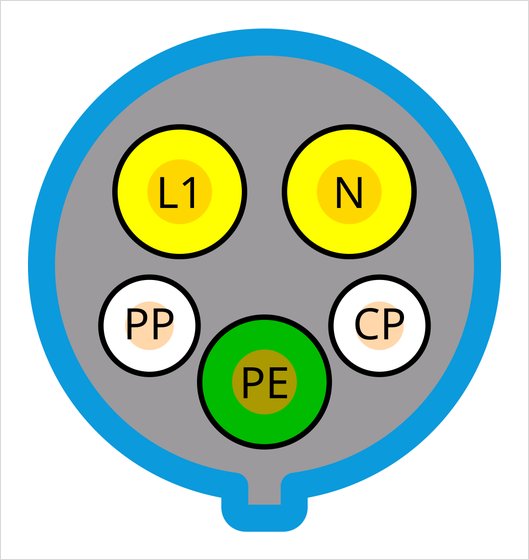
Type 1 pinout diagram — Mliu92, CC BY-SA 4.0, via Wikimedia Commons.
Type 2 — Mennekes (AC)
Europe's mandated AC plug. Crucially it carries three-phase power, which is why European AC charging reaches ~22 kW on public posts where Type 1 cannot (Wikipedia). It is also the physical basis for CCS2.
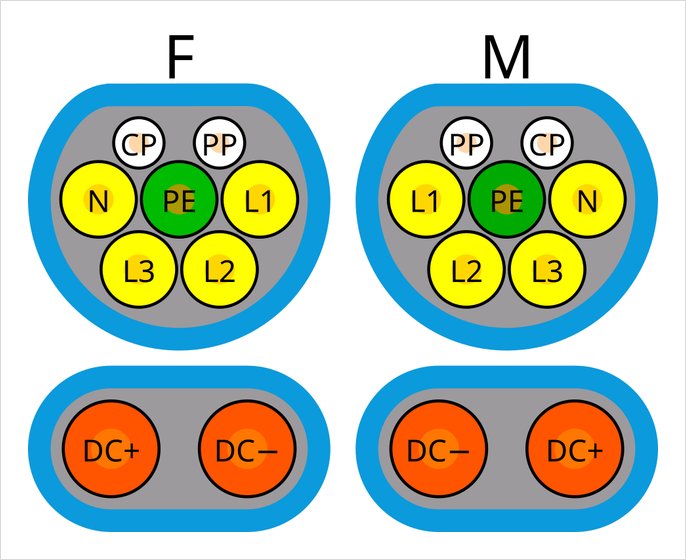
Type 2 pinout diagram — Mliu92, CC BY-SA 4.0, via Wikimedia Commons.
CCS Combo 1 (CCS1)
CCS1 takes the Type 1 plug and adds two large DC pins below it, combining AC and DC in a single inlet. Used in North America, Korea and Taiwan (Wikipedia).
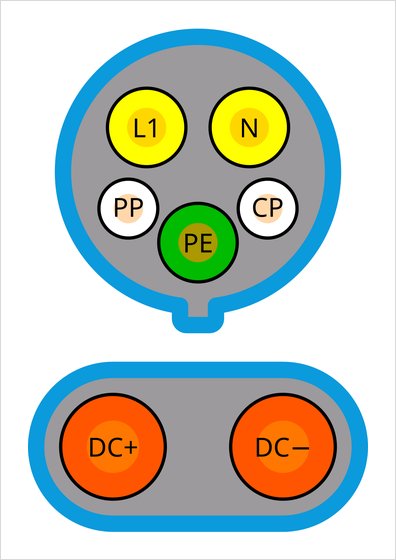
CCS1 pinout diagram — Mliu92, CC BY-SA 4.0, via Wikimedia Commons.
CCS Combo 2 (CCS2)
The same idea applied to the Type 2 plug — two DC pins added beneath the Mennekes layout. This is the EU's DC fast-charging standard and the most geographically widespread DC connector in the world, handling up to roughly 350 kW.
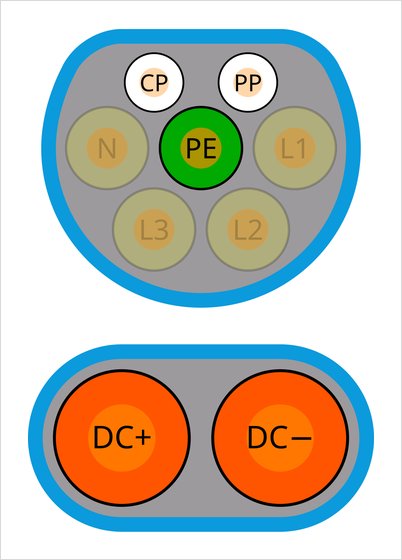
CCS2 pinout diagram — Mliu92, CC BY-SA 4.0, via Wikimedia Commons.
CHAdeMO
A DC-only connector that needs a separate AC inlet alongside it. Once common worldwide, it now survives mainly in Japan (Wevolver).
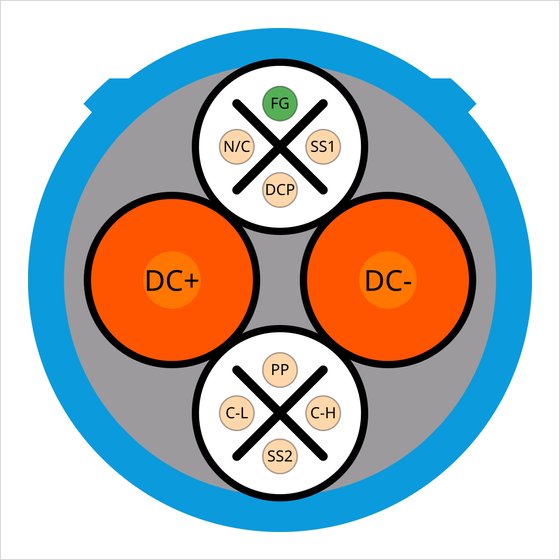
CHAdeMO pinout diagram — Mliu92, CC BY-SA 4.0, via Wikimedia Commons.
GB/T (China)
China's mandatory standard is the odd one out: it uses two physically separate connectors — a 7-pin AC plug and a 9-pin DC plug — rather than one combined inlet, so Chinese EVs have two charging ports. The 2023 DC revision allows for extraordinary power, up to 1,200 kW (Wikipedia).
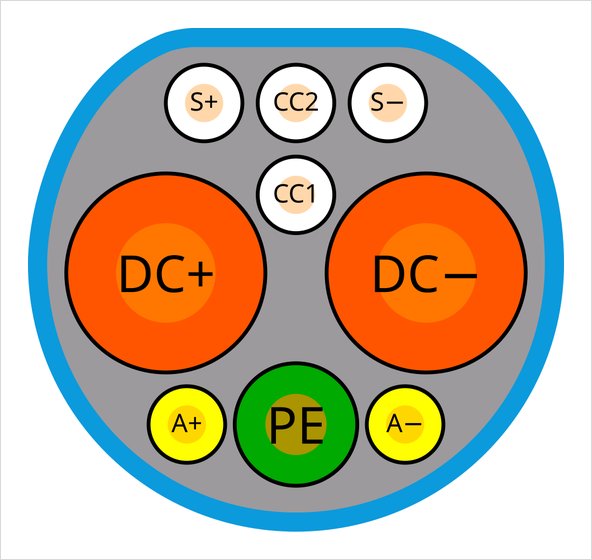
GB/T pinout diagram — Mliu92, CC BY-SA 4.0, via Wikimedia Commons.
NACS — SAE J3400 (Tesla)
Tesla's North American connector, opened up as NACS in 2022 and standardised as SAE J3400 (a technical report in December 2023, the full recommended practice in September 2024). Its trick is a compact five-pin design in which the same two large contacts carry either AC or DC, so one slim inlet — about half the size of CCS1 — handles every charging level, up to 1000 V / 500 A (Wikipedia).
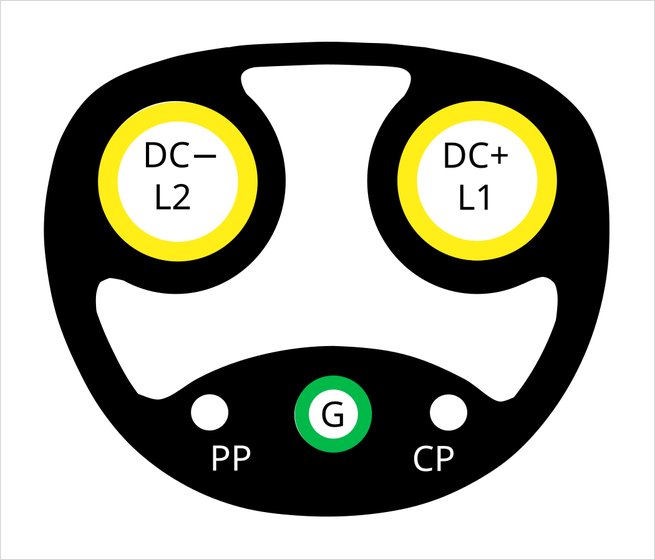
NACS pinout diagram — RickyCourtney, CC BY-SA 4.0, via Wikimedia Commons.
Where Tesla fits
Tesla is the clearest example of regional fragmentation, using a different plug in each major market:
- North America — NACS. After Tesla opened the connector in November 2022, Ford and GM signed on in mid-2023 and most automakers followed; by March 2025 the US had roughly 36,499 public NACS ports against ~16,925 CCS ports, about two to one (TechCrunch).
- Europe — CCS2. Under regulatory pressure, Tesla announced the switch in November 2018; European cars and Superchargers have used CCS2 since (Wikipedia).
- China — GB/T, as the national standard requires.
The practical upshot: a US-market Tesla cannot plug into European public DC infrastructure without an adapter, because the connector geometry is entirely different.
Why it matters to European owners
For drivers in Europe the takeaway is reassuring. The continent's Type 2 + CCS2 standard is settled, legally backed and shared by every brand, Tesla included — so unlike in North America, there is no connector transition to worry about and no adapter needed for everyday charging at home or on a road trip. The NACS-versus-CCS debate that dominates US coverage is, for now, largely an American story. Where it does touch Europe is imports: a Tesla or other EV brought over from North America will carry the wrong port and need an adapter — or a retrofit — to use the local network.
Image credits
Connector pinout diagrams are reproduced under Creative Commons:
- Type 1 — SAE J1772: diagram by Mliu92, CC BY-SA 4.0 — source
- Type 2 — Mennekes (IEC 62196-2): diagram by Mliu92, CC BY-SA 4.0 — source
- CCS Combo 1 (CCS1): diagram by Mliu92, CC BY-SA 4.0 — source
- CCS Combo 2 (CCS2): diagram by Mliu92, CC BY-SA 4.0 — source
- CHAdeMO: diagram by Mliu92, CC BY-SA 4.0 — source
- GB/T (GB/T 20234, DC): diagram by Mliu92, CC BY-SA 4.0 — source
- NACS / Tesla (SAE J3400): diagram by RickyCourtney, CC BY-SA 4.0 — source
Further reading
- Spread of EV connector types — worldstandards.eu
- Combined Charging System — Wikipedia
- North American Charging Standard — Wikipedia
- GB/T charging standard — Wikipedia
- Tesla Supercharger — Wikipedia
- EV charging connector types — Wevolver
Wikipedia content used under CC BY-SA 4.0.