
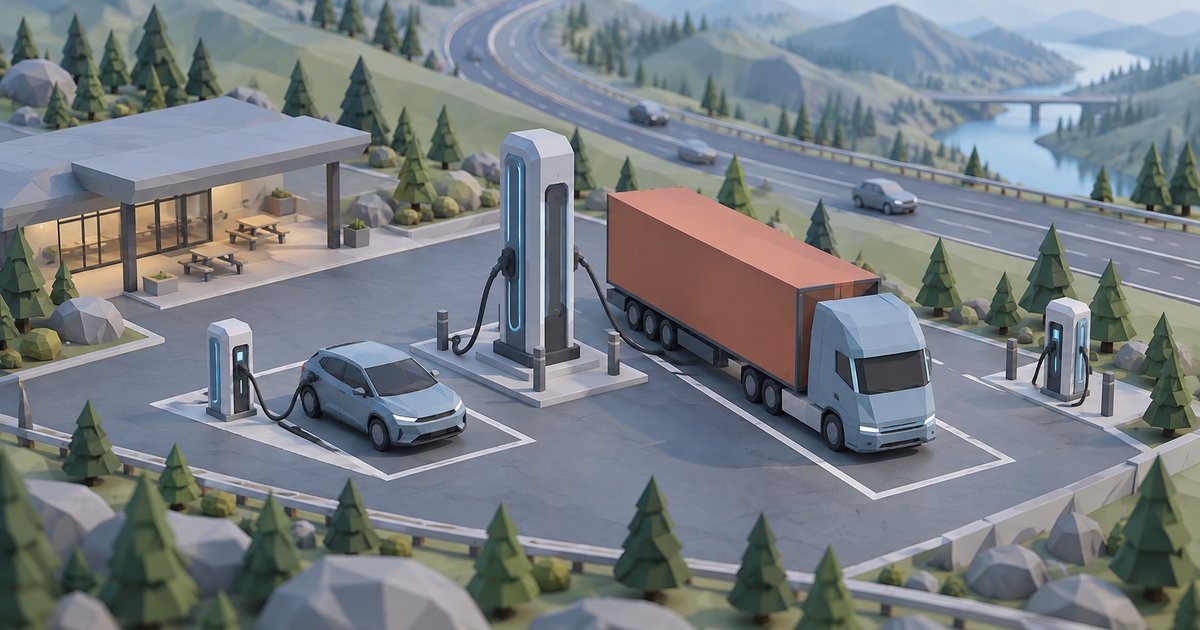
E.ON Drive Infrastructure switched on the first public 600 kW charging point in Czechia on 10 September 2026, at Dolní Dvořiště on the Austrian border. It is the most powerful public charger in the country, and no Tesla will ever draw what it is rated for.
Where it is, and why there
The site sits at the Dolní Dvořiště–Wullowitz crossing on road II/603, part of European route E55, reachable in both directions from exit 174 of the D3 motorway — the last exit before the frontier. That is the main Czech corridor running south towards Linz, and from there to the Alps and the Adriatic. It is a transit stop rather than a city one, which is the whole design brief: the cars that need 600 kW-class hardware are the ones that stop for fifteen minutes and leave.
The upgraded location now offers three power levels — 300, 400 and, new, 600 kW, with the stand's output shared across two connectors. E.ON's own Czech records before this were 175 kW, then 400 kW.
It was built for trucks as much as cars
Dolní Dvořiště is the third E.ON Drive location in Czechia adapted for electric trucks and buses, not just passenger cars. The operator put some numbers to why: across its heavy-vehicle-capable sites over the past twelve months it recorded 326 charging sessions from electric trucks and buses, delivering 95 MWh, at an average speed approaching 300 kW.
That average is worth pausing on. Nearly 300 kW sustained across a year of real sessions is a different kind of figure from a peak, and it is roughly what a Tesla gets as its best moment.
What a European Tesla owner actually gets
| Site headline | 600 kW |
| Tesla passenger-car peak | 250 kW |
| Share of the headline a Tesla can use | under half |
This is the same point TeslAnt made when Ionity's 200th German site opened with 600 kW cabinets, and it is worth repeating because the headline number gets quoted at people. No current Tesla passenger car goes beyond 250 kW on DC — not the Model 3, not the Model Y, not the Model Y L.
The benefit is not the peak. It is what happens when the site fills up. The failure European drivers actually meet is arriving at a busy stop and watching a car that should take 250 kW settle for 110 kW while the cabinet divides its output. Hardware specified far above any single car's appetite is how that gets engineered out, and on a border crossing that funnels holiday traffic south, busy is the normal condition.
The caveats
It is a CCS site, so for a Tesla it is the alternative rather than the default, and the tariff decides whether it is worth using — E.ON published no price with the launch. The 600 kW is also one stand among several power tiers, not the whole location.
Still, the direction is consistent across the region. Slovakia has a 1 MW passenger-car charger under test and Poland is installing 400 kW units no Tesla can use either. Central Europe is building for the cars that come after the ones on sale.