
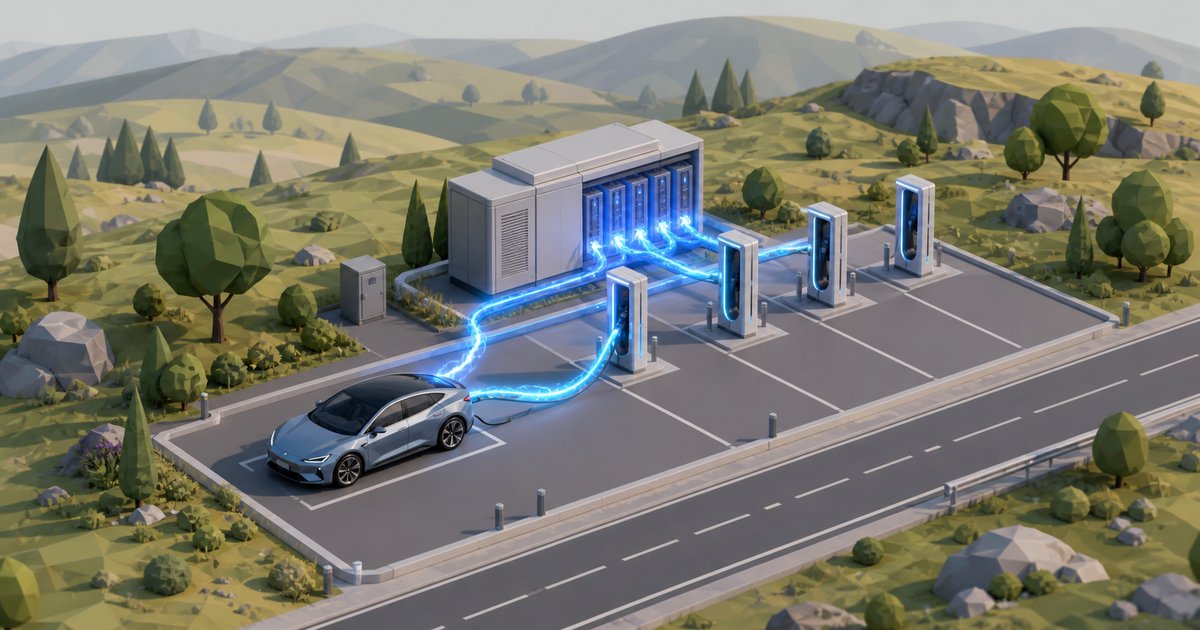
An engineer at BYD France has recorded 721.85 kW while charging a Denza Z9 GT at a public charge point in the Cantal — on a unit whose nominal rating is 600 kW. It is the highest charging power reported on a European public charger, and it was pulled by a car that is already on sale in France.
Song Yu ran the session at an Atlante site in Saint-Flour. Power oscillated between 560 and 722 kW, and the car went from 47% to 80% state of charge in four minutes, taking on 43 kWh. According to Automobile Propre, it held high power all the way to 90% — not just in a brief spike at the bottom of the curve.
How a car draws more than the nameplate
A charger's rating is a continuous figure at a reference condition, not a hard ceiling, and modern high-power sites do not put one cabinet behind one cable. They run a central power cabinet feeding several dispensers with dynamic allocation, so a single vehicle can be handed most of the site's output when the neighbouring stalls are idle. Alpitronic's HYC1000 works exactly this way, and in June it raised its CCS ceiling from 600 kW to 1,000 kW over a single cable — the same 600 kW number quoted for the Saint-Flour unit. Atlante has not published which hardware it installed at Saint-Flour, so treat that as the likely mechanism rather than a confirmed one.
The car is the other half. The Z9 GT runs a 122.5 kWh second-generation LFP Blade pack on a 1,000-volt architecture, which is what lets it accept this much current without cooking the cables. BYD rates its Flash Charging system at up to 1,500 kW with the right equipment, so 721 kW is under half of what the car claims it could take.
What a Tesla does at the same kind of post
| Peak DC power | |
|---|---|
| Denza Z9 GT (measured, Saint-Flour) | 722 kW |
| Alpitronic HYC1000, CCS ceiling since June | 1,000 kW |
| Tesla V4 cabinet, Hellerudsletta, Norway | 500 kW |
| Typical European Supercharger stall | ~250 kW |
| Tesla Model 3 / Model Y | ~250 kW |
Europe's charging hardware has now run about three times ahead of what any Tesla can accept. Tesla's own answer, Europe's first 500 kW V4 cabinet in Norway, is headroom for the site rather than speed for the car — no Tesla on sale gets near it.
The part that should bother Tesla
Peak power was never Tesla's claim. The flat curve was: a Model 3 or Model Y holds a useful rate deep into the pack while rivals taper early, which is why Tesla road trips beat cars with better headline numbers. Holding high power to 90% is precisely that advantage, and this run took it.
What it changes for a European owner
Nothing about your charging speed, and quite a lot about your waiting. A car that clears a stall in four minutes occupies it for a fraction of the time a Tesla does at a shared CCS site — and as Superchargers keep opening to other brands, that cuts both ways. On France's own motorway network the real average is 81 kW over 29 minutes. The record and the reality are a long way apart.
The Z9 GT costs about €115,000, weighs 2.9 tonnes and returns roughly 400 km of real highway range. It demonstrates what the infrastructure can already deliver, not what most people will buy.