
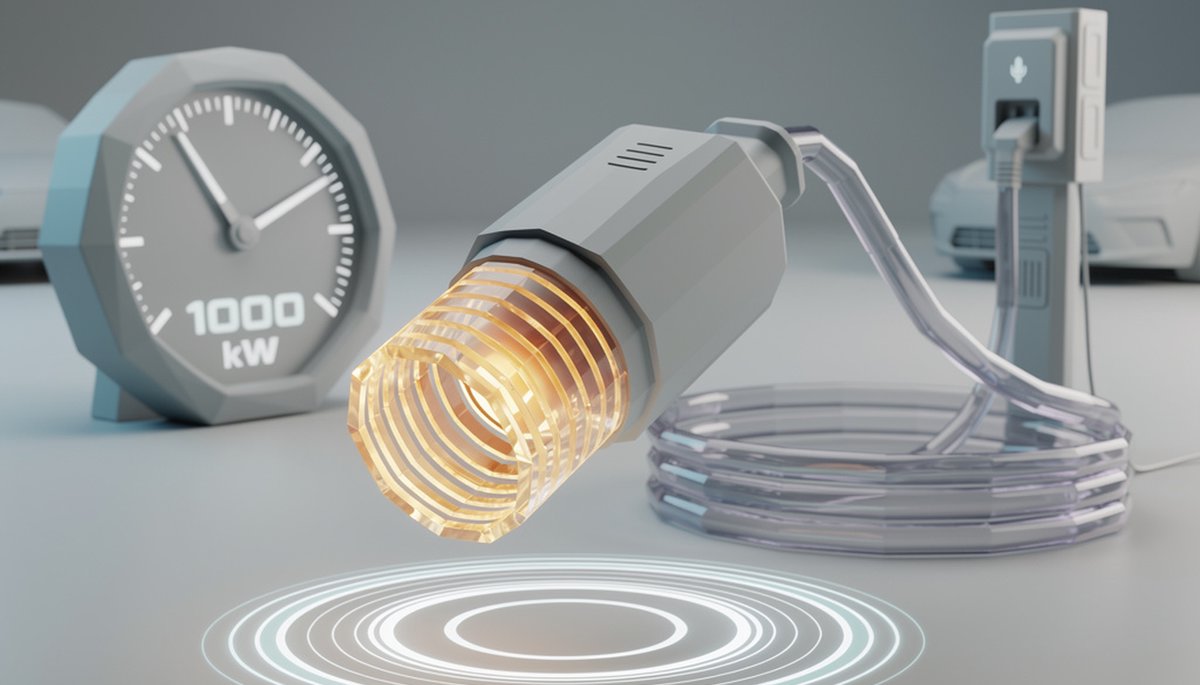
European charging hardware keeps climbing the power curve. Alpitronic, the South Tyrol company whose Hyperchargers sit at thousands of European sites, has added a new high-performance dispenser to its HYC1000 system that can push up to 1,000 kW through a single CCS cable, well beyond what any electric car on the road can actually accept today.
What changed
The HYC1000 already existed as Alpitronic's megawatt-class platform. The news is a new liquid-cooled CCS dispenser that lifts the output of a single connector to over 1,000 A and up to 1,000 kW. Until now, the HYC1000 topped out at 600 kW over CCS. That is a near-doubling of the power available at one cable.
For context, Tesla's V4 Superchargers are built to scale toward roughly 500 kW, and today's fastest production EVs draw a peak in the 250 to 500 kW range only briefly. A 1,000 kW CCS cable is firmly aimed at the next several years of vehicles rather than the current fleet.
How the system is built
The HYC1000 uses a decentralised design that separates the power electronics from the cables drivers actually touch. A central power cabinet houses eight 125 kW silicon-carbide modules, for 1 MW total, and feeds up to eight separate dispensers. Power is allocated dynamically across those points, so a site can serve many cars at once and concentrate output on a single high-demand connector when needed.
| Spec | HYC1000 |
|---|---|
| Total cabinet power | 1 MW (8 × 125 kW silicon-carbide modules) |
| New CCS dispenser peak | up to 1,000 kW / over 1,000 A |
| Previous CCS ceiling | 600 kW |
| Charging points per cabinet | up to 8, dynamically allocated |
| Connector options | CCS, NACS, MCS (heavy trucks) |
Crucially, the dispensers can be fitted with CCS, Tesla-style NACS, or the Megawatt Charging Standard (MCS) connector used by electric trucks, which is where four-figure power outputs make immediate sense.
Why it matters in Europe
The pan-European network IONITY was the first operator to procure the HYC1000, signalling that megawatt-class hardware is moving from spec sheet to motorway. For now the practical benefit for car drivers is headroom and future-proofing: a charger that will not need replacing as vehicles gain faster charge curves, and one that can split its power intelligently so a busy site keeps every stall fast.
The obvious limitation is the cars. No passenger EV on sale can come close to 1,000 kW, so the immediate winners are heavy-duty trucks on MCS and operators who want to install once and not rebuild as the fleet catches up. It also raises the competitive bar for Tesla, whose Supercharger network has long set the pace on reliability and speed and now faces third-party hardware quoting bigger numbers.