
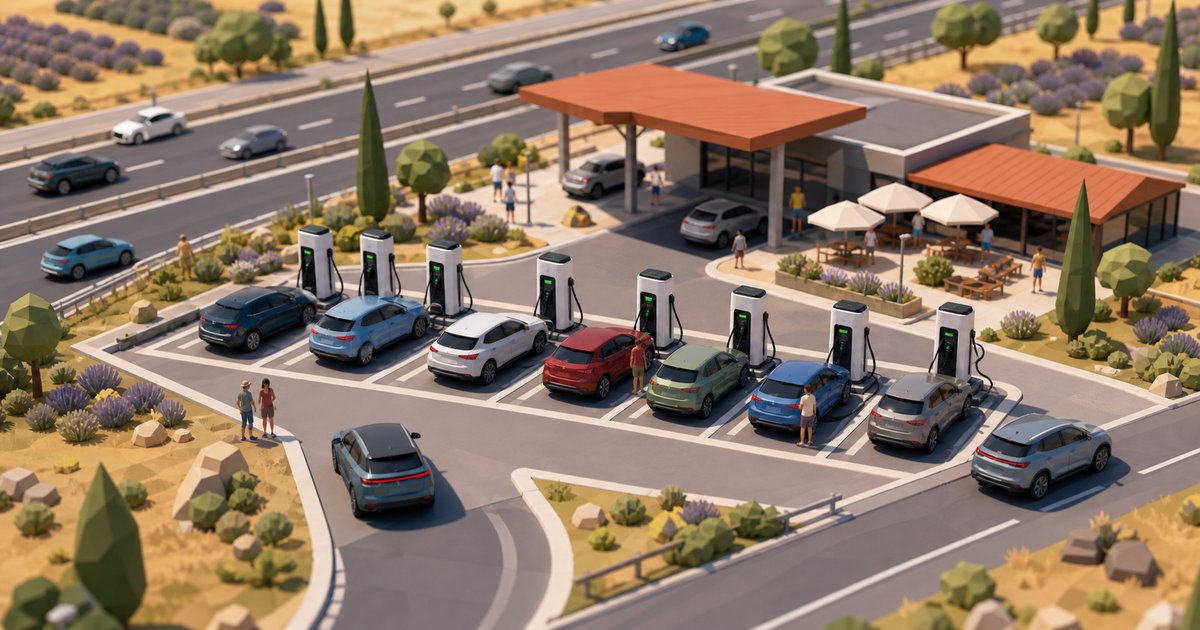
French outlet Automobile Propre did something the charging industry rarely does in public: it sat at a motorway service area for a day and wrote down what actually happened. The location was the rest areas at Montélimar on the A7, during the chassé-croisé — the August weekend when one wave of French holidaymakers drives home as the next drives south, and the motorway network is at its most loaded. Around 100 vehicles were observed.
The numbers
| Metric | Average | Median |
|---|---|---|
| Session duration | 29 min | 28 min |
| Power delivered | 81 kW | 79 kW |
| Starting charge level | 43% | 44% |
| Energy added | 38 kWh (35 kWh net) | — |
| Share of battery recovered | 41% | — |
The average car in the sample had 76 kWh of usable capacity and left with roughly 230 km of range added. Observed consumption in motorway traffic came out at 15.2 kWh/100 km. Charging losses averaged 7.5%, with individual cars scattering widely up to 20%.
The gap between peak power and real power
The single most revealing figure is that only 17 of the roughly 100 cars ever exceeded 100 kW. Almost every modern EV on that motorway is rated well above 100 kW, and many are rated at two or three times it, yet the fleet average landed at 81 kW.
Two things explain it, and neither is a broken charger. First, drivers arrived with an average 43% state of charge — above the window where lithium-ion cells accept their highest current. A car plugged in at 43% is already past its peak-power phase. Second, only 20% of drivers stopped at or below 80%, meaning the majority sat through the tapering portion of the curve where power falls away steeply. Around 15% stayed connected beyond 40 minutes.
The extremes make the same point. The quickest session was a Mercedes EQE that took 19 kWh in 9 minutes, arriving low and leaving early. At the other end, a BMW iX stayed plugged in for 1 hour 25 minutes after its session had finished — occupying a charger without drawing anything from it.
What it means for planning a European road trip
The practical lesson is that arrival state of charge matters more than the number on the spec sheet. Two identical cars can average 150 kW or 60 kW on the same charger depending purely on whether the driver arrives at 10% or 45%. Running the battery down further between stops and stopping for shorter sessions beats topping up early and waiting through the taper.
The loss figures are worth noting too. A 7.5% average gap between energy billed and energy stored is money paid for nothing, and it sits in the same range the ADAC found when it measured charging losses at home wallboxes versus household sockets.
And the iX left plugged in for 85 idle minutes is the strongest argument in this dataset for idle fees. On the busiest driving weekend of the French year, charger availability was constrained by occupancy, not by power.