
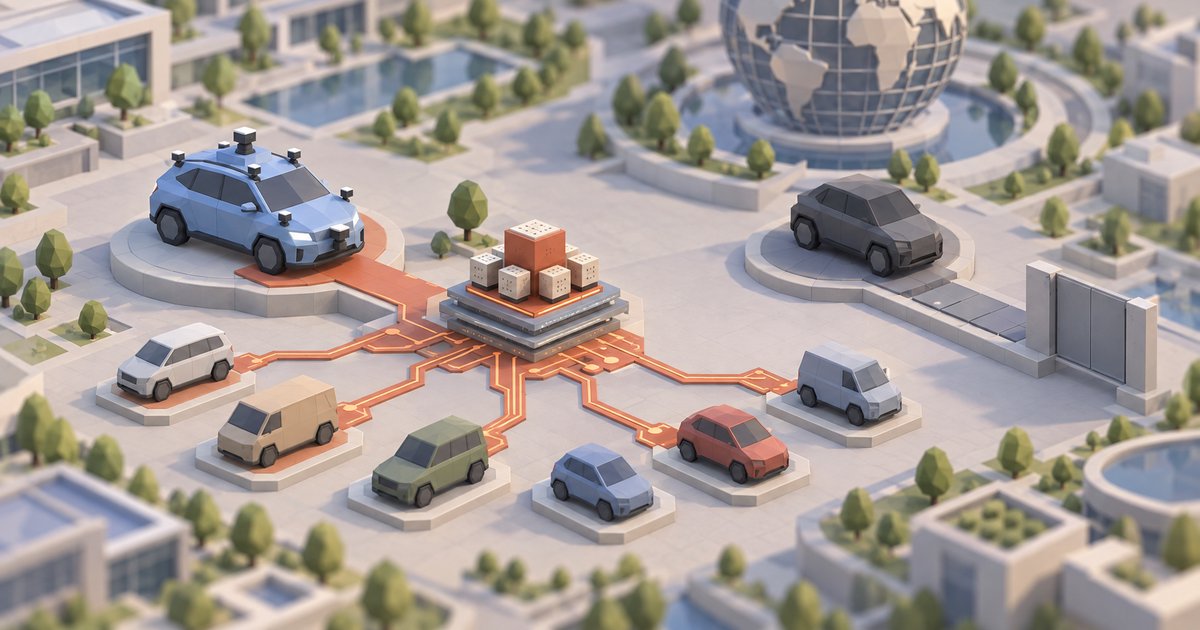
XPeng is reportedly shopping its software to the rest of the car industry. According to a Reuters report carried on 18 September 2026, the Chinese manufacturer has spent about six months building a strategic commercialisation team whose job is to license the parts of an XPeng that are not the car.
The catalogue is unusually broad: the electrical and electronic vehicle architecture, the smart cockpit, XPeng's in-house Turing AI chips, its ADAS and autonomous-driving software, and even its robotaxi and humanoid-robot work. No new customer has been named. XPeng says interested parties have made contact, and that they may include foreign software developers and suppliers as well as carmakers.
Volkswagen is the template
The proof of concept already exists. Volkswagen put roughly 700 million dollars into XPeng in 2023 for a 4.99% stake and then leaned on the startup's software and electronics for its own China-market cars. The jointly developed ID. UNYX 08 went into mass production in March 2026. XPeng's services revenue — the line that captures this work — grew by nearly 94% year on year in the second quarter of 2026, to about 400 million dollars.
That is the pitch to the next customer: not a slide, a shipping vehicle.
Tesla has been making the same offer for five years
The idea of licensing a self-driving stack to other manufacturers is not XPeng's. It is Tesla's, and Tesla has been unable to close it.
| When | What Tesla said |
|---|---|
| 2021 | Preliminary discussions mentioned |
| 2023 | Open to licensing, after the Ford charging deal |
| April 2024 | Talks with "one major automaker" |
| November 2025 | Musk conceded automakers had turned the offer down |
Ford's chief executive Jim Farley put it bluntly in public: Waymo is better. The more consequential obstacle was reportedly liability — established manufacturers wanted Tesla to carry the crash risk that came with its software, and Tesla would not.
Why the Chinese offer may land where Tesla's did not
Technically the two approaches rhyme. Both lean on end-to-end neural networks and camera-led perception. The difference is what each kept. XPeng retained redundant sensors as a safety layer; Tesla removed radar and ultrasonics in pursuit of pure vision.
For a carmaker buying someone else's autonomy, that redundancy is not a detail. It is the thing that is easier to defend to a type-approval authority and to an insurer — which is precisely the ground on which Tesla's offer kept failing.
There is also the matter of who is asking. A supplier relationship with XPeng looks like a supplier relationship. A licensing deal with Tesla means handing a direct competitor a position inside your vehicle programme, and paying for it.
What it means for Tesla
Licensing FSD has long been described as a second revenue stream sitting on top of car sales — software margin without factory capital. Nothing in this report changes Tesla's technology. What it changes is the market: the buyer Tesla has been waiting five years for may now have somewhere else to go, from a company that also aims an L03 squarely at the Model Y in Germany, that Porsche chose over Tesla for its CO₂ pool, and that already has a humanoid robot production line running.
Update: 2026-09-23
On 22 September 2026 Musk publicly reaffirmed the position, replying “Exactly.” to a post stating that no carmaker has ever accepted the offer — a year on from the November 2025 concession in the table above, the count is still zero. Reporting since has added two obstacles this article did not name: a licensee would have to adopt Tesla’s eight-camera layout and onboard compute, effectively rebuilding its cars around a rival’s hardware, and a licensed system would send telemetry back to Tesla, exposing a competitor’s intervention rates and performance gaps. The timing is pointed — the same week, Mercedes-Benz confirmed it had chosen Wayve for its next-generation driver assistance, the kind of production deal Tesla has been pitching since 2021.