
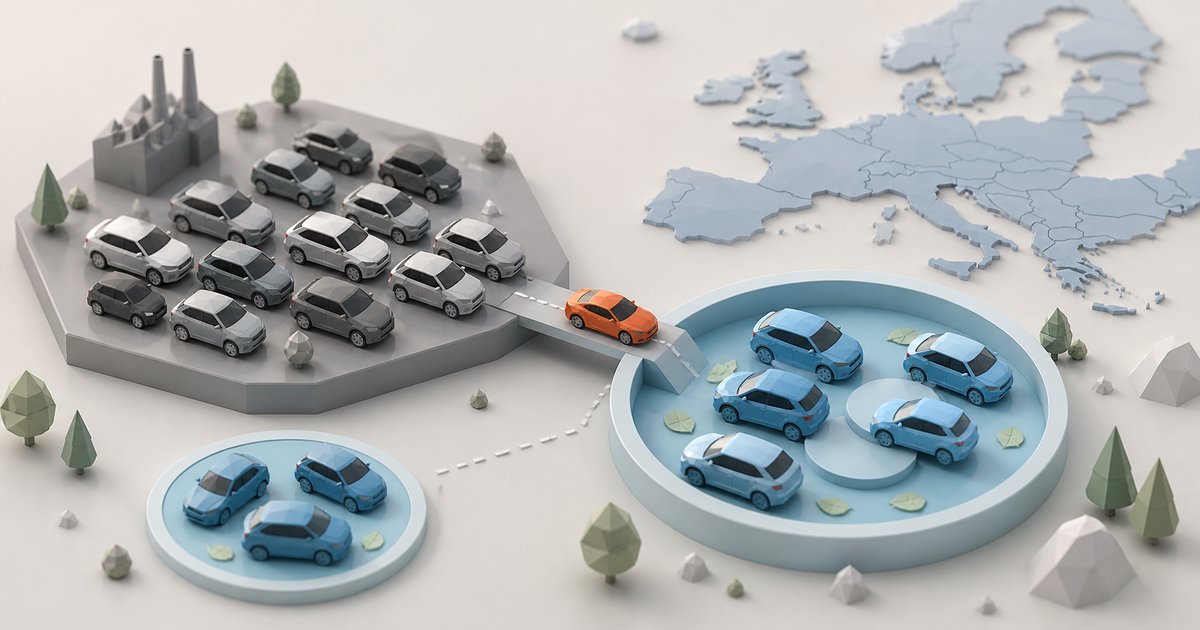
An EU filing dated 5 August 2026 records Porsche withdrawing from the Volkswagen Group's CO₂ pool. For 2026 and 2027 it will sit in an open pool with XPeng instead.
The part worth a Tesla owner's attention is not that Porsche needs help meeting an emissions target. It is where a manufacturer with money to spend on compliance now goes to buy it — and that it is no longer Tesla.
How pooling works
EU rules let carmakers combine their fleets for compliance: a maker whose average CO₂ sits above its target can average itself down against one selling mostly zero-emission cars, and pays for the privilege. Miss the target alone and the fine is €95 for every gram per kilometre over it, multiplied by every car registered that year.
That is the mechanism Tesla has monetised in Europe for years — and the one Porsche has just bought into somewhere else.
The numbers behind the move
| Figure | |
|---|---|
| VW Group fleet average, 2025 | 100 g/km |
| VW Group target, 2025 | 93.6 g/km |
| Porsche fleet average, 2025 | 118.6 g/km |
| Fine per gram over target | €95 per car registered |
| XPeng, Western Europe H1 2026 | just under 20,000 |
| XPeng, Western Europe 2026 forecast | around 50,000 |
At 118.6 g/km, Porsche was the heaviest thing in the group's pool. Removing it improves Volkswagen's own position against a target it missed in 2025; placing it with XPeng gives Porsche access to a fleet that is entirely electric.
Porsche needs that access more than it did a year ago. Its battery-electric volumes are down roughly 30% year-on-year in 2026, and EVs now account for about 30% of its Western European registrations, down from around 40%. Volkswagen Group holds a 5% stake in XPeng, so the credits do not travel far from home.
Where Tesla fits
Tesla built a business out of being the pool everyone else joined, and that business is contracting from both ends.
For 2026 the Tesla-led European pool shrank to Tesla, Ford, Honda, Mazda and Suzuki after Toyota, Stellantis and Subaru filed to leave. In Q2 2026 Tesla booked $146 million in regulatory-credit revenue worldwide — down 67% from $439 million a year earlier, the weakest quarter since 2020, and 0.6% of total revenue against a peak of $2.76 billion across the whole of 2024.
Two changes drained it. In the United States, removing the penalties for missing fuel-economy standards removed the reason to buy credits at all. In Europe, the Commission allowed compliance to be averaged over 2025–2027 rather than judged year by year, which lets a maker with an improving EV mix wait instead of pay — the same flexibility the EU's revised 2035 target sits inside.
Porsche shows what follows. A manufacturer that genuinely needs credits, in the one market where the rules still bite, went to a Chinese brand selling 20,000 cars a year in Europe rather than to the company with the largest zero-emission fleet on the continent. XPeng keeps arriving on two fronts at once: credits on one side, the L03 aimed squarely at the Model Y on the other.
What it means for owners
Nothing in the car changes. The pressure shows up elsewhere.
Credit revenue is close to pure margin — it arrives without a factory attached. Tesla's Q2 2026 operating profit fell 57% year-on-year, and the $293 million that vanished from credits was a meaningful share of that decline. Money that used to appear for free now has to be earned from cars, storage and software — the arithmetic behind trim reshuffles, price moves and the push to sell FSD.