
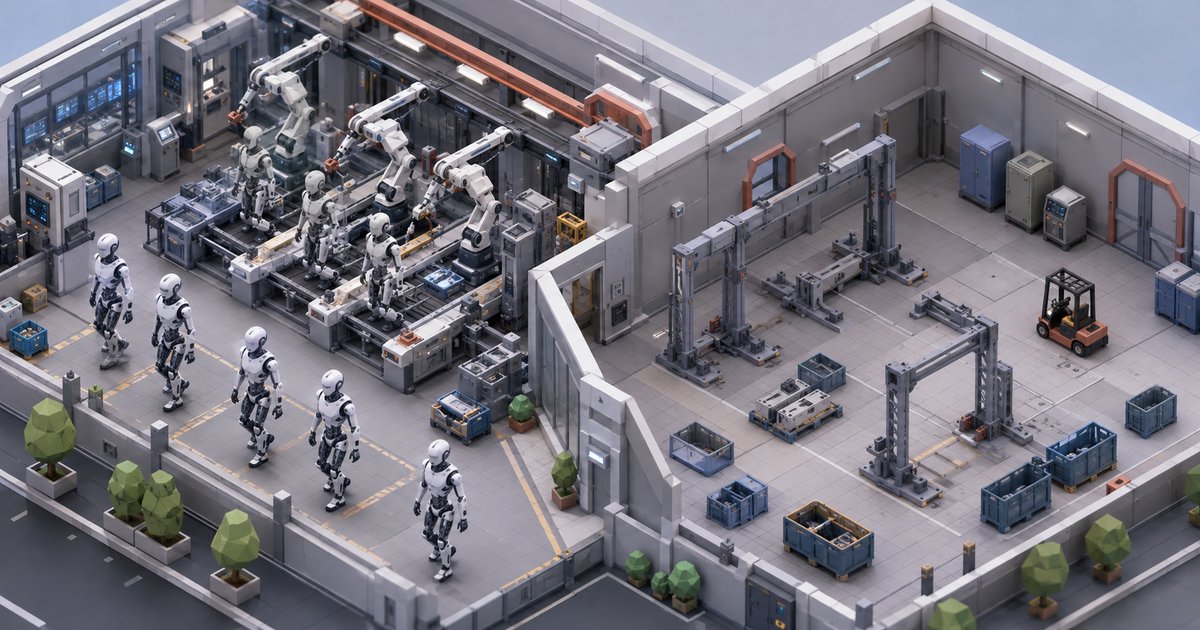
XPeng commissioned a humanoid robot factory in Guangzhou on 7 September 2026, and its IRON robot walked off the line under its own power. Tesla, which once promised roughly 10,000 Optimus units in 2026, is still installing the equipment meant to build them.
That contrast is the story. Both companies argue that humanoid robots are the larger business hiding inside a car company, and both intend to get there by applying car-factory discipline to something that has only ever been hand-built. This week one of them started.
What XPeng switched on
XPeng calls it the world's first automated production line for advanced humanoid robots. More than 80% of core processes are automated, running the automotive-grade quality systems XPeng already uses for cars. The claim is not that robots are being assembled faster, but that they are being assembled the way cars are.
The IRON that came off it carries 76 degrees of freedom across the body and 21 in each hand, three in-house Turing AI chips rated at up to 2,250 TOPS, and a fully enclosed flexible lattice structure that acts as both skin and safety layer. It runs its Physical AI model on-device, with no teleoperation.
The schedule XPeng gave:
| Stage | Timing |
|---|---|
| Mass production begins | End of 2026 |
| First deployments | XPeng's own stores and campuses |
| Commercial launch, China and overseas | 2027 |
| Stated ambition | 1,000+ robots a month, one million a year by 2030 |
There is money behind it. XPeng's robotics arm raised more than $900 million in August 2026 at a valuation above $6.3 billion, led by IDG Capital with Tencent and Alibaba as strategic investors — which XPeng describes as the largest single private round in China's embodied-AI sector. The company has form for large targets: it also aims for more than a million vehicle sales outside China by 2030.
Where Optimus actually is
Tesla's second-quarter shareholder update, published on 22 July 2026, confirmed that the former Model S/X lines at Fremont are fully decommissioned and that first-generation Optimus lines are being installed. It replaced an earlier summer start date with the broader "anticipated later this year".
Tesla has not published a start date, a unit count or a price. Optimus has never appeared as a line item in a quarterly production report. The V3 reveal has slipped repeatedly, and in January Musk conceded that none of the robots built to that point were doing useful work.
Why this matters to Tesla owners
Musk has said for years that Optimus could eventually account for most of Tesla's value. That argument is why a share of Tesla's valuation is not about cars at all — and it rests on Tesla reaching volume manufacturing before its rivals do.
The gap is narrower than "prototype versus product" suggests. Tesla is converting a car line; XPeng has built a dedicated one. Both target the end of 2026. Neither has sold a robot to a customer, and XPeng's 2027 delivery date is a promise, not a shipment.
What changed on 7 September is the burden of proof. Until now Tesla's competitors were showing demonstrations, and Tesla could reasonably answer that a demonstration is not a factory. XPeng showed a factory. If Optimus volume does not arrive this year, the comparison stops being about whose robot is better and becomes about who can build one at all.