
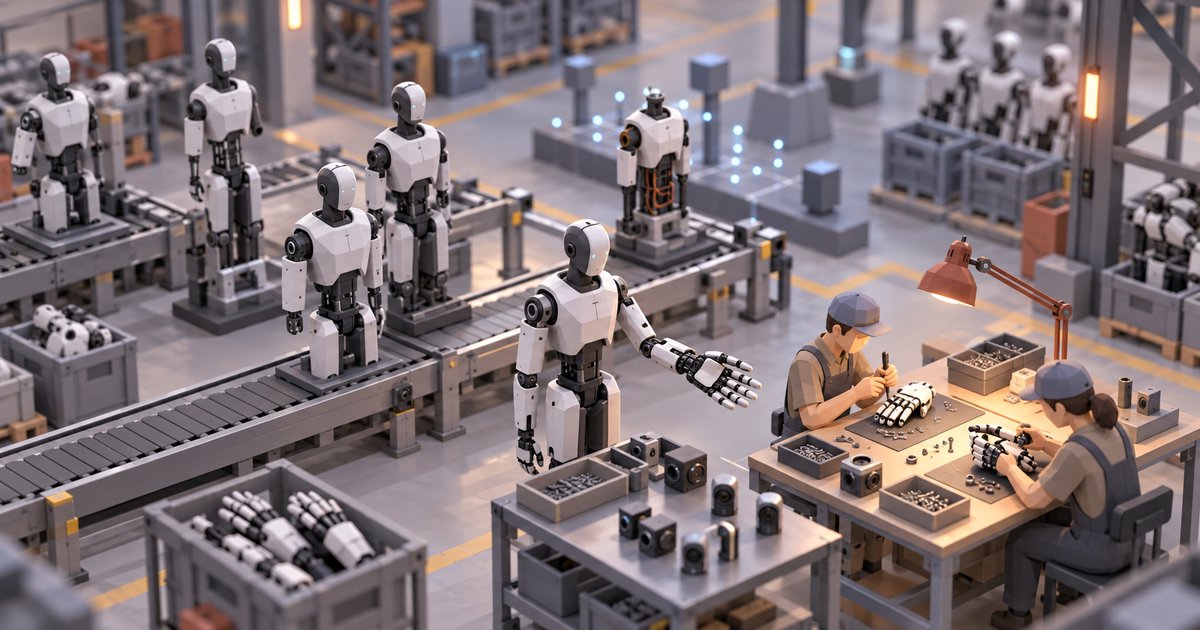
Tesla has taken Optimus production at Fremont from a few dozen units a week to several hundred, roughly a tenfold increase since the second quarter, according to a report in The Information summarised by Electrek on 25 September 2026. The robots coming off that line still cannot do a generalised job, and most of them are not doing any job at all.
The ramp
| Period | Build rate |
|---|---|
| Q2 2026, small-batch testing | a few dozen a week |
| August 2026 | several hundred a week |
| End-2026 target | more than 1,000 a week |
| Long-term goal | about 20,000 a week |
The end-of-year target depends on a continuous automated line that does not exist yet. The current one is not fully automated, and the reason is instructive.
The hands are the bottleneck
Each Optimus hand contains more than 100 screws and small components, and workers still assemble them by hand. The fixtures Tesla built for the job struggle to line up parts that are far smaller and held to tighter tolerances than anything on a car, so assemblies need rework.
Some of the touch sensors are unreliable. Tesla's answer is a replaceable "sensing glove" planned for next year — a design that accepts the sensors will fail and makes swapping them cheap, rather than making them last.
Suppliers are the other half of the problem. They can make good parts in prototype quantities and struggle to hold quality as volume rises. That is a recognisable stage for any new product, and it is the stage Tesla is in nine months after it expected to be past it. It is also why the company has been auditing prospective Chinese suppliers in Zhejiang.
Generalisation is the harder problem
Building the robot and making it useful are separate engineering problems, and Tesla has made much more progress on the first.
Optimus cannot reliably handle a wide range of tasks, and its behaviour is unpredictable in situations it has not been trained on. Learning even a basic task takes several days. A robot that needs days of training per task and behaves unpredictably outside it is a demonstration unit, not a worker — which is why most of the units built so far are used internally for testing, training and data collection rather than deployed on a line.
That is the metric to watch, and Tesla's own record on it is unflattering. In January 2025 Elon Musk predicted 10,000 robots built during that year, with several thousand doing useful work by the end of it. In January 2026 he acknowledged that no Optimus robots were doing useful work at Tesla.
What this means for a European Tesla owner
A tenfold production increase is real and it is not nothing. Tesla is now building the dedicated Optimus factory structure at Giga Texas, and the Gen 3 design that surfaced in the Android app looks like something meant to be manufactured rather than demonstrated.
But production rate is the easy number to move and the easy number to announce. The two figures that decide whether humanoid robots make money are generalisation and reliability, and on the evidence of this report neither has moved. XPeng is running into the same wall from the other direction.
Nothing here concerns a car you can buy, and no Optimus is going to appear in a European showroom or factory on this timetable. It matters for two indirect reasons. Optimus carries a large share of the valuation argument for Tesla, so what it can actually do feeds the share price that funds everything else. And the compute, data pipeline and training approach behind it are the same ones behind FSD — a system that does move unpredictably in situations it was not trained on is a familiar description to anyone following FSD's slow progress through European approval.