
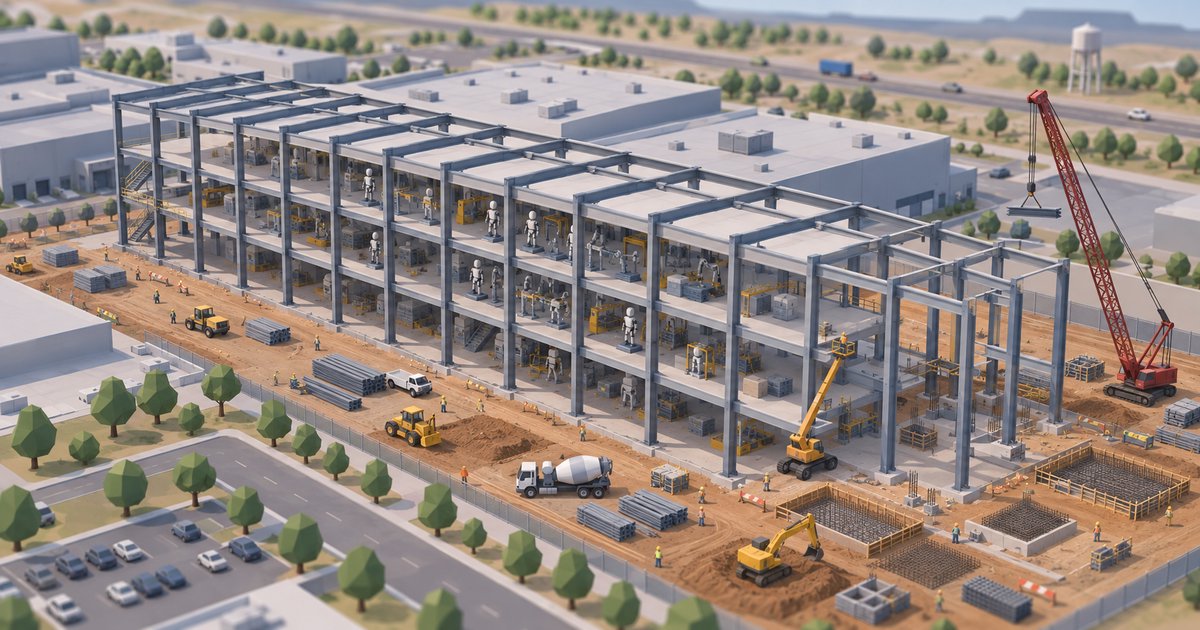
The building Tesla intends to build humanoid robots in now has most of a skeleton. Drone footage filmed over Giga Texas on 17 September 2026 by Joe Tegtmeyer shows the steel frame of the dedicated Optimus factory within about five column grids of closing its north perimeter beam, with concrete poured on three upper floors and rebar and foundation work continuing elsewhere on the site.
How fast it has gone up
| When | Stage |
|---|---|
| Late March 2026 | Ground broken |
| May 2026 | First steel installed |
| September 2026 | Frame near closure, three floors poured |
| Summer 2027 | Target for high-volume production |
Six months from bare ground to a nearly closed frame is quick for a structure of this size, and the size is the other half of the story. The building runs more than 1,200 metres alongside the existing vehicle factory — longer than the car plant, though considerably narrower — and forms part of a North Campus expansion of about 5.2 million square feet that also holds the Terafab chip operation Tesla is co-locating with SpaceX.
What the schedule actually says
Tesla's stated target is high-volume Optimus production at Giga Texas in summer 2027. Pilot Gen 3 units have been coming out of Fremont since January.
It is worth being precise about what is new here and what is not. The production date is not new; Tesla has given it before and has not revised it. Elon Musk's often-repeated ambition of eventually building up to 10 million units a year is not a plan with a date attached, and should be read as the ceiling he is describing rather than a schedule. Tesla has made no formal announcement of when the Texas building itself starts producing anything.
What is new is narrow and physical: on 17 September the frame was nearly closed, and it was not before.
Why construction progress is worth watching anyway
Because with Optimus, the gap between demonstration and manufacture is the whole question. A humanoid robot that works in a lab is an engineering result; one built at rate on a line is a product, and Tesla has spent two years describing the second while showing the first.
A factory is the least ambiguous signal available. It has a footprint, a steel schedule and a concrete pour, all of which can be photographed from a drone and none of which can be walked back in an earnings call. That is why XPeng getting a humanoid production line running first registered as a competitive event rather than a curiosity: the race that matters is to volume, not to a stage demo.
The caution is equally simple. A completed frame in September 2026 is consistent with production in summer 2027, but it does not confirm it — the equipment inside is the long pole, and none of it is visible from the air. The same campus is also building a chip plant that will run on gas rather than Tesla solar, a reminder that what Tesla builds and what Tesla says it will build are worth checking separately.