
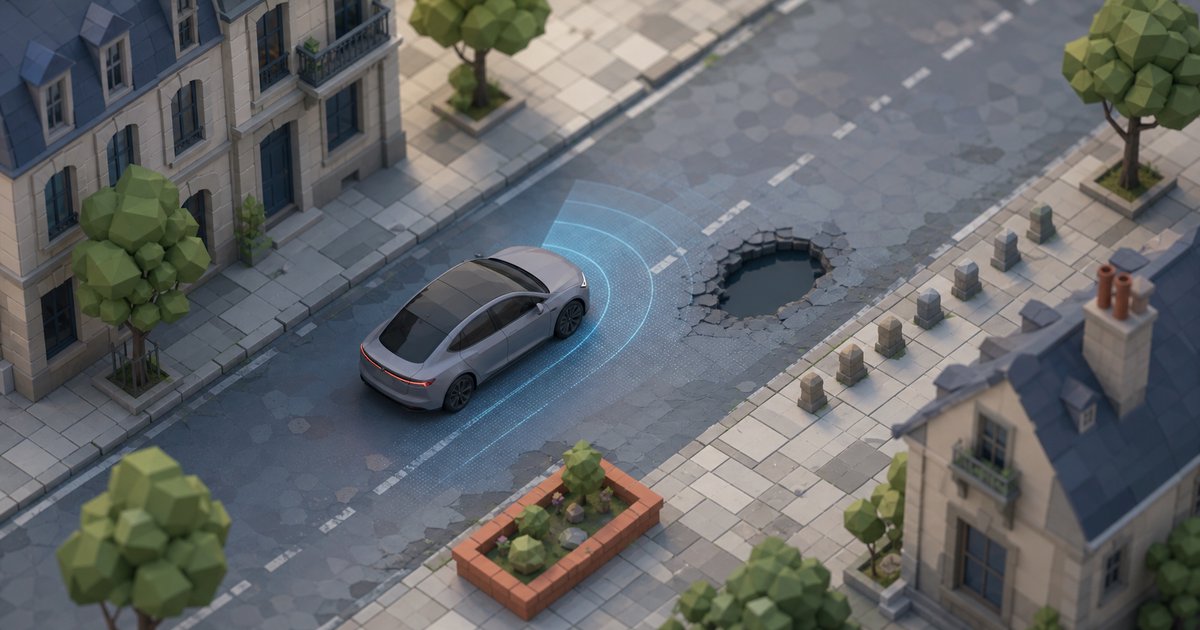
Elon Musk said over the weekend that the ability to avoid potholes on Full Self-Driving is "coming soon". Teslarati notes the feature has sat in the FSD v14 release notes as an upcoming improvement for some time. Electrek's response was to point out that he said the same thing in 2019.
He did. In April 2019, asked whether the car could "swerve the car where possible within a lane, to avoid small potholes to increase tire life", Musk answered "Definitely". In February 2020, the plan had become more specific: Autopilot would detect potholes and build mini-maps so that one car's encounter warned the rest of the fleet. By August 2020 Musk described the labelling work as under way, with cars to slow down or steer around.
Seven years later, pothole avoidance is listed as an "Upcoming Improvement" in the notes for current builds including v14.3.4 and v14.3.8, which is what "upcoming" means here: not present in the software owners have today.
What is actually promised
Two useful details are firm. No hardware upgrade is required, so the feature would reach the whole FSD-capable fleet rather than HW4 cars alone. And there is no date — "coming soon" is the whole of the timeline, from the same person who gave the same answer in 2019.
Treat the capability as unannounced rather than delayed. Tesla has published no specification for it: whether the car brakes, steers within the lane, or does both; whether it acts on what the cameras see in the moment or on mapped locations logged by other cars; and what happens when avoiding a pothole conflicts with holding a lane.
The credibility test is static obstacles
Pothole avoidance is a specific instance of a general problem, and FSD's record on that problem is documented and mixed. In August, FSD v14.1 Lite drove over a log at 32 mph, and another car missed a fallen tree three times. FSD is also still running level crossings, on video recorded on v14.3.7.
Those are large, high-contrast, stationary objects. A pothole is smaller, lower-contrast, and often full of water or shadow that makes it read as flat pavement. A vision-only stack that has trouble with a tree lying across a lane is being asked to resolve a 15-centimetre depression at speed. That is the harder version of the task, not the easier one.
Why this lands differently in Europe
Road surface quality is a live cost for European owners, and the bill is theirs. Pothole damage takes wheels and tyres first, and Tesla's own protection plans reprice on 1 October, with performance wheel-and-tyre cover up 50%.
There is also a fresh wrinkle. The base Model 3 in Europe just gained 38 km of official range from a low-rolling-resistance tyre, and efficiency-optimised tyres are not generally the most robust choice against impact damage. The car that would benefit most from pothole avoidance is the one now wearing the tyre most exposed to potholes.
Musk's 2019 framing was about tyre life, and on that reading the feature is aimed at a real and quantifiable owner cost. The gap between the promise and the release notes is what should set expectations: this is a stated intention with a seven-year record behind it, not a feature with a rollout. European owners should plan their wheel choices and their insurance on the roads as they are.
Tesla has not published a specification or a release date for pothole avoidance. This article reports statements by Elon Musk and an item in the FSD v14 release notes, neither of which constitutes a confirmed feature.
Update: 2026-10-03
On 1 October 2026 a second Tesla voice backed the promise this article is about. Replying to a driver who named broken asphalt and navigation routing as Full Self-Driving's two biggest remaining weaknesses, Tesla AI's Phil Duan wrote: "Improvements on both are coming." It is the first commitment to the pothole work from someone at Tesla other than Elon Musk, and it changes nothing about the timeline — still no version number and no date, six months after the item first appeared as an "Upcoming Improvement" in the v14.3 notes. The navigation half is new ground here: Tesla's Summer Update already shipped Preferred Routes, which biases routing towards roads the driver has actually driven rather than the path the car calculates as most efficient, and Duan's reply concedes it still needs work. Sources: Tesla says fixes on Full Self-Driving's two biggest issues are on the way, Tesla FSD to Get Navigation Improvements and Pothole Detection.