
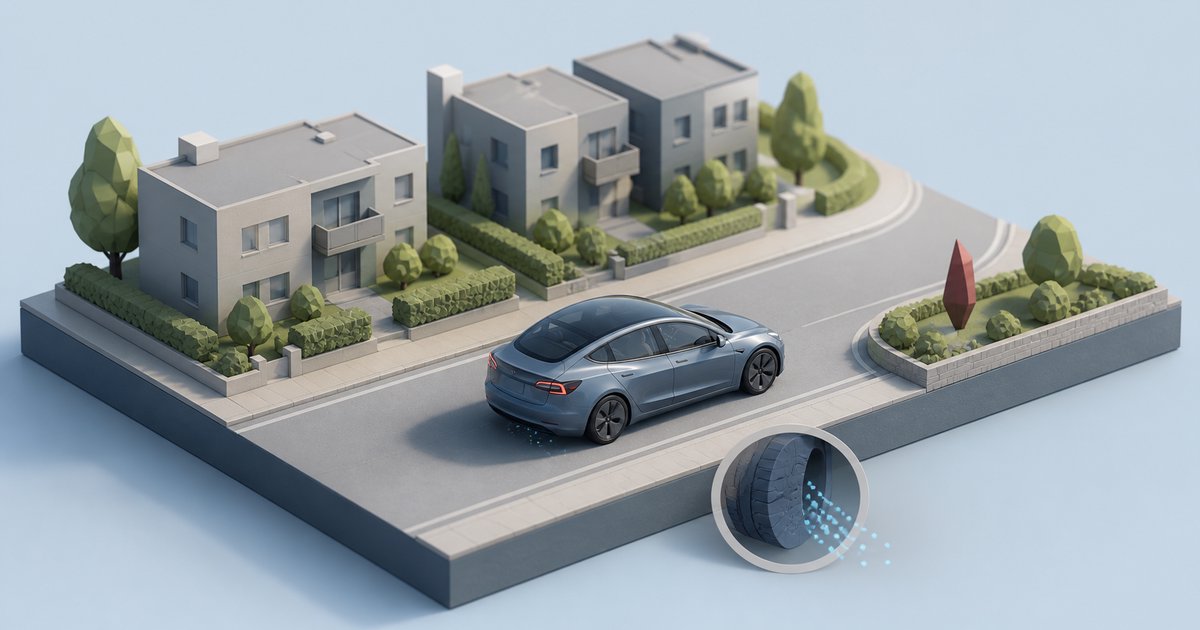
Tesla has raised the WLTP range of the entry rear-wheel-drive Model 3 from 534 to 572 kilometres. There is no new battery, no new motor and no software release behind it. The car gained 38 kilometres because it changed tyres.
The standard fitment is now a Giti tyre chosen for low rolling resistance, and the effect on the official figure is large enough to reorder the spec sheet. Rated consumption falls to roughly 12.1 kWh per 100 km — Schmidt's Blog gives 12.1, while Automobile Propre and Vaielettrico both list 12.2. Either way it is around 8.2 km per kWh, which is territory the base Model 3 did not previously occupy. The 0-100 km/h time is unchanged at 6.2 seconds.
The catch is the wheel
The gain is attached to the standard 18-inch wheel and its aero cover. Specify a larger wheel and the low-rolling-resistance advantage shrinks with it, so the 572 km figure describes exactly one configuration of the car — the cheapest one.
That is worth stating plainly because the upgrade path usually runs the other way. A buyer adding 19- or 20-inch wheels for looks is now trading away a documented 38 km of official range rather than the smaller penalty the previous tyre implied.
Why a tyre swap moves the number this much
Rolling resistance is one of the two forces a car fights at steady speed, and it dominates at the moderate speeds the WLTP cycle spends most of its time at. Aerodynamics dominates at motorway pace; rolling resistance dominates below it. A tyre compound and tread pattern optimised for the former can shift a WLTP result several percent without touching anything else in the car.
This is a familiar lever for Tesla, which has used aero covers, tyre specification and thermal management to move official numbers before. What is unusual is the size of the step — 7% more range from a consumable part.
What it means for European buyers
For anyone cross-shopping in Europe, the base Model 3 now claims a range figure that used to require moving up a variant. The list price did not move with it: Automobile Propre quotes €36,990 in France before incentives, Vaielettrico €37,976 in Italy.
Two caveats belong on the same page. First, WLTP is a laboratory cycle, and a tyre-driven gain measured there will show up in real driving as something smaller, concentrated in town and secondary-road use rather than on the motorway. Second, the figure follows the tyre, not the badge: fitting replacement rubber at the end of the tyre's life without matching the original specification hands the 38 km back. That is a running-cost consideration owners of this car will meet in three or four years, and it is not obvious from the configurator.
The Model Y's new interior is not new
Alongside the Model 3 change, Automobile Propre reports a Zen Grey cabin arriving as a €1,200 option on the Model Y Premium, replacing the previous white, and covering seats, centre console, doors and dashboard trim.
European buyers are seeing it for the first time, but the colour itself dates to April 2026, when NotATeslaApp reported that Gigafactory Shanghai had discontinued the black-and-white cabin on Model Y Premium trims and replaced it with Zen Grey for export markets including Australia, New Zealand, South Korea and Japan. It is a Shanghai decision reaching Europe on a delay, not a new design direction.
Update: 2026-08-30
On 29 August 2026, NotATeslaApp reported that the gain comes from a complete wheel-and-tyre package rather than rubber alone: Tesla has replaced the Model 3 RWD's 18-inch Photon wheels with a new 18-inch Prismata design carrying the low-rolling-resistance tyre. Polish outlet Elektrowoz identifies that tyre as the GitiControl P10, an asymmetric summer tyre Giti also sells in the car's 235/45 R18 size — the specification to match when the originals wear out. The upgrade is confined to left-hand-drive Europe: configurators in the United Kingdom and Ireland still list the Photon wheel and the older 534 km (332-mile) rating.