
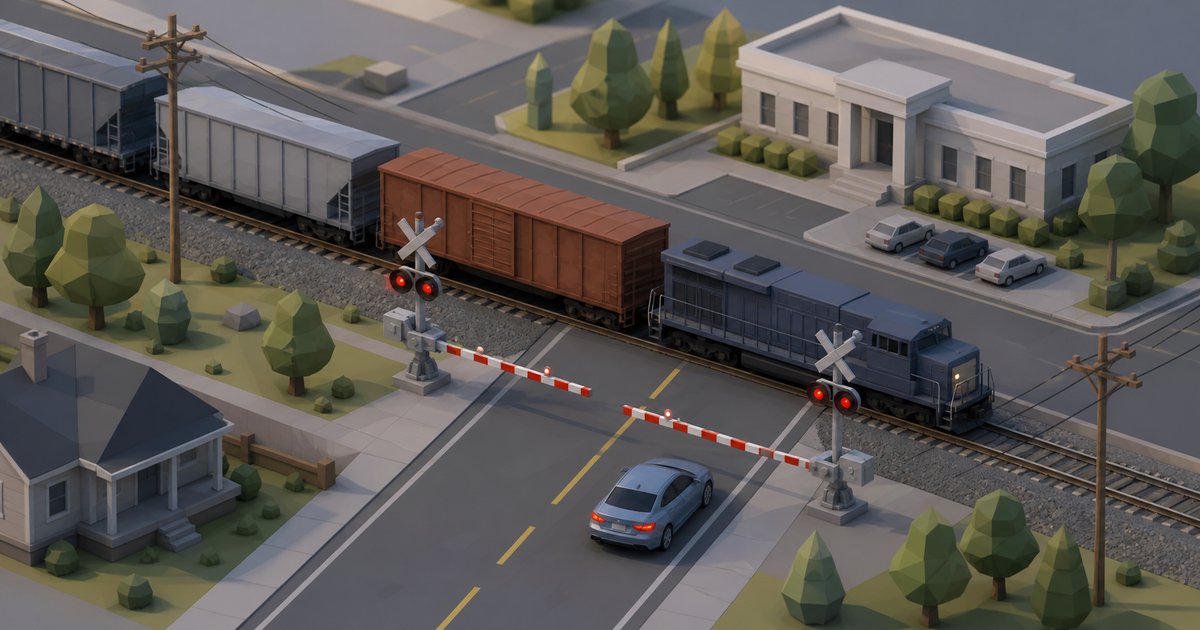
Railroad crossings have become the clearest recurring failure mode in Tesla's Full Self-Driving, and the latest documented case was recorded on the newest build the company ships.
NBC News, whose reporting Electrek summarised this week, found more than 40 separate accounts of Teslas on FSD mishandling level crossings. Reporters interviewed six owners who had experienced one, four of whom supplied video.
What the record actually contains
The incidents are not near-misses of the ambiguous kind.
In March 2026, a Tesla on FSD drove straight through lowered crossing barriers in West Covina, California, making no attempt to brake until after impact. A month later, a Texas owner's car crashed through a crossing gate seconds ahead of an oncoming train; he floored the accelerator to clear the tracks, and the descending arm struck his window. In 2025, a Tesla in Pennsylvania was struck by a train after turning onto the tracks.
The most recent case is the one that matters most for anyone assessing progress. In August 2026, Lei Xing recorded his car approaching an active crossing on FSD v14.3.7 — the newest release — without stopping. Manual braking prevented it.
That is worth stating carefully, because release notes invite the wrong reading. The v14.3 branch notes claim improved handling of "rare and unusual objects extending, hanging, or leaning into vehicle path" — language that plainly describes a lowered crossing gate. Those notes are carried forward across point releases, so they are not a claim about 14.3.7 specifically. But they do establish that Tesla considered the category, and the failure recurred anyway.
What the regulator is doing
NHTSA opened its FSD investigation in October 2025 after 58 reported crashes involving cars running red lights or driving into oncoming traffic. In March 2026 it upgraded the probe to cover roughly 2.9 million FSD-equipped vehicles — an engineering analysis, which is the step immediately before an agency can demand a recall. NHTSA has since said it will examine railroad crossings as part of that work.
The political pressure predates it. Senators Ed Markey and Richard Blumenthal wrote to NHTSA administrator Jonathan Morrison in September 2025 asking specifically for a level-crossing investigation, and have kept at the agency since — including demanding Tesla's internal documents about how its safety claims are constructed.
Why this lands differently in Europe
No European driver can buy this. FSD (Supervised) is not approved for European roads, and Germany's KBA is still weighing it, with autobahn speeds the publicly-known sticking point.
A repeatable failure at a fixed piece of signalled infrastructure is exactly the kind of evidence a type-approval authority can act on, because it is not a judgement call about driving style. A crossing barrier is either detected or it is not. Every month this stays in the American record is a month it is available to any regulator looking for a reason to wait — and it sits awkwardly beside Tesla's own pitch that FSD v15 will be a step-change.
If you drive with FSD
The system is supervised, and the naming does not change that. Treat a level crossing the way you would treat a school zone or a construction lane: hands on the wheel, foot ready, no phone. The recorded cases have one thing in common — the driver who intervened in time was the only reason there was no collision.