
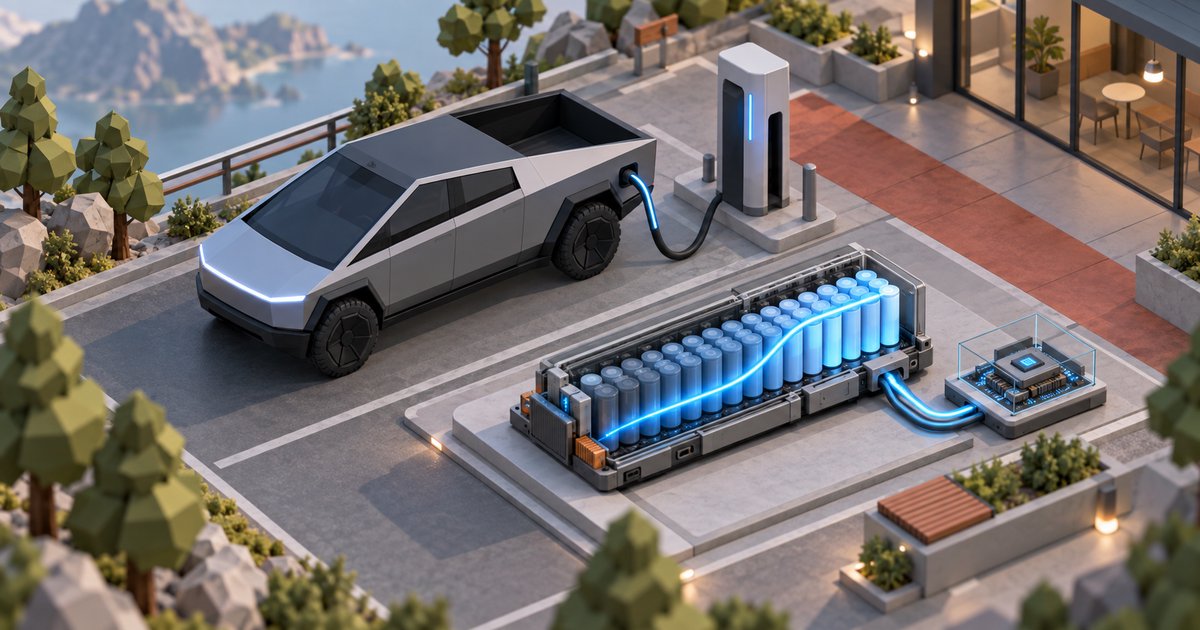
Wes Morrill, the Cybertruck's lead engineer, has been posting a running list of changes Tesla has made to the truck since production started in late 2023. On 13 September 2026 he added charging to it.
"In-house 4680 cells got better, several times actually," he wrote. "And the firmware controls improved as well — both enabled faster Supercharging. Hitting 500kW peak and more importantly shrinking the 10% to 80% charge times by several minutes."
What is new here, and what is not
The 500 kW figure is the part being quoted in headlines, and it is the part that is not news. Morrill announced a 500 kW peak for the Cybertruck in November 2024, describing it as a consequence of the truck's 800-volt architecture once Tesla's V4 Supercharger cabinets arrived. It has been the truck's published ceiling ever since.
What he is claiming now is different and more useful: that the cells and the software controlling them have improved enough to change the shape of the curve, not its peak. A peak is a number a car touches briefly. The 10-80% time is what a driver actually waits.
Two mechanisms, two different sets of owners
Morrill named two causes, and they do not reach the same trucks.
- The cells. Tesla's in-house 4680 has been revised more than once, with better thermal behaviour and a higher tolerance for sustained current. Cell improvements go into trucks as they are built. An existing Cybertruck cannot acquire them.
- The firmware. The control logic that decides how hard to push the pack at a given temperature and state of charge has been refined too, and that ships over the air. This part does reach the existing fleet.
So owners of early trucks should get some of the gain and not all of it, and Tesla has not said how the total splits between the two. That distinction gets lost when the improvement is reported as a single number.
What Tesla did not publish
No before-and-after 10-80% times. No figure for how much longer the truck now holds near its peak. "Several minutes" is Morrill's own sizing and it is the only one on offer — the same pattern as the switch from an aluminium underbody shield to self-reinforcing polypropylene he confirmed a week earlier, where the gains in mass, cost and drag were all described and none were quantified.
This is how Cybertruck hardware changes surface. There are no release notes for them. They appear when somebody photographs a part or an engineer answers a question, which makes the claims hard to check independently.
For European readers
The Cybertruck is still not homologated for EU roads and cannot be registered here, so no European owner is affected directly.
The 4680 cell is the part worth following. It is not a Cybertruck-only component — it is Tesla's own cell programme, the one that also feeds Model Y production and that began using lithium refined at Tesla's Texas refinery this month. A cell that tolerates more sustained current without overheating is a faster charge for whatever it is fitted to. Tesla has not said whether these revisions have reached cars sold in Europe, and until it does, that remains an inference rather than a promise.