
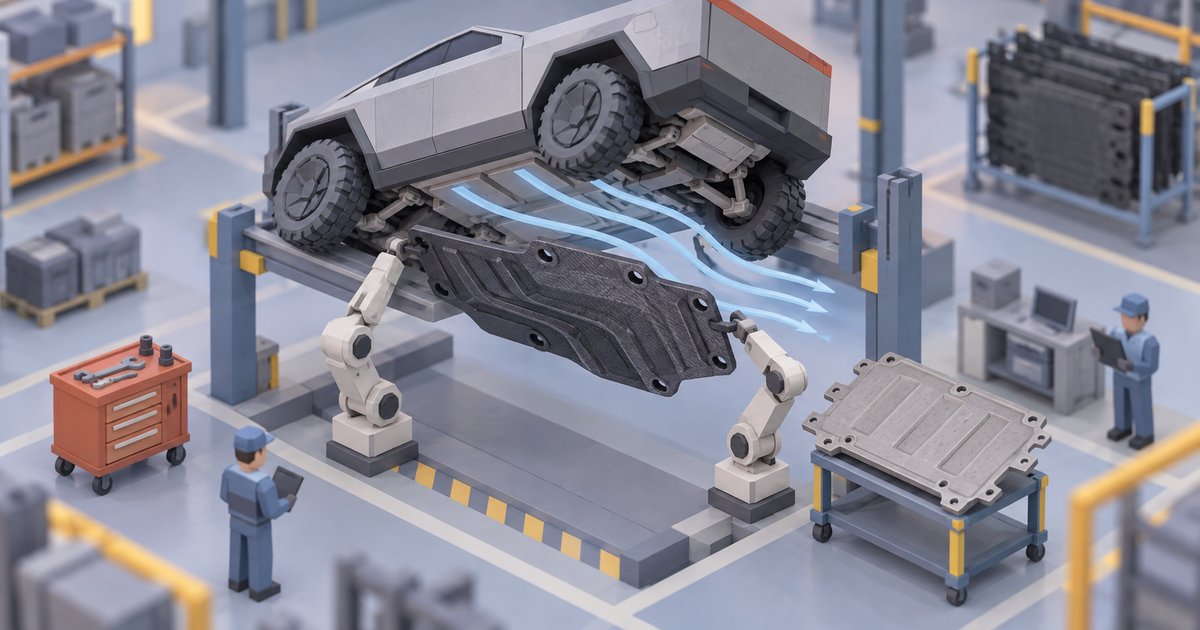
Tesla has changed what the underside of the Cybertruck is made of. The new aero shield is not aluminium and, despite what a lot of people assumed when they first saw it, it is not carbon fibre either. It is polypropylene — the same family of plastic used for bumper covers and battery cases — stretched into fibres and then laminated into shape.
The change surfaced the way most Cybertruck details do. A photographer posted underbody shots comparing one of the latest trucks with one of the earliest, spotted that the panel looked different, and Wes Morrill, the truck's lead engineer, confirmed it on X on 7 September 2026.
What actually changed
The original shield was stamped aluminium. The replacement is self-reinforcing polypropylene: the plastic is drawn out into fibres, then those fibres are laminated into the finished form. The reinforcement comes from the material's own oriented fibres rather than from glass or carbon added to it, which is where the "self-reinforcing" name comes from and why the black weave reads as carbon fibre in photographs.
Morrill said testing showed the new part to be more durable than the aluminium it replaces, while being both lighter and cheaper. He also described a "slight efficiency improvement", and attributed it to manufacturing rather than to the material: laminating the form allows better shaping around the bolts and edges than stamped aluminium allowed, which keeps airflow under the truck cleaner. Tesla has separately been credited with cutting wind noise at the knuckle for front passengers as part of the same work.
Four claimed gains, then, from one substitution: durability, mass, cost and drag. That combination is unusual — material changes normally trade one against another.
The numbers Tesla has not given
None of it is quantified. There is no published figure for the weight saved, the cost saved, or how much the drag coefficient moved. "Slight" is Morrill's own word for the efficiency gain, and it is the only sizing anyone has offered.
There is also no date. Tesla has not said which build week the new shield entered production, and the comparison that started the discussion was simply a recent truck against an early one. Anyone trying to work out whether a particular Cybertruck has it will have to look underneath.
Why a shield is worth reporting
Because it is evidence of how the Cybertruck is being built rather than sold. Morrill's framing was that the product is "a living thing, constantly evolving and improving", and he noted that some changes have yet to be revealed. Tesla ships these quietly, with no release notes, so they surface only when someone photographs a part.
It also fits a run of Cybertruck manufacturing changes that have nothing to do with features. Tesla began building trucks with 4680 cells using lithium it refined itself in Texas this month, and in August it raised US prices by $5,000 with no spec changes at all. Cost coming out of the underbody is the other half of that picture.
Nothing for European owners
The Cybertruck is still not homologated for EU roads and has no confirmed European launch date, so this is a US-market change to a truck Europeans cannot legally buy or register — as UK police demonstrated when they seized an imported one in June.
The transferable part is the method, not the panel. A self-reinforcing polypropylene process that is cheaper and lighter than stamped aluminium is not Cybertruck-specific, and the underbody of a Model Y is a far larger addressable area than the underbody of a truck Tesla sells in one region.