
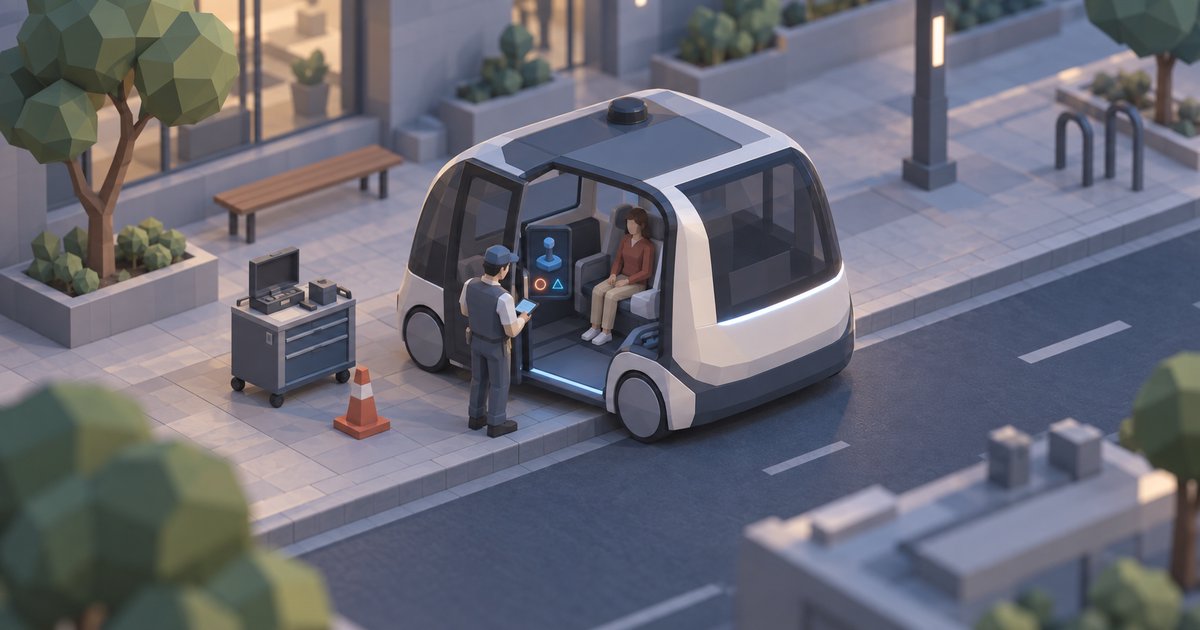
The Cybercab has no steering wheel and no pedals. On 7 September 2026 a rider found out how Tesla drives one anyway.
During a paid robotaxi ride in Austin, the cabin display briefly switched into a configuration it was never meant to show a passenger. Rider and entrepreneur Matthew Skrzypczak captured it, and at least one other rider reported the same thing the same day: a developer interface, left open, with a virtual joystick on it.
What the interface does
The controls are simple, and clearly built for someone standing over the car rather than driving it.
| Control | Function |
|---|---|
| Circular on-screen joystick | Steering angle; slide left and right to turn |
| Tap-and-hold, slide up or down | Forward and reverse throttle |
| Dedicated button | Apply the brake |
| Dedicated button | Horn |
| Dedicated button | Close the cabin doors |
The manual mode appears to be limited to speeds below 8 mph — about 13 km/h. That ceiling is the detail that tells you what it is for. This is not a way to drive a Cybercab home. It is a way for a service technician or a validation tester to shunt one onto a ramp, out of a bay, or off a transporter.
Why a car with no wheel still needs a way to be pushed
Every vehicle has to be movable by a human at some point: loaded onto a recovery truck, moved around a workshop, repositioned in a depot, pulled out of the way after a fault. A conventional car solves this by having a steering wheel. A car built without one has to solve it in software, and Tesla has.
Nothing about this was announced. Tesla has not commented, the screen is not meant for public access, and by every account it appeared because of a software glitch rather than a deliberate reveal. That is worth stating plainly: this is a look at an internal tool, not a feature.
The regulatory question, in the US and in Europe
The interesting part is not the joystick. It is that the joystick exists at all, because a control interface is exactly the kind of thing type approval cares about.
US regulators are already asking. TeslAnt covered NHTSA's audit query into how the Cybercab was certified against federal vehicle safety standards — standards written on the assumption that a car has a driver's seat, a wheel and pedals. Europe's framework makes the same assumption, and the Cybercab's first European ride is still gated behind the FSD approval vote scheduled for 6 October.
A low-speed manual mode does not satisfy a requirement for driver controls, and it would be a mistake to read it as Tesla's answer to one. A regulator asking whether a vehicle can be controlled by a human is asking about normal road speeds, not about 8 mph in a workshop.
But it does show Tesla has thought about the case where the autonomy is not in charge, and has built something for it. For a European reader, that is the useful takeaway from a glitch: the wheel-less car is not quite as wheel-less as the photographs suggest, and what fills the gap is a touchscreen control that Tesla has so far not chosen to talk about.