
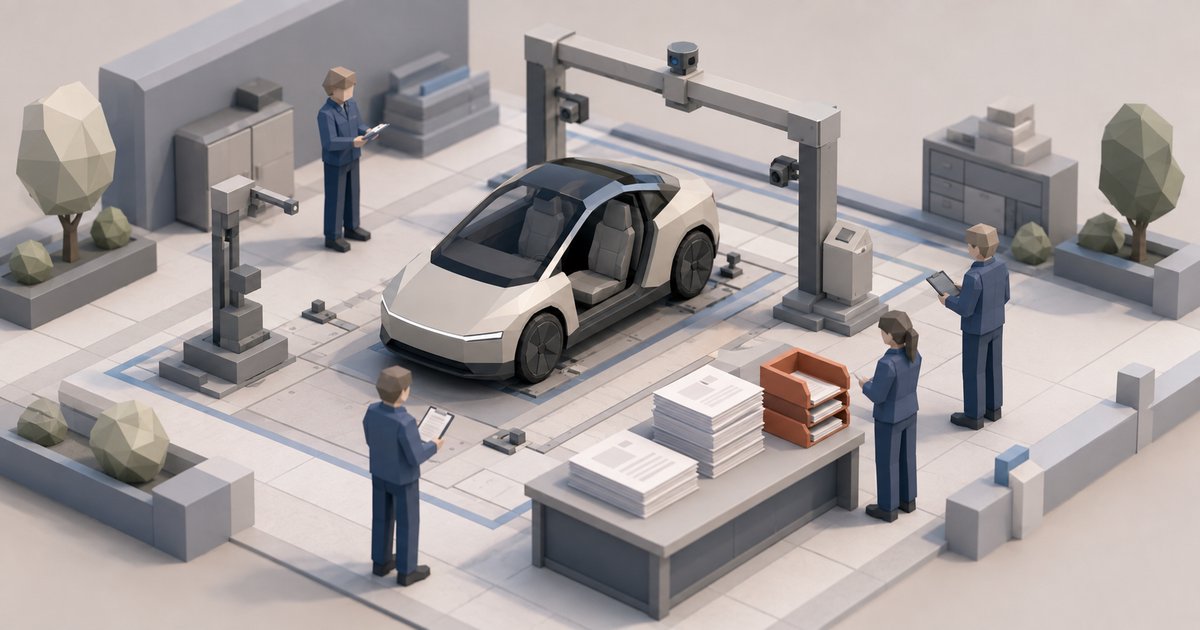
Tesla began carrying paying passengers in the Cybercab in Austin on 3 September. The same day, the US federal safety regulator opened a file on how the car was ever certified road-legal.
What NHTSA actually opened
NHTSA's Office of Defects Investigation opened Audit Query AQ26002 on 3 September 2026, covering an estimated 1,000 Cybercab vehicles. The agency said it would "examine the process and technical data on which Tesla relied when certifying the Cybercab and related issues", and that it would consider the extent to which Tesla's certification depended on determinations that certain Federal Motor Vehicle Safety Standards are inapplicable to the vehicle.
That final clause is the substance. The question is not whether the Cybercab passed the standards. It is whether Tesla was entitled to decide that some of them do not apply to it.
| Detail | Value |
|---|---|
| Designation | AQ26002 |
| Opened | 3 September 2026 |
| Office | NHTSA Office of Defects Investigation |
| Vehicles covered | ~1,000 Cybercabs |
| Subject | Tesla's FMVSS certification process and technical data |
Why self-certification makes this possible
The United States has no pre-market type-approval. A manufacturer certifies its own compliance with the FMVSS, attaches the label, and sells the car; NHTSA audits afterwards. Tesla told the agency it had self-certified the Cybercab as compliant with all applicable standards.
The Cybercab has no steering wheel, no brake pedal, no accelerator pedal and no mirrors. A large number of the FMVSS were drafted on the assumption that those parts exist — standards covering controls and displays, mirrors, and the behaviour of steering and braking systems all have text that presupposes a driver operating them. Tesla's position is that where a part is absent, the standard governing it has nothing to bite on. NHTSA has now asked to see the reasoning and the data behind that.
This is an audit, not a defect probe
Worth being precise about, because the two get conflated. An audit query examines a manufacturer's process and records. It is not a preliminary evaluation of an alleged defect: no crash, injury or field complaint triggered this one. Nothing about the Cybercab has been found unsafe, and NHTSA has not asked Tesla to stop.
What it can produce is a finding that the vehicle was not lawfully certified — which is a paperwork problem with heavy consequences, since a vehicle that fails to meet an applicable standard is subject to recall regardless of whether it has ever misbehaved.
Tesla has form here in the opposite direction: NHTSA denied the company's door-release defect petition in July while opening an industry-wide rulemaking, a reminder that the agency separates the specific vehicle from the general rule.
What a European reader should take from it
Europe cannot run this experiment. There is no self-certification: a vehicle needs type-approval granted by an authority before it may be sold, and a fully driverless vehicle needs approval under the EU's automated driving system framework rather than a manufacturer's own judgement about which rules are relevant.
That is the real reason the Cybercab is in service in Austin and nowhere near Europe. Tesla could put 45 cars on the Texas robotaxi register in a single day because Texas asks for a registration, not an approval. The audit query is the bill for that speed arriving four days later.