
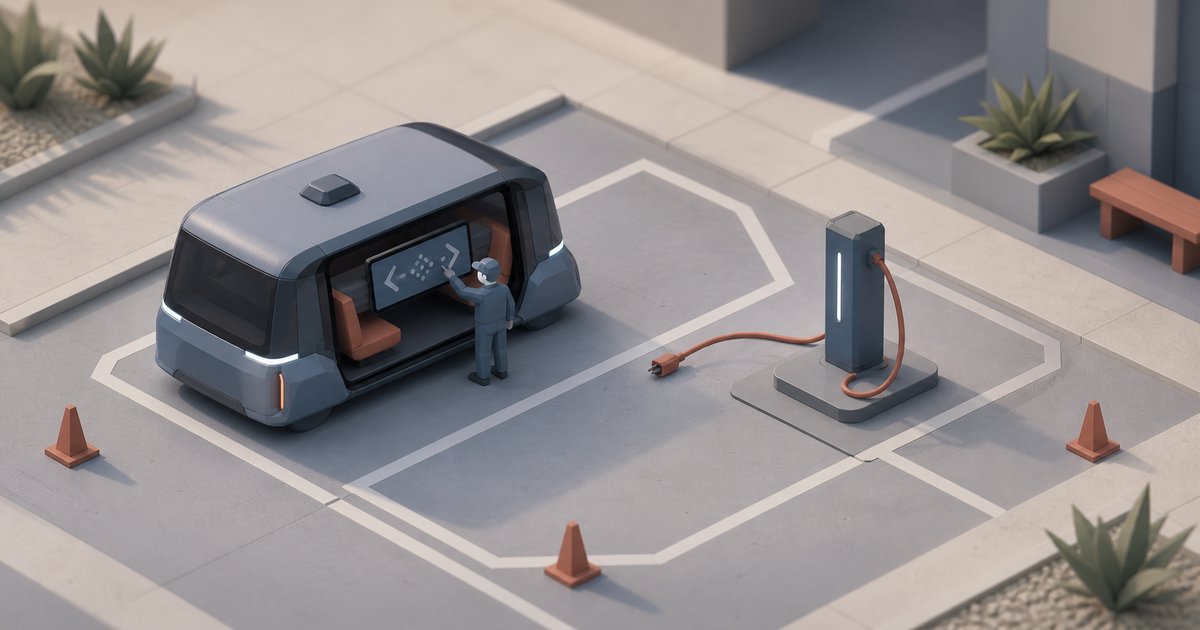
Build a car with no steering wheel and no pedals and you inherit a mundane problem: what happens when the car parks itself badly and someone has to move it three feet? Video from Austin appears to show Tesla's answer, and it is a set of buttons on the touchscreen.
What the footage shows
Videos posted to X by @barrygoodstocks on 30 August 2026 show a production Cybercab at a Supercharger station in Austin, Texas. While testing automated parking, the car ended up angled slightly too far from the stall for the charging cable to reach.
A test engineer sitting inside then used manual drive controls displayed directly on the central touchscreen — holding down on-screen directional buttons — to pull the car out of the stall, reposition it, and back into a better spot.
| Detail | What is shown |
|---|---|
| Vehicle | Production Cybercab, no steering wheel or pedals |
| Location | Supercharger station, Austin, Texas |
| Trigger | Automated parking left the car out of cable reach |
| Control method | Held on-screen directional buttons on the centre display |
| Manoeuvre | Exit stall, reposition, reverse back in |
Tesla has not commented on the footage, and the reporting does not establish the exact button layout, the speed limit imposed on the mode, or who is permitted to use it. Treat the mechanism as evidence and the interpretation as inference.
Why this is not a small detail
Every autonomous vehicle programme has to answer this. A car without controls still has to be moved by a person at some point — out of a workshop bay, off a recovery truck, away from a blocked stall, or clear of a scene an emergency responder is managing.
Waymo handles it with remote assistance and roadside staff. Zoox, whose vehicle also has no controls, published a safety case built around that constraint. Tesla's approach here looks deliberately simple: put the controls where the car already has a screen, and skip the plug-in tether or handheld controller other programmes use.
It also joins the operator-facing tooling already spotted on Cybercabs testing in Austin. The same fleet has been photographed running an operator interface with a "Roaming" state and Rodeo feedback buttons — a build clearly aimed at staff rather than passengers, of which on-screen driving is now another part.
The context is the timing. The clips were captured days before Tesla's Cybercab launch event on 3 September in Austin, during the same pre-launch push in which Tesla put 45 Cybercabs onto the Texas robotaxi register in a single day.
And the specific failure that prompted it is worth noting rather than skipping past. The car was not stuck in traffic or facing an edge case on public roads. It mis-parked at a charger, on Tesla's own site, badly enough that a human had to intervene — which is a reminder of how much of a driverless fleet's real work is the unglamorous business of docking, charging and repositioning.
Why a European owner should care
The Cybercab is not coming to Europe soon; FSD (Supervised) is not yet approved bloc-wide, and the Article 39 vote that could change that falls on 6 October. What transfers is the design question European type-approval authorities will eventually put to Tesla: how a vehicle with no manual controls is moved, recovered and made safe by a human who needs to. Austin has now shown one answer, and it is a screen.
Update: 2026-09-08
On 7 September 2026 a Cybercab passenger in Austin, X user Matthew Skrzypczak, got a clear look at this interface, and it corrects the mechanism described above. The control is a circular virtual joystick on the left of the display, worked by tap and drag: up and down for throttle and reverse, left and right for steering, with separate on-screen buttons for braking, the horn and the doors. It is not the set of held directional buttons the August footage suggested. It appeared only because the car failed to revert to passenger mode after a software glitch, and Tesla's backend held the line: the screen tracked his touches, but the drive motors never engaged and the car did not move. Sources: Not a Tesla App, Electrek.