
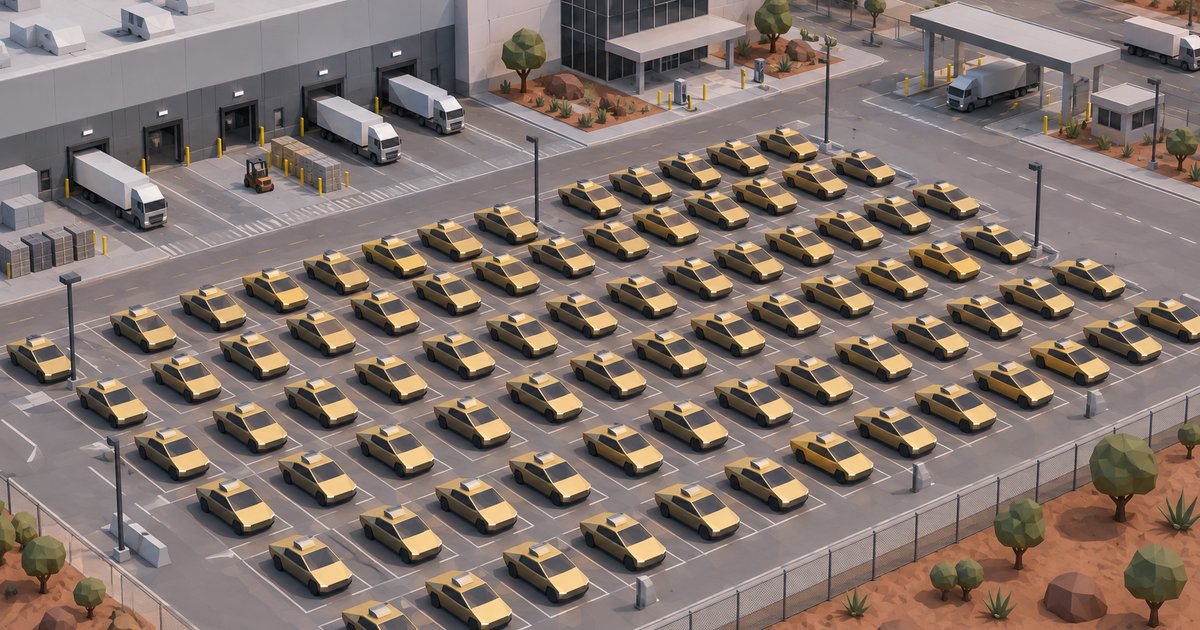
Tesla's outbound lot at Gigafactory Texas filled up on Tuesday with something that had previously been seen on exactly one car. Drone photographer Joe Tegtmeyer, who flies the Austin site regularly, reported Cybercabs parked there "for the 1st time equipped with the Starlink module ... on the hatch in big numbers", alongside hundreds of Model Y L units, as production came back up after the US Labor Day weekend.
What is actually new
Not Starlink on a Cybercab. TeslAnt covered the first Starlink-equipped Cybercab filmed on public roads in August, and Tesla's confirmation that the car would carry a built-in terminal in July. Both concerned a single gold car.
What changed on 8 September is the count. A module on one prototype is an experiment; a module across an outbound lot is a fitment decision. The photographs show the hardware sitting flush in the hatch rather than bolted on top, which is what points to factory installation rather than retrofit.
The limits of that inference matter. It rests on aerial photographs of parked cars. Tesla has said nothing, has not described any tooling or die change, and has not called Starlink standard equipment. Nobody has counted the cars either — "big numbers" is an observer's phrase, not a figure.
The streaming headline is the older story
Several outlets led on 4K streaming and high-bandwidth gaming. Those are Musk's pitches from July and August rather than new claims, and they describe what a passenger gets.
The operational case is the one that would explain a production change. Head of AI Ashok Elluswamy has framed the satellite link as constant connectivity between Tesla and the fleet, so that a rider in a breakdown or a collision can reach support. A car with no steering wheel has no fallback driver, so the connection is the fallback. Read that way, fitting every car is the point, and an outbound lot full of modules is what that looks like.
Worth repeating what it is not: the Cybercab drives on its onboard AI4 computer and needs no internet connection to drive. Starlink is redundancy and service, not autonomy.
The hardware that makes it fit
| Starlink V5 terminal | Figure |
|---|---|
| Download speed | above 375 Mbps |
| Mass | 1.1 kg |
| Size vs V4 | 35% smaller |
| Weight vs V4 | 62% lighter |
| Wind rating | 265 km/h |
Those numbers are why a roof-integrated terminal is plausible at all. A V4-sized dish on a two-seater would have been both a styling and an efficiency problem.
Why a European reader should care
Not because a European Cybercab is close — it is not, and none has been announced. The transferable part is the fitment itself. Tesla has now apparently put a satellite terminal into a production roofline at volume, and has said the Cybercab is the first of several vehicles to use the link.
Europe is where that would bite hardest. Alpine passes, Nordic trunk roads and the long empty stretches of Iberia are exactly where navigation re-routing, live Supercharger occupancy and streaming drop out today. Nothing is committed: no model, no market, no date. Treat lineup-wide Starlink as a direction of travel that just got one step more credible.