
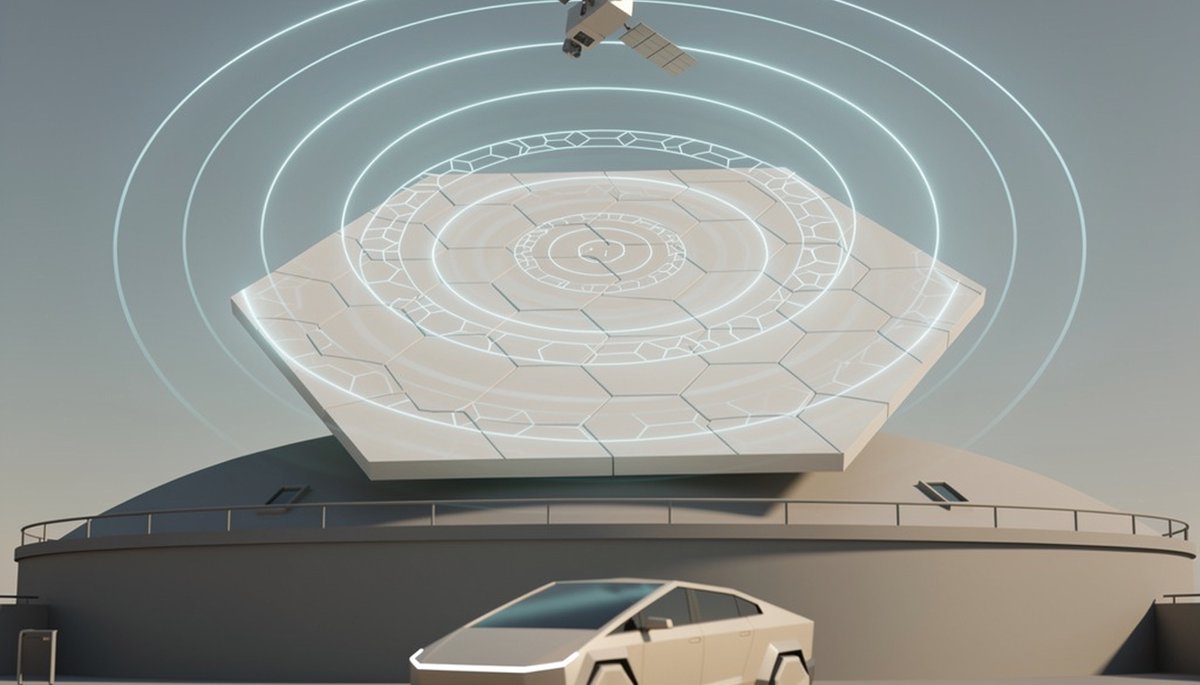
Tesla has confirmed that the Cybercab, its purpose-built two-seat robotaxi, will be the first Tesla to ship with an integrated Starlink antenna — putting a direct satellite link inside a production car for the first time. The reveal began as an infographic on a full-scale Cybercab display at Tesla's Santana Row showroom in San Jose, and was upgraded to an official confirmation on 20 July 2026 that the car uses SpaceX's compact Starlink V5 hardware.
What Tesla revealed
The showroom display shows the Starlink unit mounted in the rear of the vehicle, just behind the passenger compartment, with the compact V5 satellite setup embedded into the roof structure. That placement matches earlier sightings of Starlink antennas fitted to Cybercab prototypes during testing, so the production design appears to carry the feature over rather than treat it as a concept.
Unlike a bolt-on rooftop dish, the antenna is built into the car's body, sitting alongside the Full Self-Driving computer and the external camera suite as standard hardware rather than an accessory.
Why a robotaxi needs its own satellite link
For a driverless vehicle, connectivity is not a convenience feature — it is part of the safety case. A Cybercab with no steering wheel or pedals depends on a reliable data link far more than a normal car does. Starlink addresses several needs at once:
- Coverage in dead zones. Satellite connectivity keeps the car online where cellular networks are weak or absent, so a robotaxi does not lose its link mid-trip on a rural road or in a signal-starved underpass.
- Faster fleet updates. High-bandwidth links make it easier to push over-the-air software across a large, distributed robotaxi fleet.
- Remote oversight. When the car meets an edge case it cannot resolve on its own, a stable connection lets a remote human operator step in — a capability regulators increasingly expect from driverless services.
- Sharper positioning. The link can support more precise GPS positioning to complement the car's onboard sensors.
What it means for Europe
The direct European relevance is limited for now. The Cybercab is a robotaxi aimed first at Tesla's US ride-hailing ambitions, and neither the vehicle nor a driverless commercial service has a confirmed European launch — the regulatory path for autonomy in the EU remains far slower than in parts of the US.
The longer-term signal is more interesting. If Tesla is willing to embed Starlink as standard hardware in one model, the same connectivity could eventually reach consumer cars, where satellite backup would help in exactly the kind of rural and mountainous areas where European owners lose signal today. For now, though, the Cybercab's satellite link is a robotaxi feature first — a marker of where Tesla's autonomy hardware is heading rather than something European drivers will use soon.
Update: 2026-08-10
On 10 August 2026, Tesla's @robotaxi account posted the first photographs of a Cybercab with the Starlink antenna actually fitted — a gold car at Gigafactory Texas, shown from the front three-quarter and from the rear, captioned "First Cybercab with @Starlink integration." The July material was a cutaway rendering and a showroom infographic rather than a finished car, so this is the first look at the hardware in the metal: a low-profile unit integrated into the roof rather than bolted on. Tesla has still published no antenna specification, no functional description and no timeline. Worth keeping in view alongside it — the Cybercab's onboard AI4 computer drives without an internet connection, and current robotaxi operations run in dense urban areas with strong cellular coverage, so the satellite link remains provisioning for conditions the fleet does not yet work in.
Update: 2026-08-15
On 9 August 2026 Musk answered the question this article left open, posting on X that "All cars will have Starlink in the future. It's the only way to get super high bandwidth to billions of vehicles." Read it as a statement of intent about the industry rather than a Tesla product commitment: no model, no timeline and no price has followed it. Two details have firmed up alongside it. The Cybercab pairs its satellite link with 5G cellular hardware rather than replacing it, the two covering for each other through coverage gaps. And the Starlink V5 terminal measures 384 x 306 mm, weighs about 1.1 kg and draws 35-50 W — 48% smaller by area and 62% lighter than the V4, on roughly half the power. That shrinkage is what makes fitting one to an ordinary car arguable at all. Source: Not a Tesla App.