
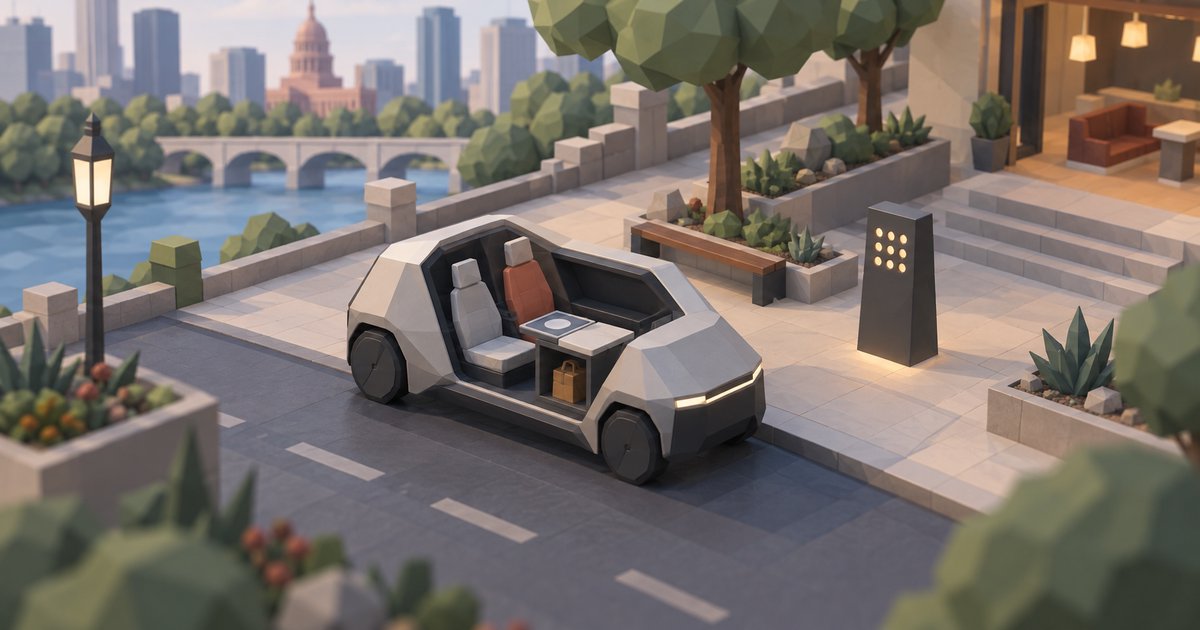
Tesla put the Cybercab into public service in Austin at the start of September. Within days it began asking passengers what the car should have had.
Riders who have taken a trip are receiving an email headed "Take Our Survey", and the second half of it reads less like customer service than like a specification review.
What it asks
The first section is conventional feedback, graded on a five-star scale: vehicle availability and wait times, door functionality, centre touchscreen responsiveness, mobile app performance, seat comfort, interior space, overall ride comfort, cabin cleanliness and cargo capacity. It closes with an overall satisfaction score and a Net Promoter Score question.
Then it asks riders to choose up to three features they would like added.
| Feature offered | On the Cybercab today |
|---|---|
| Heated seats | No |
| Ventilated seats | No |
| Fully reclining seats | No |
| Tray table | No |
| Wireless phone charger | No — USB-C only |
| Better sound system | Fitted; riders asked to rate it |
| More storage | Limited |
"None of these" and a free-text "Other" box complete the list.
The pattern in that list
Almost every option is equipment Tesla already sells on its consumer cars — heated seats, ventilated seats and wireless charging are standard or optional on a Model 3 or Model Y. The Cybercab was specified without them, which reads as a deliberate choice: a robotaxi is a shared asset that has to be cleaned and turned round between riders, not a car someone lives in.
The cabin handles temperature a different way. Rather than heating a seat once a passenger is aboard, the Cybercab pre-conditions itself before pickup. That works for a scheduled hail and does less for a rider who changes their mind once inside.
Why the timing matters
Tesla is collecting this while the fleet is small. The Cybercab entered public passenger service in Austin days ago, and the vehicle is early enough in its production life that interior hardware can still change without scrapping tooling. Asking after volume production starts would be asking too late.
It is also a different kind of question from the ones Tesla has been answering about this car. Most of what is known about the Cybercab cabin so far has come from teardowns, code and the rider guide Tesla published with the launch — Tesla telling riders how the car works. This is Tesla asking.
What it does not tell us
A survey option is not a product plan. Listing ventilated seats establishes that Tesla is willing to ask about them, not that a future Cybercab will have them, and Tesla has not commented on the survey or committed to any of the items in it. The cap of three selections is the part to note: it forces riders to rank, which is what you do when you intend to build some of the list and not all of it.
Why Europe should still read the list
There is nothing to act on here yet: the survey covers Austin riders only and the fleet does not operate in Europe. The list is still worth reading, because it is the earliest indication of what the production Cybercab's cabin may contain by the time it does — and it comes from the only people who have ridden in one.
One item matters more here than in Texas. A robotaxi that pre-conditions the cabin instead of heating a seat on demand behaves very differently at −10°C than at +35°C, and if Tesla specifies the Cybercab's comfort equipment from Austin ride data, it is reading it off a fleet in close to the mildest conditions it will ever work in.
Update: 2026-10-13
On 10 October 2026, Eric Earley, Tesla's chief engineer for the Cybercab, told an "Inside Cybercab" session at the X Takeover event at Giga Texas that new seats are coming to the car, as reported on X by @teslawelt. A second attendee quoted him saying "some very cool upgrades are coming to the experience in Cybercab very soon". Earley did not say what the new seats change or when they arrive, and Tesla has published nothing. It is the first word from Tesla that the survey above will feed into hardware; which of the listed options made the cut is still unknown. NotATeslaApp reported the remarks on 12 October.