
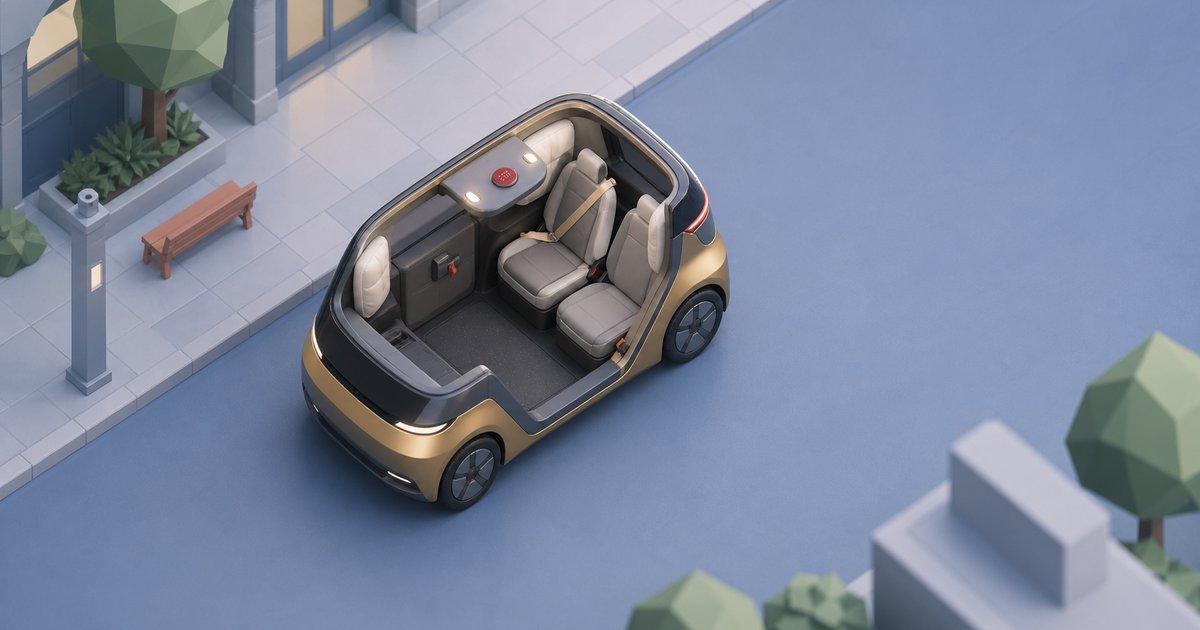
Tesla published the Cybercab Rider Guide on 3 September 2026, a few hours before the launch event in Austin. It is the first passenger-facing document for a car with no steering wheel and no pedals, and it answers the question that matters most to anyone getting in: what can you actually do if something goes wrong?
A physical button, in Braille
The Cybercab has a Stop button mounted overhead, between the dome lights. Pressing it triggers an immediate pull-over request: the car navigates itself to the side of the road, stops, turns on the hazard lights, ends the ride and connects the rider to Tesla Robotaxi Support.
The button is engraved with Braille. Nothing currently requires that — accessibility rules for autonomous vehicles are still being written — so Tesla chose to do it. In a vehicle where every other control is a touchscreen, it is the one thing a blind passenger can find without help.
Riders can also ask the car to pull over through the touchscreen or the Robotaxi app. Tesla notes that on a highway this may take longer, because the car has to find somewhere safe first.
The escalation path if that is not fast enough
The guide describes a second, blunter option for a rider who believes they are in immediate danger: fully pull the mechanical door release. That ends the trip and tells the Cybercab to stop in its lane as soon as it safely can, rather than looking for a shoulder.
Two interlocks back this up. Opening a door or unbuckling a seatbelt disengages autonomous driving and puts the car in park. There is no scenario in the guide where the Cybercab keeps driving with a door open.
Exterior microphones and speakers carry two-way audio between the cabin and Tesla Robotaxi Support, and support staff can contact 911 if needed. That is the human in the loop — not in the car, and not watching the road, but reachable.
The guide also lists at least ten airbags: front, knee, side-mounted, inner and outer seat-mounted, and curtain. For a two-seater with a very short nose, that count is the structural half of the safety argument.
Why this document is the interesting one
Tesla released a Cybercab first responders' guide back in June, and we covered Tesla's first responder plan filed with Texas DPS. Those documents are written for people trained to cut a car open. This one is written for a passenger who has never seen the vehicle before and has about four seconds to work out what to press.
Read that way, the design choices are a statement about how much Tesla expects riders to trust the car on day one. The answer is: not entirely. Every control described here exists to let a passenger overrule the autonomy — one button, one door handle, one seatbelt.
What it means in Europe
Nothing immediate. The Cybercab is not homologated for European sale, and Tesla has not announced a European robotaxi service. The relevance is that the EU is currently deciding what an autonomous vehicle owes its passengers, and this guide is the most concrete answer any manufacturer has published. The overhead Braille button in particular is the kind of detail that tends to become a requirement once one company has shown it is practical.
The Austin event was scheduled for the evening of 3 September, so what Tesla says on stage may add to this. The guide is already public.