
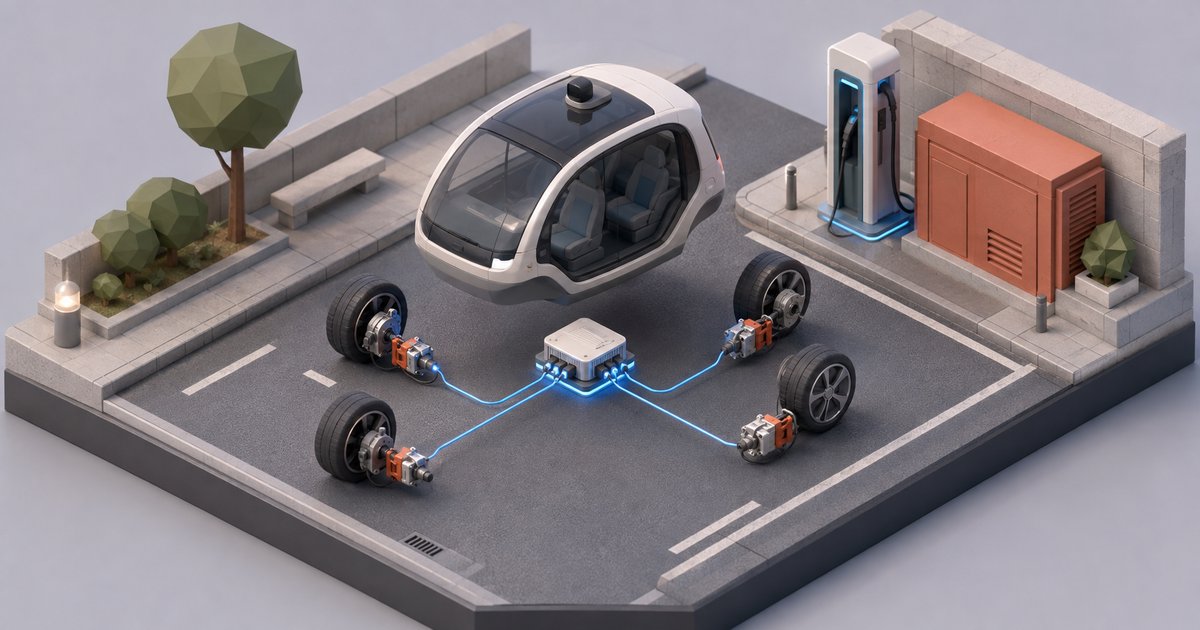
Take away the steering wheel and the pedals and a lot of the car underneath has to change too. The Cybercab's braking system is the clearest example: it has no brake lines, no master cylinder and no brake fluid anywhere in the vehicle.
How it stops
Each caliper carries its own electronically controlled actuator that clamps the pad against the rotor. There is no hydraulic circuit tying them together and no fluid to transmit force. A sensor reads the braking demand, a control unit interprets it, and the actuators at each wheel do the work — a fully dry, electromechanical brake-by-wire system.
Because the Cybercab has no brake pedal at all, the demand never comes from a person. It comes from the autonomy stack.
| Component | Conventional car | Cybercab |
|---|---|---|
| Force transmission | Hydraulic fluid in sealed lines | Electrical signal to per-wheel actuators |
| Master cylinder | Yes | None |
| Brake fluid service | Periodic replacement | None required |
| Braking input | Driver's pedal | Autonomy stack |
The steering follows the same logic. With no wheel there is no steering column either; the steer-by-wire unit sits behind the front-mounted motor.
What Tesla gains
Three things, and they are real rather than marketing.
Efficiency: with no residual hydraulic pressure, the pads can retract fully clear of the rotor, removing the light drag that a conventional caliper never quite loses. On a car built to run most of the day, that is free range.
Maintenance: brake fluid is hygroscopic and is replaced on a schedule. Removing it removes the schedule — which matters more for a vehicle expected to spend its life in a commercial fleet than for a private car. Elon Musk's stated reasoning is simply that electric brakes avoid routing hydraulic plumbing around the vehicle.
Packaging: no lines, no reservoir, no cylinder. The rest of the car is a similar exercise in subtraction — the 163 kW single front motor shown at the Austin launch is, Tesla says, 18% smaller and 25% lighter than comparable units and uses no rare earth metals, in a car that weighs 3,113 lb (1,412 kg).
The question nobody has answered
What happens when the power fails.
A hydraulic system has a useful property: it is mechanical, so a driver can still push fluid through it after the electronics die. A dry brake-by-wire system has no such fallback by construction. Tesla has not published the redundancy scheme — how the actuators are powered independently, how many failures the system tolerates, or what the car does when it can no longer stop itself.
That is not an accusation — every manufacturer building this architecture has to solve it, and Tesla presumably has. But it is unpublished, and it is the single most important fact about the system.
This is the first Tesla to use brake-by-wire, and among the first production cars anywhere to drop hydraulics entirely.
Why it matters for Europe
It is another item on the list of things that make the Cybercab hard to type-approve here. European braking regulation is built around a vehicle retaining defined braking performance after a single failure, and it was written with hydraulic architectures in view. A fluid-free system can meet that bar, but it has to demonstrate it rather than inherit it.
It also stacks with the other absences — no wheel, no pedals, no mirrors — that have already drawn a federal audit of how Tesla certified the car in the United States, and that made even repositioning a badly parked Cybercab a design problem.