
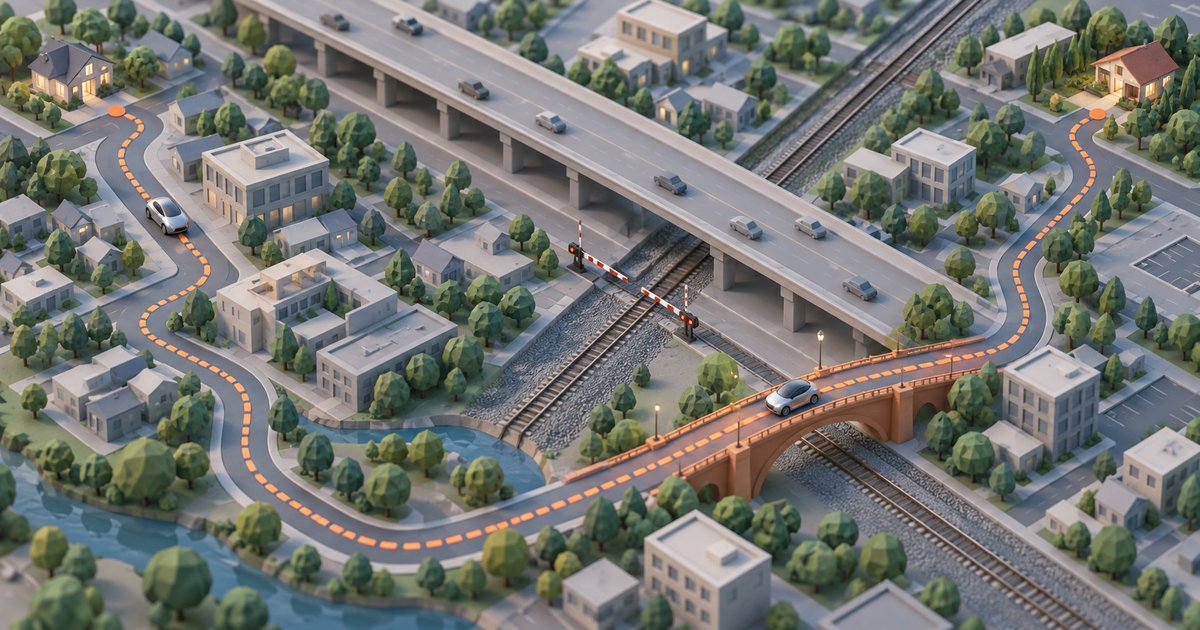
A rider in Austin booked a Cybercab from the 99 Ranch Market to the Domain, two points in the north of the city that a human driver connects in about ten minutes by going straight up the freeway. The Cybercab took 70 minutes, and the fare was $20.
The account comes from a post on Reddit's Austin community, reported by Electrek on 14 September 2026. Tesla has not commented on the individual trip, and nothing about it is independently verifiable. The reason it happened, however, is not in dispute at all.
The robotaxi does not use freeways
Tesla's driverless service in Austin stays on surface streets. It does not use US-183, and it does not use Loop 1, the two roads that make that particular journey short. Riders also report that it avoids at-grade railroad crossings.
Put those two constraints on the same map and the detour explains itself: with the freeways off-limits and the level crossings off-limits, the car ran far south on surface streets, parallel to Capital Metro's Red Line, until it could finally get over the tracks on a bridge in East Austin — then came back north.
This is a deliberate choice rather than a bug. A vision-only system inside a tight geofence, operating at 35 mph rather than 65, is one where a perception failure plays out at a third of the energy. TeslAnt covered the most recent widening of that boundary when Tesla expanded the Austin service area to about 288 square miles. Bigger is not the same as faster: adding area without adding freeways adds more places the car has to reach the long way round.
What the app tells you, and what it does not
Tesla's app shows a price estimate when the ride is booked. It does not show a time estimate. A rider comparing $20 against an Uber fare is comparing one number and guessing at the other — and on this trip the guess was wrong by an hour.
The fare itself sits in a pattern TeslAnt has already tracked. The Cybercab launched about 35% cheaper than a Model Y robotaxi and within three days cost more than both it and Uber. Priced at roughly market rate for a ten-minute hop, $20 is a poor deal for a seventy-minute one.
The comparison Tesla invites
Waymo already runs fully driverless rides on freeways. That is the single clearest capability gap between the two services, and it is a routing constraint rather than a pricing one — it shapes which trips are usable at all, not just what they cost.
The Cybercab has only been carrying paying passengers in Austin since 3 September 2026, and federal regulators opened an audit into its certification paperwork on that first day. Tesla's own roadmap points at a larger stack: 24-hour operation is gated on the FSD v15 merge, which Tesla's AI lead has said is coming "next month or so".
Neither of those adds a freeway. Until highway driving is part of the service, a robotaxi map that keeps growing outward will keep producing journeys where the straight line is the one route the car cannot take.
What this would mean in Europe
Europe would get this version first, geofence and all, and the constraints bite harder here. European cities carry far more at-grade level crossings than Austin, and their dense cores are precisely the places ringed by motorways the car would not be allowed to use. A service that cannot take the ring road is confined to one sector of a city at a time.
Musk has said the Cybercab is coming to Europe without saying when. Whether it arrives able to use a motorway decides how much of a European city it can serve.