
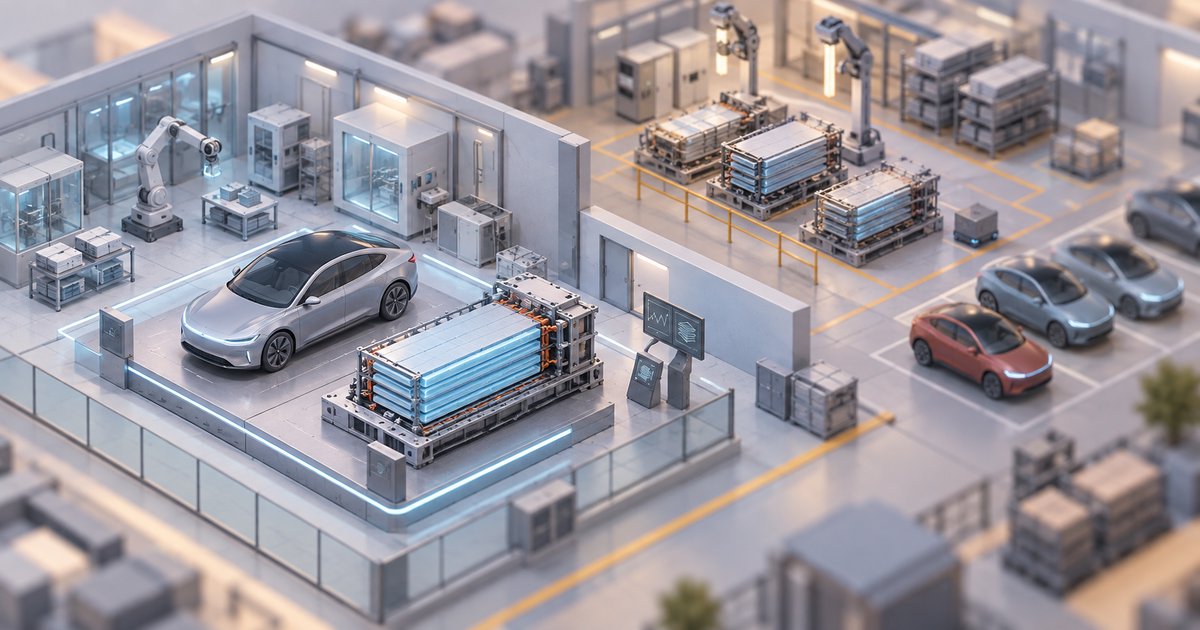
BYD's executive vice-president has put a date on the company's first solid-state car, and it sounds nearer than anything BYD has formally committed to. Speaking to Carwow's Spanish edition in Valencia, in an interview picked up on 28 September 2026, Stella Li said that "next year, we have one model that will be the first one with that technology".
What was actually said
Li's claim arrived as a positioning argument rather than a product announcement. "Talking about solid-state batteries, BYD is in the leading position," she said, adding that the company leads "for commercialization and technology".
She named no model, no launch market, no energy density, no range figure and no price. That absence is the story, because "one model with the technology" and "a model you can buy" are different claims, and only the first was made.
BYD's own roadmap says something narrower
BYD's formal position has been on the record since February 2025, when Sun Huajun, chief technology officer of BYD's battery subsidiary FinDreams, set out the timeline at a battery conference.
| Stage | BYD's stated timing |
|---|---|
| Demonstration and first fitment | 2027 |
| Mass production | Around 2030 |
Reporting around that 2027 step describes small-batch trials of roughly a thousand cars, going to selected customers on BYD's premium Yangwang and flagship Denza platforms rather than a volume launch. On those numbers, the first solid-state BYD is a demonstration fleet, not a showroom car.
BYD's group chief scientist, Lian Yubo, has been more cautious still. In April 2026 he called solid-state batteries a "critical breakthrough stage" while describing commercialisation as constrained, and urged the industry to keep investing in liquid lithium-ion cells, which he framed as complementary rather than superseded. The specific obstacle attached to BYD's sulphide electrolyte is dry-room manufacturing at scale, a step nobody has yet demonstrated.
Read together, Li's "next year" and the company's "around 2030" are not actually in conflict. They describe different events, and only one of them is a car a customer chooses.
Nobody in the industry is further ahead
The claim to lead is harder to test than it looks, because everyone credible points at the same decade.
| Who | Stated timing |
|---|---|
| BYD (FinDreams, Feb 2025) | Fitment 2027, mass production ~2030 |
| China's battery five-year plan | Solid-state targeted by 2030 |
| Hyundai R&D | About five years out, and still expensive |
| LG Energy Solution | Large-format cells roughly a decade behind |
TeslAnt reported two days ago that Hyundai's R&D chief put solid-state cars five years away and warned they would stay costly, and yesterday that Beijing's own five-year plan for the battery industry targets 2030. A Tesla cell supplier has been blunter still, arguing that large-format solid-state cells are about a decade behind the ones already in phones. BYD's cell rival has said much the same: TeslAnt covered CATL matching BYD on a 2027 pilot, with 2030 as the realistic date back in August. The nearest thing to a counter-example is not a carmaker at all: ProLogium has a certified 381 Wh/kg cell in series production, and it is semi-solid rather than the all-solid sulphide chemistry BYD is describing.
What it changes for a European Tesla buyer
In the near term, nothing. Neither Yangwang nor Denza sells the flagship models in question in Europe, so a thousand demonstration cars in 2027 are not vehicles a European buyer can cross-shop against a Model 3 or Model Y. Nor does BYD's European range — the models it actually registers here — enter this timeline at any point Li described.
What is worth tracking is the gap between BYD's two statements. When a carmaker's commercial leadership says "next year" and its chief scientist says the manufacturing process is unproven, the engineer is the one describing the constraint. The date to hold BYD to is 2030, and the useful question in 2027 will be how many of those thousand cars actually got built.
Update: 2026-10-04
BYD has since given that car a shape. Official images of a new Yangwang ultra-luxury executive sedan appeared in late September 2026: roughly 5.5 metres long, built on the quad-motor e4 platform, and the first BYD with rear-hinged coach doors. BYD calls it the result of three years of development and aims it at the Rolls-Royce Phantom and Maybach S-Class, with an official debut expected in October. The solid-state link is not BYD's own claim: China's Autohome, and separately sources cited by CarNewsChina, place the first fitment in this car, while BYD executive Zheng Yu has confirmed only "unprecedented disruptive technology". Estimated pricing is above 2 million yuan, about USD 300,000. If the identification holds, it narrows the Yangwang platform named above to a single limousine — and reinforces rather than softens the point that this is not a car a European buyer will cross-shop. Sources: BYD tests new ultra-luxury EV with coach doors and a solid-state battery, Yangwang teases new luxury sedan.