
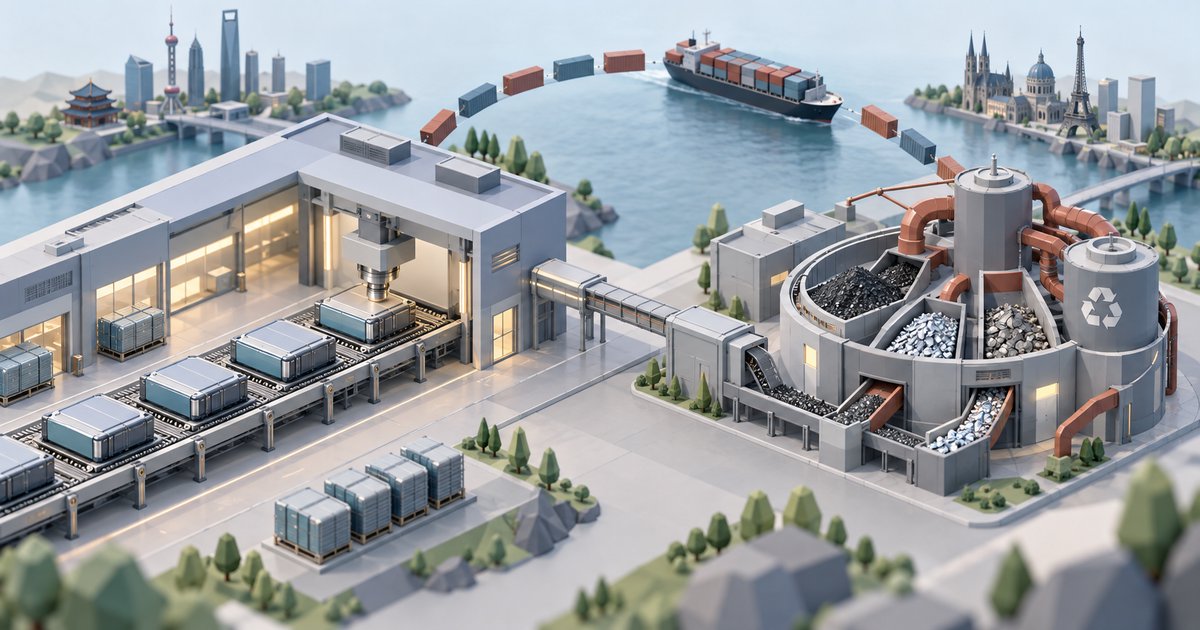
China has now written a plan for the cells as well as the cars. On 28 September 2026 the Ministry of Industry and Information Technology (MIIT), together with six other authorities including the National Development and Reform Commission and the Ministry of Transport, published a five-year plan for the battery industry.
It is the companion document to the vehicle plan issued a fortnight earlier, which set a 70% new-energy share of passenger car sales by 2030 and a first-ever capacity brake on new entrants. This one addresses the layer underneath: who makes the cells, how good they have to be, and what happens to them afterwards.
The technical targets
| Area | Target |
|---|---|
| Solid-state batteries | deployment at larger industrial scale for the first time by 2030 |
| Lithium-ion cycle life | 15,000 charge and discharge cycles for long-life cells |
| Manufacturing quality | defect rates at parts-per-billion level |
| Sodium-ion | cold-resistant and long-life storage variants |
| Raw materials | accelerated domestic lithium and cobalt development |
On solid-state the named research priorities are ionic conductivity, cycle stability, cost reduction and pressure-applied cell concepts — the last of which is the unglamorous problem, because a solid-state cell needs mechanical pressure held across it for its whole life, and that is packaging and mass, not chemistry.
The 2030 framing is also a correction to the marketing. It sits closer to Hyundai's R&D chief saying solid-state cars are five years away and will stay expensive than to the 2027 pilot-production dates CATL and BYD have both claimed. Beijing is planning for scale at the end of the decade, not the middle of it.
The clause that reaches Europe
The plan requires battery manufacturers to build take-back system capacity matching their sales volumes, and says they should build recycling capacity in key export markets. For CATL, BYD and their peers, the largest such market that is not China is Europe.
That lands on the same ground as the EU's own rules. Under Regulation (EU) 2023/1542, every electric-vehicle battery placed on the EU market must carry a digital battery passport from 18 February 2027, holding carbon footprint, recycled content, chemistry and state-of-health data behind a QR code. China's plan separately proposes exploring battery passports of its own and mutual recognition of CO₂ footprint data — which is a bid to have Chinese compliance data accepted in Brussels rather than duplicated.
Why a Tesla buyer should care
Because the cells in a large share of European Teslas are Chinese. Tesla's LFP packs come from CATL and BYD, and the Shanghai plant supplies part of what Europe registers. A Chinese plan that pushes consolidation — the document explicitly supports mergers and restructuring — thins the supplier field Tesla buys from, and a plan that mandates recycling capacity in export markets adds cost that ends up in cell prices.
The caveat is the same one that applies to the vehicle plan: this is intent with ministries behind it, not law, and it binds no individual company. What it records is that China intends to keep the cell industry it already dominates, and to arrive in Europe holding paperwork the EU will accept.