
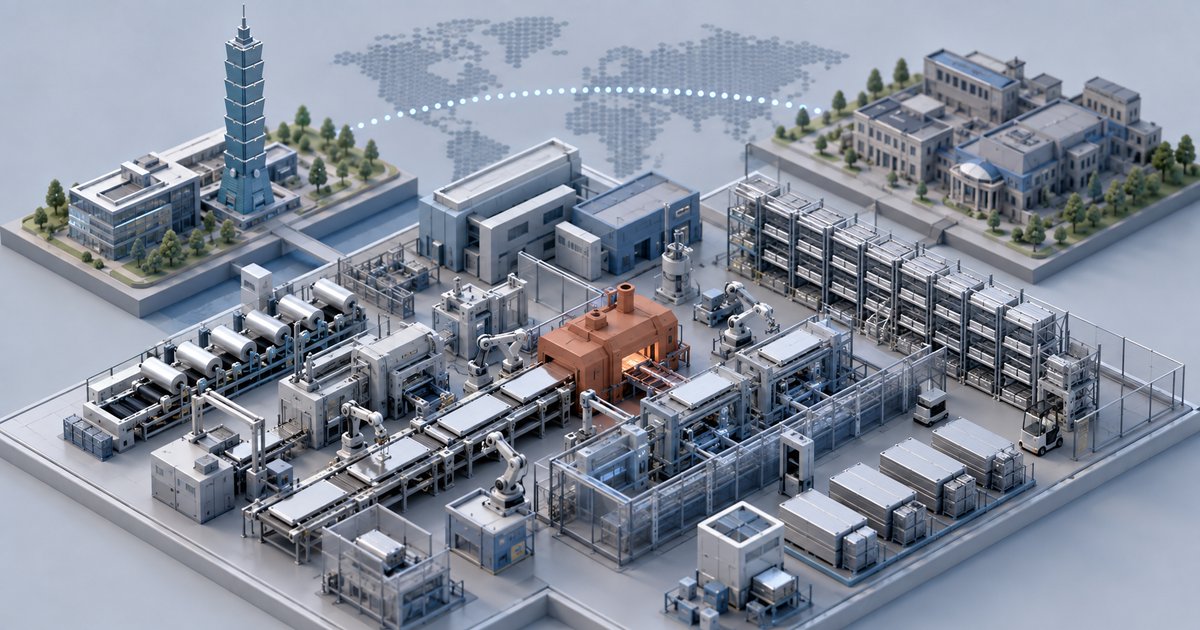
ProLogium has started series production of its Generation 3.5 lithium-ceramic cell in Taiwan, and had the specification certified rather than announced. TUV Rheinland confirmed 381 Wh/kg gravimetric and 903 Wh/L volumetric energy density at cell level, measured on a large-format 185.4 Ah cell. UL Solutions separately tested the same cell against the Chinese standard GB/T 43568-2026.
Two details make this more than another energy-density press release: the number was verified by a third party, and it was verified on an automotive-sized cell rather than a laboratory coupon.
Where the industry said it would be
The rest of the field is still describing solid-state as a pilot-line problem for 2027 and beyond.
| Company | Claim | Stage |
|---|---|---|
| ProLogium | 381 Wh/kg, TUV-certified | Series production, Taoyuan, 3 GWh |
| Geely | 500 Wh/kg | Pilot from 2027 |
| CATL | not stated | Pilot production 2027 |
| LG Energy Solution | large-format is the hard part | "a decade" behind |
TeslAnt covered Geely's 500 Wh/kg pilot claim and CATL's 2027 pilot target in August. In the same month a Tesla cell supplier argued the opposite case — that large-format solid-state cars are a decade behind solid-state phones, precisely because scaling the format is where the chemistry fails.
ProLogium's announcement is the first concrete answer to that objection. It is also a smaller one than the headline suggests: 3 GWh of capacity at Taoyuan is roughly one mid-sized battery plant line, not a supply base for a mass-market car programme.
The European part
The plant that matters for European drivers is in Dunkerque. Construction began in February 2026. Phase 1 is scheduled for completion in 2028 with an initial 0.8 GWh for the next-generation Gen 4 cell, rising to 4 GWh a year by 2030 and a targeted 12 GWh by 2032.
That is a long ramp. A car buyer looking at 2028 deliveries will not be choosing between a solid-state pack and a conventional one; 0.8 GWh is a few thousand cars' worth of cells.
What it means for Tesla
Nothing immediately, and that is the honest answer. ProLogium named no automotive customer, quoted no cell price, and gave no date for a car you can buy. Its only named downstream arrangement is with "local partners" in North America for pouch-cell assembly.
The relevance is the trend line. Tesla's competitive position on range rests on pack efficiency and vehicle efficiency rather than on leading cell energy density — a 4680 cell is nowhere near 381 Wh/kg. If a certified 381 Wh/kg large-format cell can be built at any volume in 2026, the gap between "solid-state someday" and "solid-state in a car" is narrowing faster than Tesla's own supplier said it would in August.
The number to watch is not 381 Wh/kg. It is cost per kWh, which ProLogium has still not published, and cycle life at that density, which nobody outside the company has measured.