
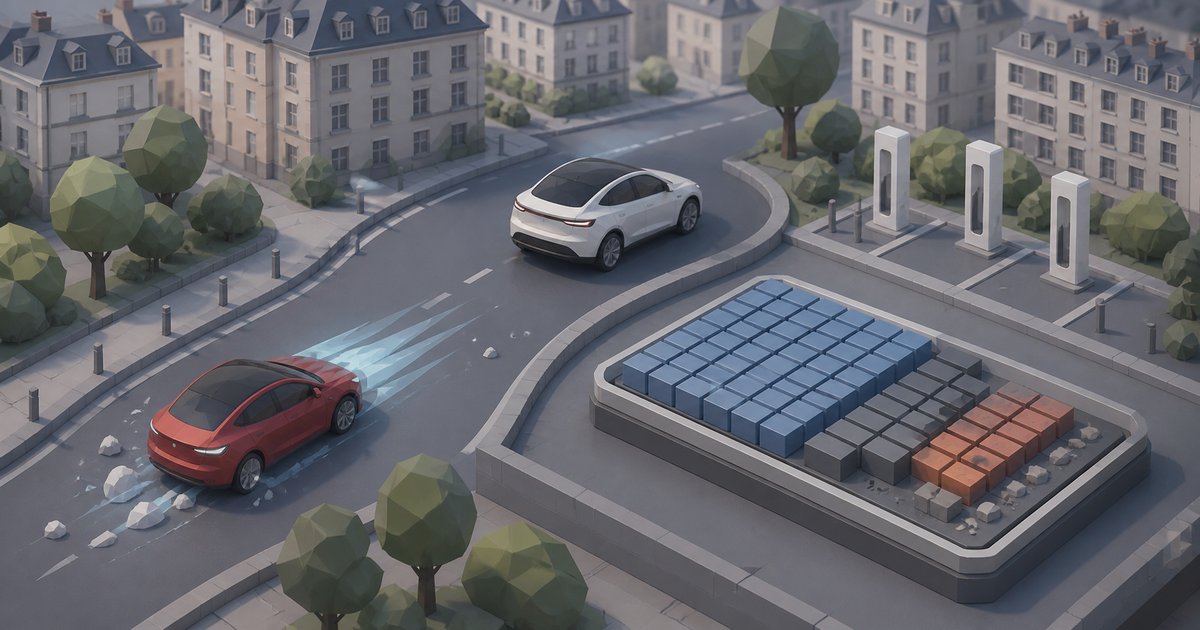
Researchers at Shanghai Dianji University have put a number on a question Tesla owners ask constantly: does driving hard actually wear out the battery? Their answer is yes, by a factor of about 2.5 — with a caveat most of the coverage has dropped.
The paper, by Hao Cheng, Zhongwei Gu and Wangqiang Gao, appeared on 14 August 2026 in Scientific Reports, the open-access journal in Nature's portfolio.
What was actually measured
The team took a year of real driving data from 15 electric cars operating in Guangzhou during 2022. Each car reported every 10 seconds — speed, battery current, state of charge, voltage and pack temperature — and those samples were compiled into 60-second blocks, then sorted by machine learning into five driving styles from smooth eco-driving to consistently aggressive.
What separated the groups was not speed. It was how often the driver asked the pack for a large current.
| Driving style | Average current (RMS) | Modelled capacity loss at 1,000 cycles |
|---|---|---|
| Eco-driving | 20.56 A | 21.15% |
| Most aggressive | 66.02 A | 53.22% |
Repeated high-torque acceleration from low speed — the stop-start pattern of city driving — did more damage than sustained high-speed cruising. Current, not velocity, is what stresses the cells.
The caveat the number needs
The 21% and 53% figures are not observations. They are the output of a degradation model extrapolated to 1,000 charge-discharge cycles, and the authors say so plainly: that rate is a prediction, and they had no 1,000-cycle battery-life data for any driving group.
Fifteen cars is also a small sample from one subtropical city in a single year, and the study does not separate Tesla vehicles out. So the direction of the finding is well supported — high current accelerates ageing, and driving style controls current — while the specific multiplier deserves to be read as the estimate it is.
Why this lands differently in a Tesla
Instant torque is the product. A Model 3 or Model Y delivers exactly the current spike this study penalises every time the pedal goes down, and it does it without the theatre of a downshift, which is what makes the habit easy to form and hard to notice.
Set against the Swedish Carla study ranking Tesla's LFP Model 3 pack, the two findings are complementary: chemistry sets the ceiling on how well a pack ages, and the driver decides where within it a given car lands.
What it means in Europe
Two things make this more consequential here than for the fleet it was measured on.
The first is climate. A subtropical city over one year captures heat stress and says nothing about the cold-weather cycling that dominates a Scandinavian winter. Cold limits how much current a pack will deliver at all, which blunts the mechanism the paper describes.
The second is disclosure. From February 2027, every EV battery sold in the EU carries a QR code exposing state-of-health data, so pack condition becomes a number a buyer reads at the kerb rather than a private matter between an owner and their car. TeslAnt has covered how used Model S prices fell much further than their batteries did; once state of health is printed on the car, that gap closes in whichever direction the data points.
What to do with it
Nothing here argues for driving timidly. The mechanism is frequency — how often the pack sees a large current draw, not whether it ever does. Smoothing out repeated full-power launches in traffic addresses that; one enthusiastic on-ramp does not undo it.
For a used-car buyer the useful implication is about provenance: two cars of the same age, mileage and chemistry can have measurably different pack health, and how the previous owner used the accelerator is part of the reason why.