
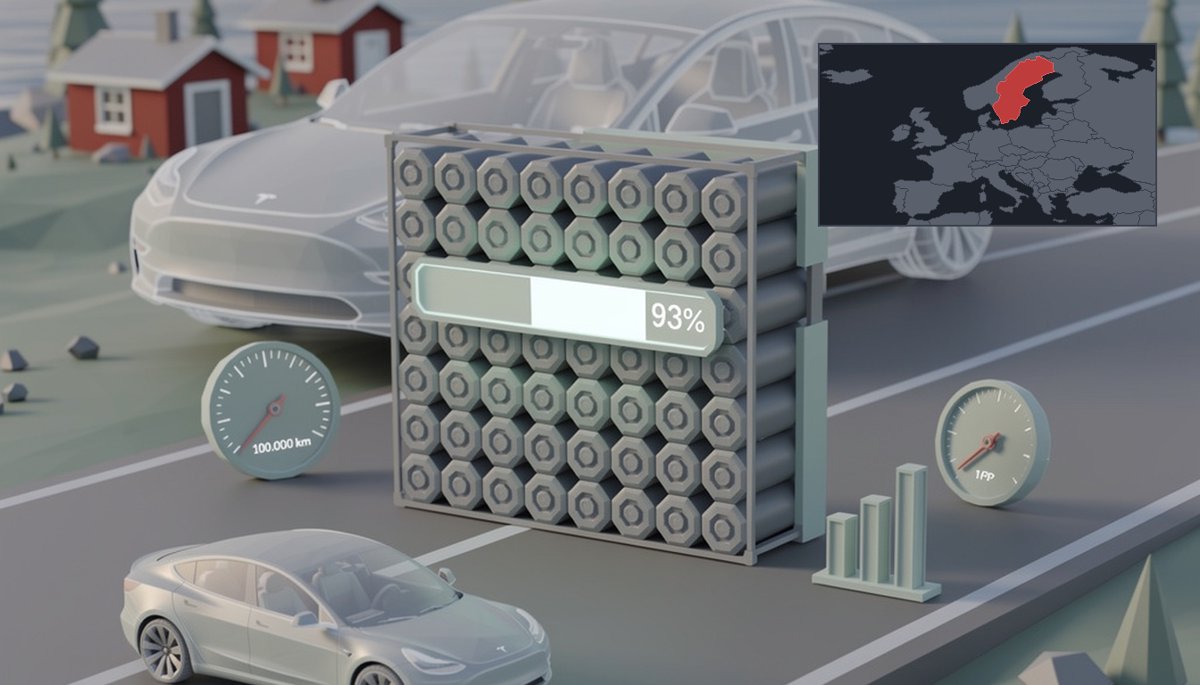
A large Swedish study of real-world battery health has delivered a nuanced verdict for Tesla owners: the Model 3's lithium iron phosphate (LFP) pack is one of the most durable batteries on the road, while its older nickel-based packs fall further down the ranking.
What the study measured
Carla, a Swedish used-EV marketplace, compiled 9,954 battery-health tests carried out between 2022 and 2026 on cars that had covered more than 100,000 kilometres (about 62,000 miles). The analysis ranks 20 models by how much of their original usable capacity remains at that mileage.
The headline finding is reassuring for the whole industry: every model in the top 20 retained more than 91% of its capacity, meaning less than a tenth of the battery was lost after 100,000 km. South Korean cars led the field — the Kia e-Niro topped the list at 97.25%, followed closely by the Hyundai Kona Electric at 97.18%. At the other end of the top 20, the Volkswagen ID.3 held 91.79%.
Where Tesla lands
Tesla's position depends entirely on which battery is inside the car. Carla compared four Model 3 battery variants:
| Model 3 battery | Supplier | Capacity retained | Overall rank |
|---|---|---|---|
| LFP | CATL | 93.3% | 8th |
| NMC (nickel) | LG Chem | 91.5% | 12th |
| NCA (nickel) | Panasonic | 89.8% | — |
| NCA (nickel) | Panasonic | 88.2% | — |
The CATL-supplied LFP pack was the strongest Tesla result, finishing eighth overall, while the nickel-based packs from LG Chem and Panasonic degraded noticeably faster.
Why LFP matters for European buyers
The distinction is directly relevant in Europe. LFP is the chemistry Tesla fits to the entry-level, rear-wheel-drive Model 3 and Model Y — the versions most European buyers choose — while the Long Range and Performance cars use nickel-based cells. On this evidence, the cheaper standard-range Tesla is also the one that holds its range best over high mileage, an unusual case where the budget option is the more durable one.
The result echoes a wider industry shift toward LFP for standard-range trims, prized for its longevity, tolerance of daily 100% charging and lower cost, despite giving up some energy density.
The bigger picture
For used-EV shoppers, the study is a useful counter to the persistent fear that electric-car batteries wear out quickly. Even the weakest Tesla variant in the test kept nearly 88% of its capacity past 100,000 km, and the LFP car did far better. Buyers weighing a second-hand Model 3 or Model Y in Europe now have hard data suggesting the battery — long the biggest unknown in a used EV — is likely to be among the car's more dependable components, especially on LFP-equipped examples.