
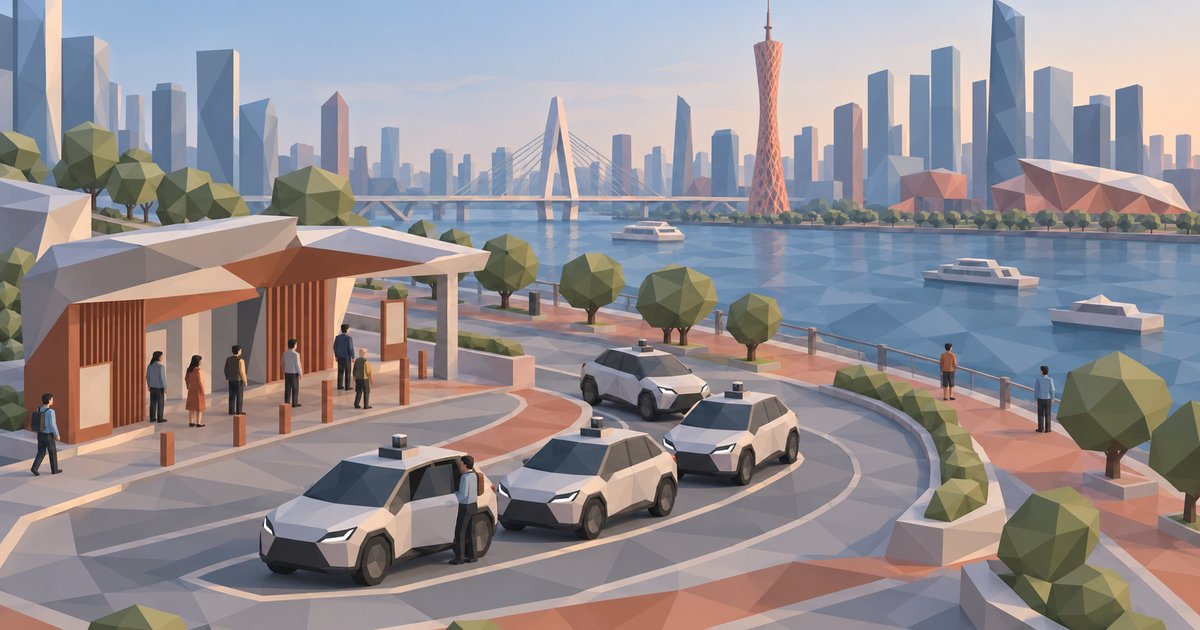
XPeng's robotaxi now has a name and a sign-up page. On 8 October 2026 the company said its autonomous ride service will trade as XPeng Yoyo, and it opened online registration to the public in China through invitation codes. XPeng says it picked a name that is short, easy to pronounce and consistent across languages because it wants the brand recognised in global markets, not only at home.
What is on offer
The service runs in Guangzhou, where the car is built, and riders book through a WeChat mini-program once they hold an invitation code, CarNewsChina reports. XPeng has not disclosed the fleet size or the fares.
The car is derived from XPeng's flagship GX SUV and engineered for Level 4 driving. It carries four of XPeng's in-house Turing AI chips, which the company puts at 3,000 TOPS and calls the highest in-vehicle compute in the world, and it runs the second-generation Vision-Language-Action model, VLA 2.0. There is no lidar and no high-definition map, XPeng's announcement says. That is the bet Tesla made first.
| XPeng Yoyo | Tesla Cybercab | |
|---|---|---|
| Base vehicle | GX SUV derivative | Purpose-built two-seater, no steering wheel |
| Sensors | Cameras, no lidar, no HD maps | Cameras, no lidar |
| Compute | 4 Turing chips, 3,000 TOPS (XPeng figure) | Tesla's own FSD computer |
| Public rides | Invitation codes, Guangzhou, from 8 Oct 2026 | Paying passengers in Austin since 3 Sep 2026 |
| Fleet | Not disclosed | 319 on the Texas register |
| Who runs the fleet | Partners, Amap first | Tesla |
| Rides with nobody in the driver's seat | Targeted for 2027 | In service |
The timeline behind the name
In May 2026 the mass-produced robotaxi rolled off the line in Guangzhou. In July the company completed the full chain from online hailing to automated pick-up and drop-off. In August it obtained Guangzhou's remote-testing qualification, which allows road tests without a safety operator in the driver's seat on designated test roads.
Chairman He Xiaopeng said on the 24 August earnings call that the cars had completed more than 2,000 internal test rides, CnEVPost reports, and the company aims to carry passengers without safety drivers in 2027. CarNewsChina adds that XPeng expects the Guangzhou operation to break even at the vehicle level as early as the second half of 2027.
XPeng wants to sell the car, not drive the cab
He Xiaopeng describes XPeng as a technology provider and ecosystem enabler: it will earn from hardware sales, services and a share of operating revenue, and partners will run the fleets. The mapping and ride-hailing platform Amap was named as the first of them in November 2025, electrive reports.
That is the mirror image of Tesla, which operates its own cars and only in September opened an interest form for companies wanting to buy Cybercabs. It follows the same logic as the licensing push XPeng began this year.
What it means for Tesla, and for Europe
Two companies now run public robotaxi programmes on cameras alone. The gap is where each stands. Tesla's Cybercab has carried paying passengers in a car with no steering wheel since 3 September, and the Texas register lists 319 of them. XPeng's riders are invited, in one city, and the stage without a safety operator is set for next year.
For Europe, CarNewsChina reports that XPeng is discussing Yoyo partnerships in Europe, the Middle East and South-East Asia, with no partner, city or date. XPeng already sells cars here, the L03 opened in Germany at a price aimed at the Model Y. What it does not have is an approval. Waymo has named Munich and a driverless date of end-2027; Musk's only word on the Cybercab in Europe is "hopefully soon". XPeng has filed nothing either. The race worth watching is not who has the better name, but who gets a driverless car approved in a European city first.