
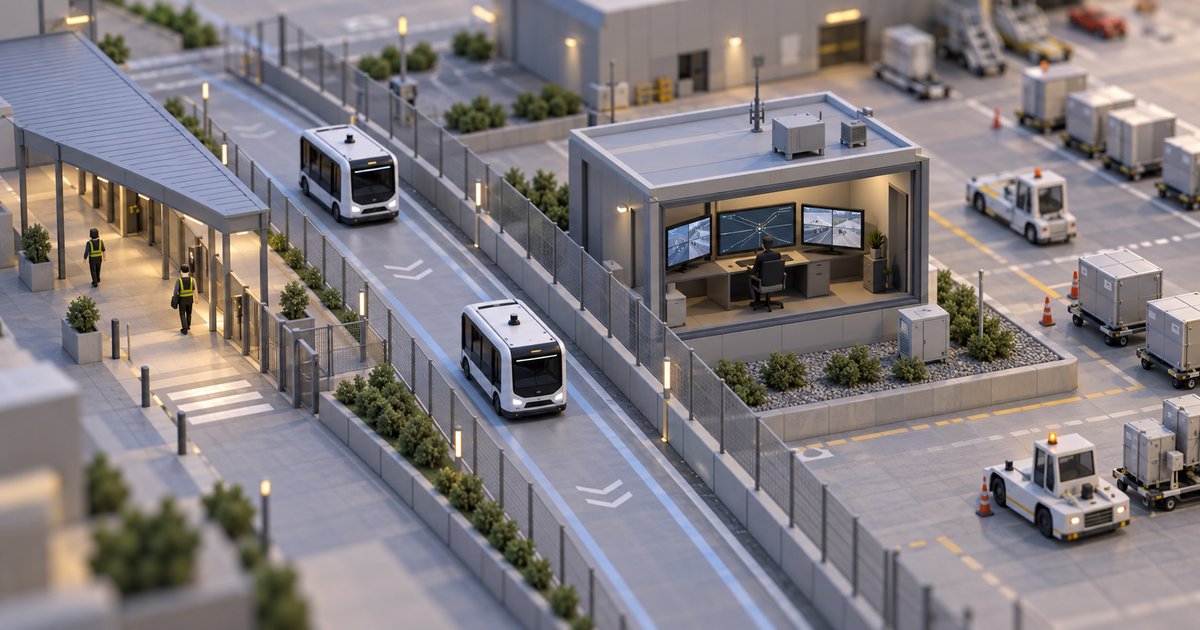
Zurich Airport announced on 9 September 2026 that its two automated electric shuttle buses are now running with nobody on board. The safety drivers who had ridden along since the trial began have been taken out, and the airport describes the vehicles as operating at SAE Level 4 on a defined route on its own grounds.
What actually changed
The shuttles have been running since March 2025, with Chinese autonomous-driving firm WeRide supplying the technology. From June 2025 they operated at Level 3 with a safety driver in the seat, and airport staff were allowed to ride along. The step taken this month is narrow but real: the person inside the vehicle is gone. Across the phased trial the buses have covered more than 15,000 kilometres.
They have not been left to themselves. A remote cockpit at the ZRH Innovation Hub in the Circle, which began testing in September 2025, now supervises the buses and can intervene. The people staffing it are the former onboard safety drivers from partner companies Swissport and Krummen Kerzers, retrained for the remote role.
That distinction is worth stating plainly, because some coverage has described the deployment as running "without a human monitor". There is a human monitor. What there is not is a human in the bus.
| Phase | From | Supervision |
|---|---|---|
| Trial start | March 2025 | Safety driver on board |
| Level 3, staff carried | June 2025 | Safety driver on board |
| Remote cockpit testing | September 2025 | Safety driver on board |
| Level 4 | September 2026 | Remote cockpit only |
The schedule also slipped. In September 2025 senior innovation manager Raphaël Glaesener said the airport expected initial tests without a safety driver "by the end of the year at the earliest". They arrived roughly nine months after that earliest case.
The route is not a public road
The buses run between the staff access point at Gate 101 and the works yard at Gate 130, a segregated route with several stops that does not cross aircraft taxiways. The first driverless trips are being made empty; staff are expected back on board after around four weeks of testing. Operation of the two buses is currently planned only through the end of 2026.
A fixed, closed, low-speed route under remote supervision is a far smaller problem than an unmarked city street, and the airport frames the point as staffing rather than autonomy for its own sake. "Automated driving does not mean that people disappear. But the tasks change," Glaesener said. "Operations will also become more efficient, because in the future one employee will be able to monitor several buses." Coralie Klaus Boecker, who heads the ZRH Innovation Hub, casts gradual automation as one answer to skilled-labour shortages.
Why a Tesla owner should care
Europe keeps handing its driverless milestones to somebody other than Tesla. WeRide was also the operator behind Slovakia's first robotaxi demonstration, and the continent's first genuinely driverless public robotaxi rides began last week in Croatia, not in a German or French city. Tesla, meanwhile, is still in talks with Brandenburg about driverless shuttles, and FSD (Supervised) remains unapproved for European customer cars.
None of this means a Chinese minibus on airport tarmac is ahead of FSD. It means the regulatory path to taking the human out exists in Europe, and is being walked by operators who accept a fenced route and a control room. Tesla is asking for something much harder: no route restriction and no remote cockpit at all.