
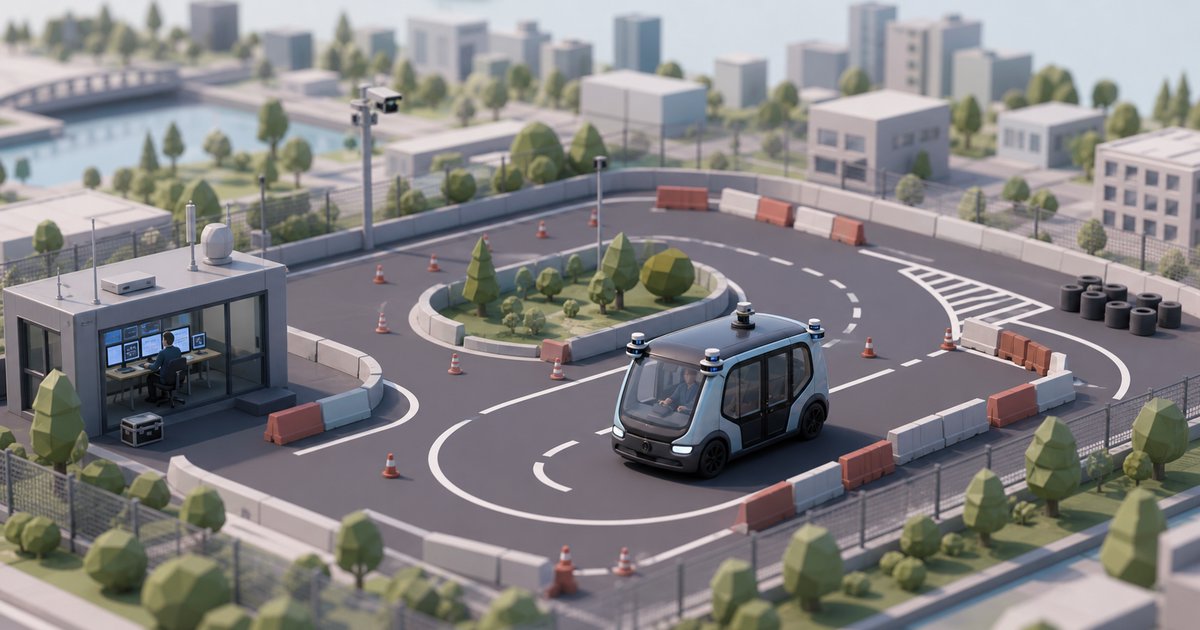
A WeRide robotaxi has completed the first autonomous test drive in Slovakia. The catch is in the setup: the run took place on a closed circuit, with a safety driver at the wheel whose job was to watch the drive and intervene if needed.
What actually happened
This is the first vehicle movement of a programme announced in March 2026, when the Chinese autonomous-driving firm WeRide entered Slovakia with the local partner ELEVATE Slovakia. The car is WeRide's Robotaxi GXR, which senses the road with lidar plus a camera array rather than cameras alone.
| Element | Status |
|---|---|
| First drive | Completed, on a closed test circuit |
| Safety driver | Present, at the wheel |
| Pilot city | Bratislava |
| Later phases | Kosice and the High Tatras |
| Public commercial service | No date announced |
Testing runs under the supervision of Slovakia's Ministry of Transport, which is also the reason the programme exists in this form. The ministry prepared a legislative framework that permits testing vehicles with no physical driver at the wheel — a step no other EU member state has taken in the same way. The closed circuit and the safety driver are therefore not the limit of what Slovak law allows. They are where a cautious operator starts.
The wider programme is broader than taxis. WeRide plans to deploy its Robotaxi, Robobus, Robovan and Robosweeper products, with the Ministry of Transport on passenger mobility, Slovak Post on parcel logistics and the City of Bratislava on municipal cleaning. The Slovak Academy of Sciences is involved, and DiusAi is handling financing and technical implementation.
Why a Tesla owner should care
Tesla cannot do this in Europe yet. FSD (Supervised) remains unapproved across the EU, and Tesla's route runs through the Dutch RDW and a UNECE process that has repeatedly slipped. Meanwhile a Chinese operator is running hardware on a European test track under a national framework written for driverless testing.
That pattern is now the norm rather than the exception. Germany cleared Momenta for Level 4 testing nationwide in July, and Waymo and Pony.ai have been booking European cities while Tesla waits on approval. Slovakia adds a fourth data point, and the most permissive legal text of the group.
There is a real asymmetry in how these approvals work. A geofenced operator with lidar, a remote operations centre and a named test area is a contained regulatory question: an authority can bound the risk to a circuit or a district. Tesla is asking for something structurally harder — a camera-only system, on customer-owned cars, on any road in the country. The comparison flatters neither side automatically, but it explains why WeRide is driving in Bratislava while European Model Y owners still get Autopilot.
What to watch next
Two things will tell you whether this is momentum or a photo opportunity. The first is when WeRide moves off the closed circuit onto Bratislava's public streets, and whether the safety driver stays. The second is whether the Slovak framework gets used by anyone else — a national law that permits driverless testing is far more valuable to the European autonomy debate if a second operator, or a carmaker, takes it up. Neither has a date.