
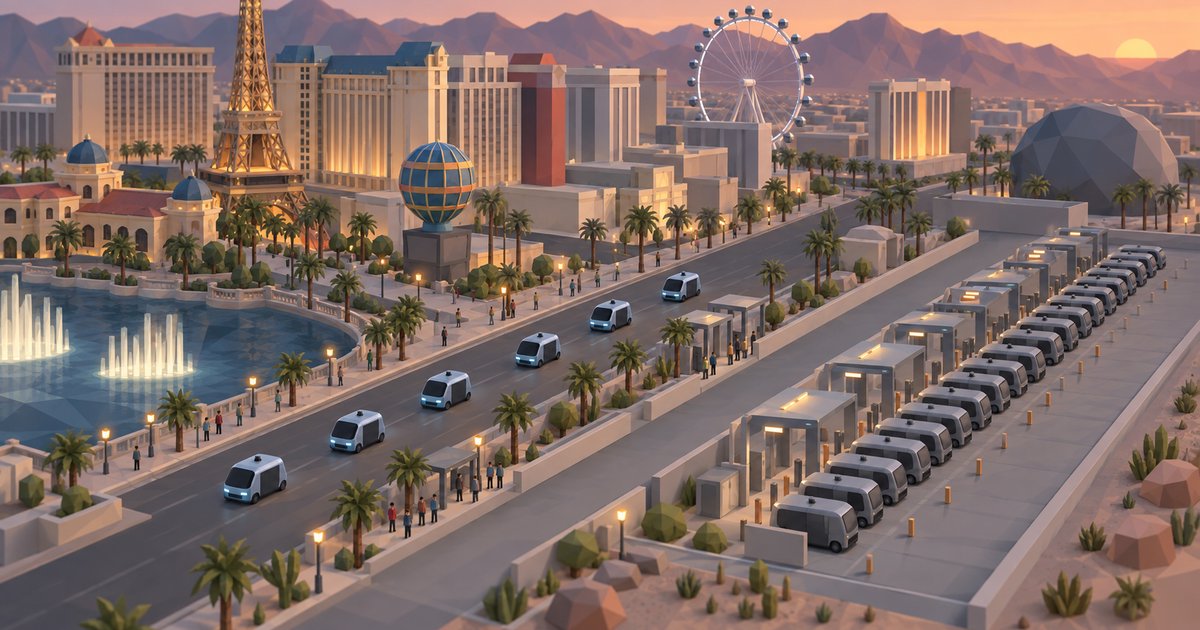
Waymo started carrying paying members of the public in Las Vegas on 14 September 2026. It is the company's 15th metro area and Nevada its eighth state — and it happens in the county where Tesla holds a permit five times larger and has not yet sold a ride.
What Waymo actually opened
The initial service area covers roughly 24 square miles. It runs along Las Vegas Boulevard from Boulder Junction north to Sahara Avenue, taking in resorts including the Venetian and reaching Allegiant Stadium, then spreads east into Winchester and west to the edge of Spring Valley. Riders are admitted in batches from a waitlist Waymo puts at more than 100,000.
The cars are the Zeekr-built Ojai running Waymo's sixth-generation Driver, the same combination Denver and San Diego received on 1 September.
This is a change of status rather than an arrival. Waymo has been driving without anyone at the wheel in Las Vegas since 8 July, with its own employees in the back seat. What changed on Monday is that strangers can pay.
The gap between a permit and a service
| Operator | Nevada cap, first 12 months | Permit granted | Public rides in Clark County |
|---|---|---|---|
| Tesla | 5,000 | 20 August 2026 | Not yet |
| Waymo | 1,000 | 20 August 2026 | Since 14 September 2026 |
| Aviari Services (Uber) | 1,000 | 20 August 2026 | Not yet |
When Nevada raised Tesla's cap from ten vehicles to 5,000 in a week, this site noted that the county had authorised up to 8,000 driverless vehicles for hire, and that the gap between authorisation and deployment would be the story. This is that gap becoming visible: the operator with the smallest paper allowance is the first one selling rides.
Tesla's permit is not dormant by choice. Under the Nevada Transportation Authority's terms, service cannot begin until vehicle inspections, insurance and filed rates are complete, and it must start within 120 days of the permit being issued — a deadline falling around 18 December 2026. Tesla's Cybercab chief engineer has already played down the headline number, calling 5,000 "a ceiling" and saying the company would be "extremely happy" to reach 2,500 within the year. The rollout is expected to start on Model Y before any Cybercab carries a passenger.
Why this matters beyond Nevada
Clark County is now the cleanest comparison available between the two approaches. Tampa put Waymo and Tesla in the same city on 1 September, but Nevada puts them under one regulator, with the caps, the dates and the operating conditions all public and all set by the same authority. Whatever each fleet does next is measured against a number the state wrote down.
Waymo says its vehicles are involved in 94% fewer serious-injury or fatal crashes than human drivers over comparable distances. That is the company's own figure, drawn from its own multi-city data, and no regulator has published an equivalent for Tesla's driverless fleet.
What Europe can take from this
The transferable part is the licensing model rather than the ride. Nevada authorised generously and then gated on inspection, insurance and filed rates — permission first, proof before passengers. Europe is not close to that: FSD (Supervised) still waits on a vote scheduled for 6 October before it can operate here at all, and the continent's first fully driverless rides are running in Zagreb — from neither of these two companies.