
Waymo has described the computer inside its robotaxis in public for the first time, and the number that travelled furthest from the disclosure - "over 1,000 TOPS, ten times Tesla's chip" - is not the number Waymo presented.
The details came out at Hot Chips 2026 in late August, where Waymo walked through a custom sensor-fusion ASIC now shipping in its latest robotaxi generation. What the chip does, and what it deliberately does not do, matters more than any headline figure.
What Waymo actually disclosed
| Waymo sensor-fusion ASIC | |
|---|---|
| Process | TSMC N5 |
| Silicon / package | 208 mm2 in a 45 x 45 mm FCBGA |
| Compute | 160 TOPS (INT8), 80 TFLOPS (FP16) |
| On-chip SRAM | 64 MB, 2 MB per processing element |
| Register file | 8 MB |
| Memory | in-package LPDDR5x, 273 GB/s |
| Power | under 75 W |
| Host interface | PCIe Gen 5 x8 |
| Networking | 25G Ethernet |
Waymo's own stated figures are 160 TOPS at INT8 and 80 TFLOPS at FP16, and it made a point of the second one. The design favours higher precision over maximising low-precision throughput, because the job is preserving fidelity in raw sensor data rather than accumulating operations. One report puts two of these chips in each vehicle for redundancy; Waymo did not present a per-vehicle count.
It is not a driving computer
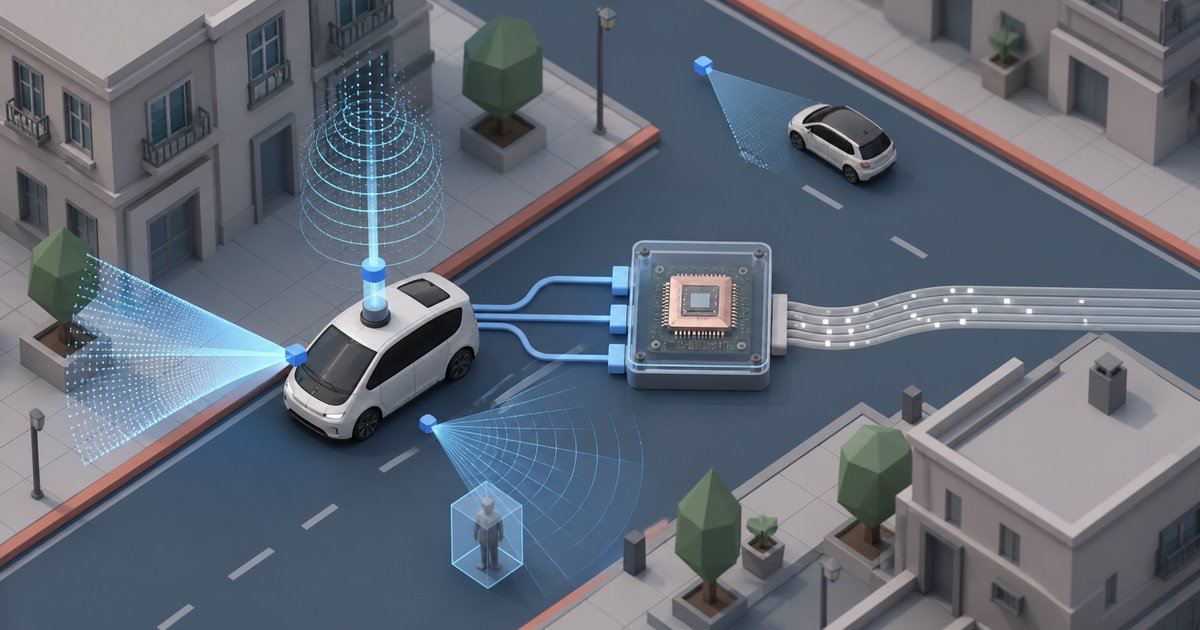
The more important detail is where the chip sits. It processes raw camera, lidar and radar streams at the front end - its cores are split across three backbones, one for camera, one for radar, one for fusion - and then hands the result to the main machine-learning system that actually drives the car.
That makes the comparison everyone wants to make a category error. Tesla's AI4 runs the entire driving stack. Waymo's ASIC runs the plumbing in front of it. They are not competing for the same job, and a compute rating from one says very little about the other.
Tesla makes the arithmetic harder still by never having published a definitive figure for AI4. Third-party estimates run from roughly 120 TOPS to over 700, depending on the precision used, on whether one chip or the redundant pair is counted, and on which of Tesla's own past statements you start from. Any "10x" claim multiplies two numbers that do not measure the same thing.
What the silicon does argue
The chip is a real argument, just not a numerical one. Designing custom silicon around fusing three sensor types is an expensive commitment to reverse, and it hardens the position Waymo's co-CEO set out earlier this month when he said cameras alone hit a ceiling short of driverless. Waymo engineer Daniel Rosenband made the same case plainly: people keep asking why a car cannot drive on two eyes like a human, but the goal is not to match a human driver - it is to build one that crashes far less often.
Tesla's answer is the opposite bet, and its hardware encodes that too. AI4 and AI5 are built for cameras, with radar dropped from the cars in 2021 and ultrasonic sensors in 2022.
What it means for Europe
Both bets now arrive in Europe on a known schedule. Waymo has picked Munich as its first EU robotaxi city, with driverless service targeted for the end of 2027, while Tesla's FSD is still waiting on European approval. By then the sensor argument stops being a disagreement between executives and becomes two fleets on the same continent, each running silicon built on the assumption that the other side is wrong.