
Waymo's co-CEO has made the clearest public case yet for why cameras alone will not get a car to full autonomy. Speaking at Y Combinator's Startup School, Dmitri Dolgov argued that what he calls weak sensing runs into a capability ceiling well below the reliability an unsupervised driverless vehicle needs — and that the gap is not the kind you close with more training data.
The argument, and why it is not the obvious one
The intuitive objection to lidar is that humans drive with two eyes and no laser scanner, so cameras ought to be sufficient in principle. Dolgov's answer is that the existence of a human solution does not oblige an engineer to copy its architecture. Humans also bring a general world model to the task that no current system has.
His framing is the problem of nines. Getting a driving system from 90% to 99% reliable is comparatively easy; getting from 99% to 99.99% is a different order of work, and it is the last stretch that decides whether you can take the driver out. A camera-only stack, on his account, makes an excellent driver-assist product and stalls before the number of nines that unsupervised operation requires.
The two examples he brought
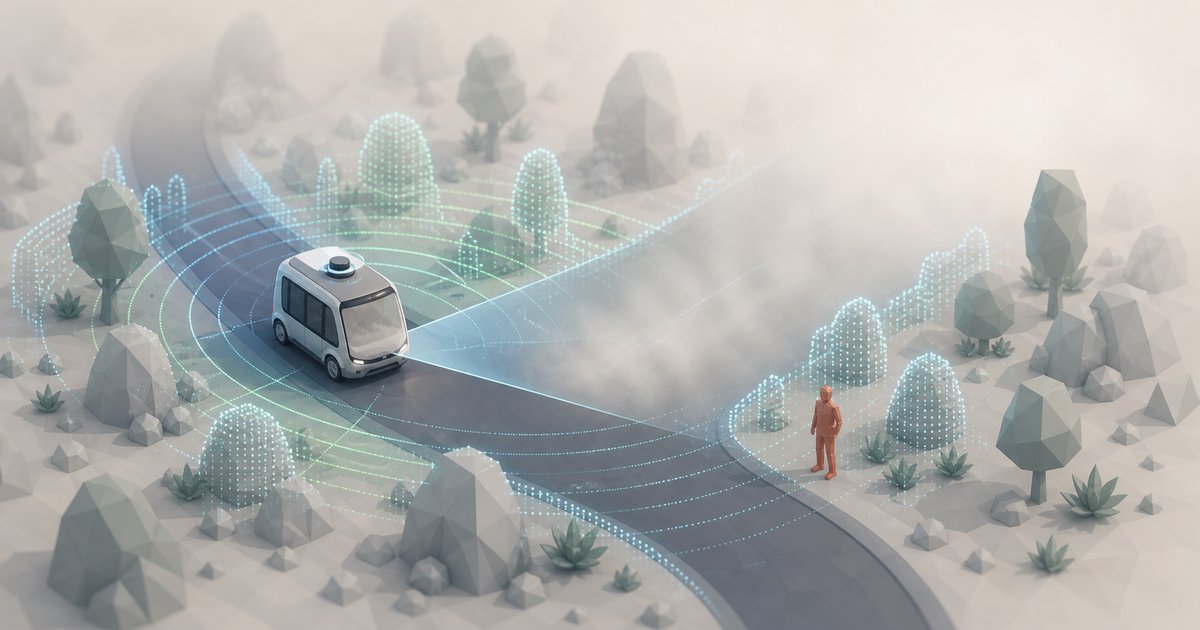
Dolgov's case rested on situations where the camera has no signal to work with rather than on abstractions. In a dust storm, the camera feed shows almost nothing while lidar cuts through and resolves a pedestrian standing at the roadside. And he showed a Waymo vehicle whose windshield was obstructed driving itself safely back to the depot on lidar and radar alone — no usable camera view at all.
That is the point of sensor fusion as Waymo practises it: not that lidar sees better than a camera in good conditions, but that the failure modes of cameras, lidar and radar are different, so a condition that blinds one leaves the others working.
| Sensor | Contributes | Fails at |
|---|---|---|
| Cameras | High resolution, colour, text and signals | Darkness, glare, dust, heavy weather |
| Lidar | Direct 3D structure and distance | Cost, some reflective surfaces |
| Radar | Object presence and velocity | Low resolution, limited classification |
The numbers behind the claim
Waymo has more than 220 million fully autonomous miles on public roads, and by its own published safety figures its vehicles are involved in 94% fewer crashes causing serious or fatal injury than human drivers in the same areas. TeslAnt covered the independent read on that record in the IIHS study of Waymo's crash rate.
Tesla is the counter-position and everyone knows it, though Dolgov made his case by architecture rather than by naming the company. Tesla's bet is that cameras plus a sufficiently good neural network get there, that lidar is an expensive crutch, and that fleet scale beats sensor redundancy. Tesla's own robotaxi service currently runs with a safety monitor in the front seat, which is the practical measure of where that bet stands today.
Why it matters in Europe
European type approval and national permitting for driverless operation are being written now, and regulators reading a Waymo argument about sensor redundancy are being handed a technical standard to point at. If "cameras only" becomes the thing an approval authority asks you to justify, that shapes which systems can be deployed here and when — regardless of which architecture eventually turns out to be right.