
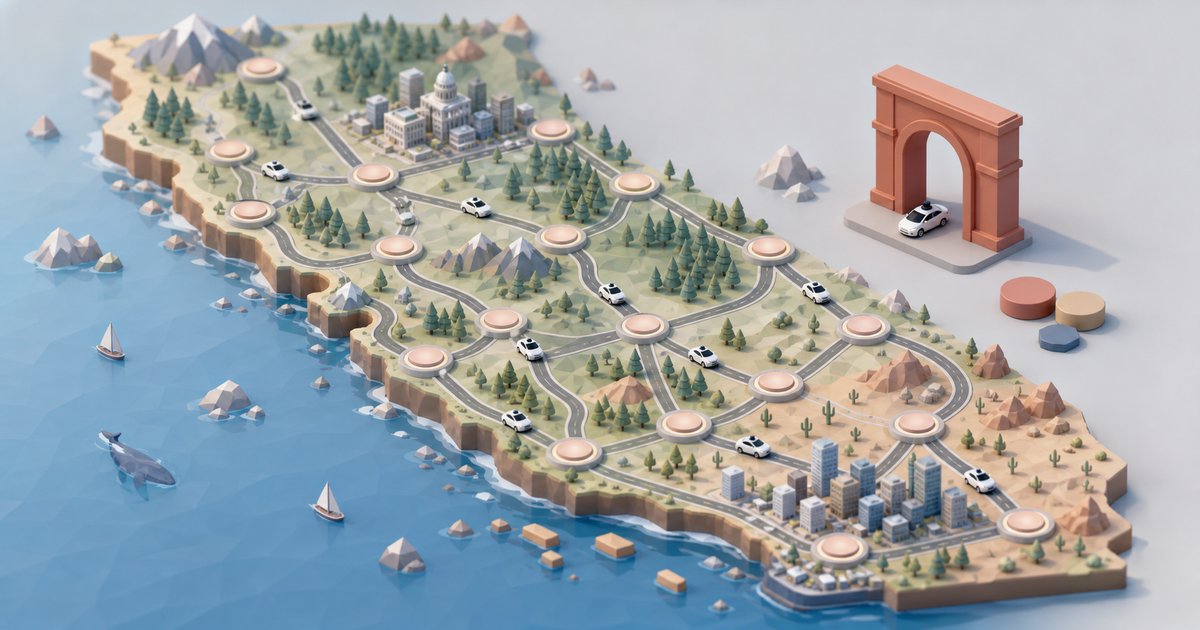
California regulators have cleared Waymo to charge for fully driverless rides across 18 counties, the largest single expansion of paid robotaxi service the state has approved. The decision landed on 14 August 2026, the same week Tesla learned how many robotaxis Nevada would let it run.
What was approved
The California Public Utilities Commission signed off on a filing it had suspended since 28 January for review. The approved territory covers 12 counties in the north — Alameda, Contra Costa, Marin, Napa, Sacramento, San Francisco, San Mateo, Santa Clara, Santa Cruz, Solano, Sonoma and Yolo — and six in the south: Los Angeles, Orange, Riverside, San Bernardino, San Diego and Ventura.
Sacramento and San Diego open as new markets. For context, Waymo's paid service area stood at about 1,400 square miles across 11 cities in May.
The operating envelope is broad. Waymo is cleared for all speed limits, on freeways, highways, city streets, rural roads, parking lots, driveways and rail crossings, day and night, in rain, fog and hail. Widespread snow or ice is the only carve-out.
The comparison Tesla cannot avoid
Put the week's two autonomy decisions side by side.
| Waymo, California | Tesla, Nevada | |
|---|---|---|
| Approved area | 18 counties, Sonoma to San Diego | State permit |
| Vehicles | Around 3,000 in the fleet | Capped at 10 |
| Paid driverless rides | Yes | Permitted, at that scale |
| Cumulative trips | Over 20 million | — |
Tesla asked Nevada for 5,000 robotaxis and was granted ten. Waymo, on the same calendar, was handed most of the populated area of the largest state in the US and is targeting a million rides a week by year end.
That gap is about method, not ambition. Waymo's approvals rest on a lidar-and-radar stack, a fixed and surveyed operating domain, and a regulatory paper trail stretching back years — the approach whose limits Waymo's own co-CEO described when he said cameras alone hit a ceiling short of driverless. Tesla's bet is that a camera-only system generalises, and therefore scales, in a way Waymo's cannot. Neither position has been settled by this decision. What has changed is the size of the deployment each company is being allowed to learn from.
Why a European Tesla owner should care
This is a California ruling with no direct European effect, and it is worth being clear about that. Waymo does not operate in Europe and Tesla's FSD is not approved for unsupervised use anywhere in the EU.
The relevance is competitive. Regulators watch each other, and a body of real-world driverless miles is the evidence any approval process eventually asks for. Waymo is accumulating that evidence at a rate Tesla currently cannot match in the US, and it is already booking European cities while Tesla waits on EU approval for FSD.
For an owner who paid for FSD in Europe, the practical question is not which system is better in theory. It is which one will have the operating history that European regulators demand when they finally decide. Independent work has already put Waymo's crash rate 68% below human drivers. Tesla has no comparable published record for unsupervised operation.
Bottom line
Waymo's largest approval yet, granted in the same week Tesla's robotaxi ambitions were cut to ten cars in one state. The technical argument is unresolved; the deployment gap is not.